

01Status calls
Registered on WhatsApp, updated at every step.
- Photos and documents read in the chat
- Garage, hospital and surveyor booked; every step pushed
Customers stop calling to ask

CommercialAutoClaims · claims intake & renewals for insurers
For general and health insurers and their TPAs. Claims registered on WhatsApp, documents read on arrival, triaged by your rules, suspicious ones flagged for investigation — and every customer kept informed, so nobody calls to ask. Renewals worked by segment so fewer policies lapse.
WhySound familiar?
From claims heads, TPAs and retention teams at insurers. Composite quotes from discovery calls — the problems are real; the names are left out.

“Half our call-centre volume is ‘where is my claim?’”
Customers are not told what happens next, so they call — and every call is cost.
Claims headStatus calls and TAT
“We find the bad claims after we have paid them.”
Triage is by queue, not by rule, so suspicious patterns slip through.
Investigation leadLeakage
“Renewals get one email and a last-minute call.”
Policies lapse that would have renewed with the right reminder at the right time.
Retention headLapsed policies
HowWhat changes with AutoClaims
Product screens with illustrative data. In a working session we map one of your claim journeys.
01Status calls
Customers stop calling to ask
02Leakage after payout
Bad claims caught before payment

03Last-minute renewals
Fewer lapses

FieldAutoClaims in the field
The workplace it runs in, the person who uses it on a phone, the team at the desk and the detail it reads.
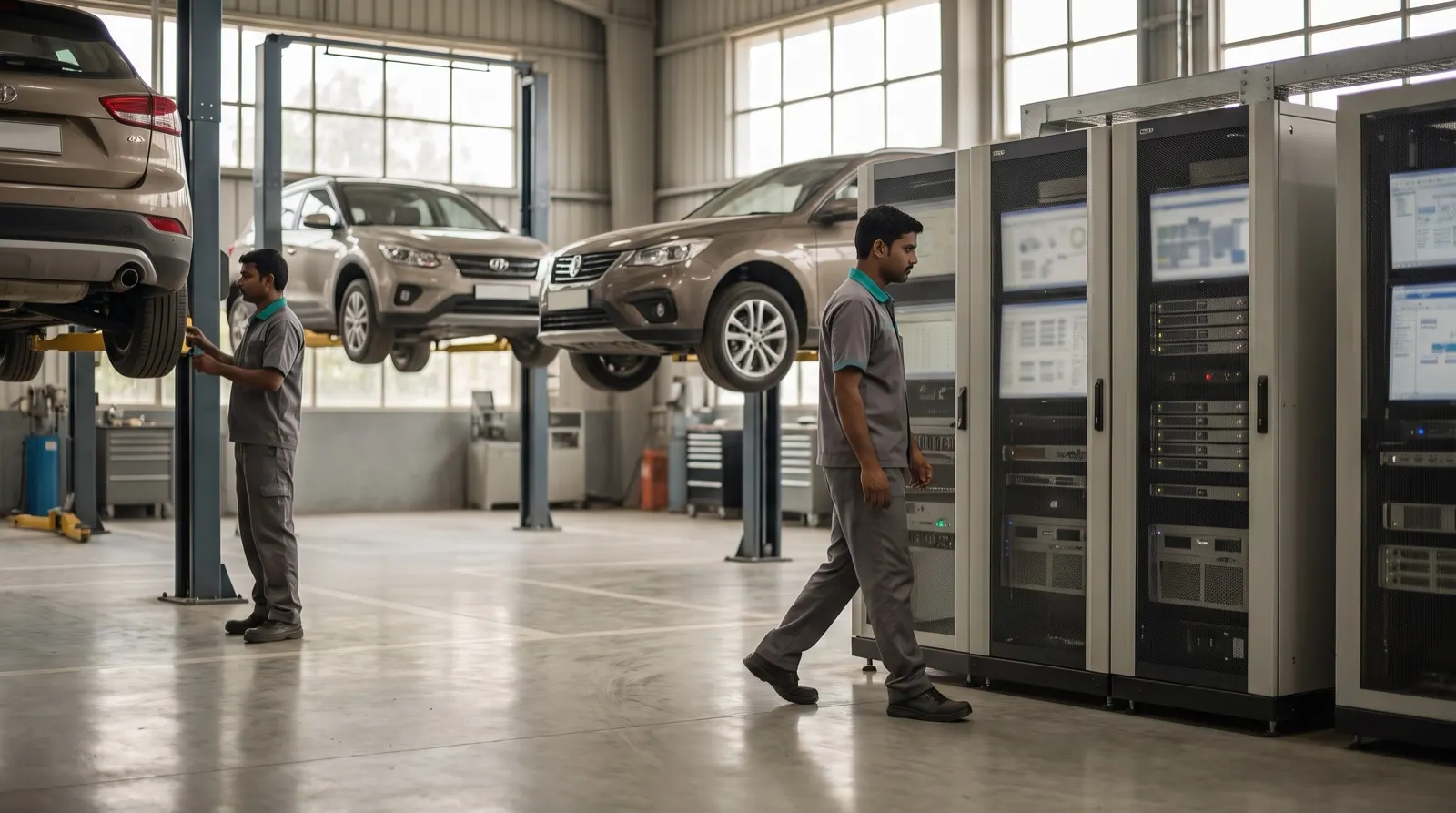
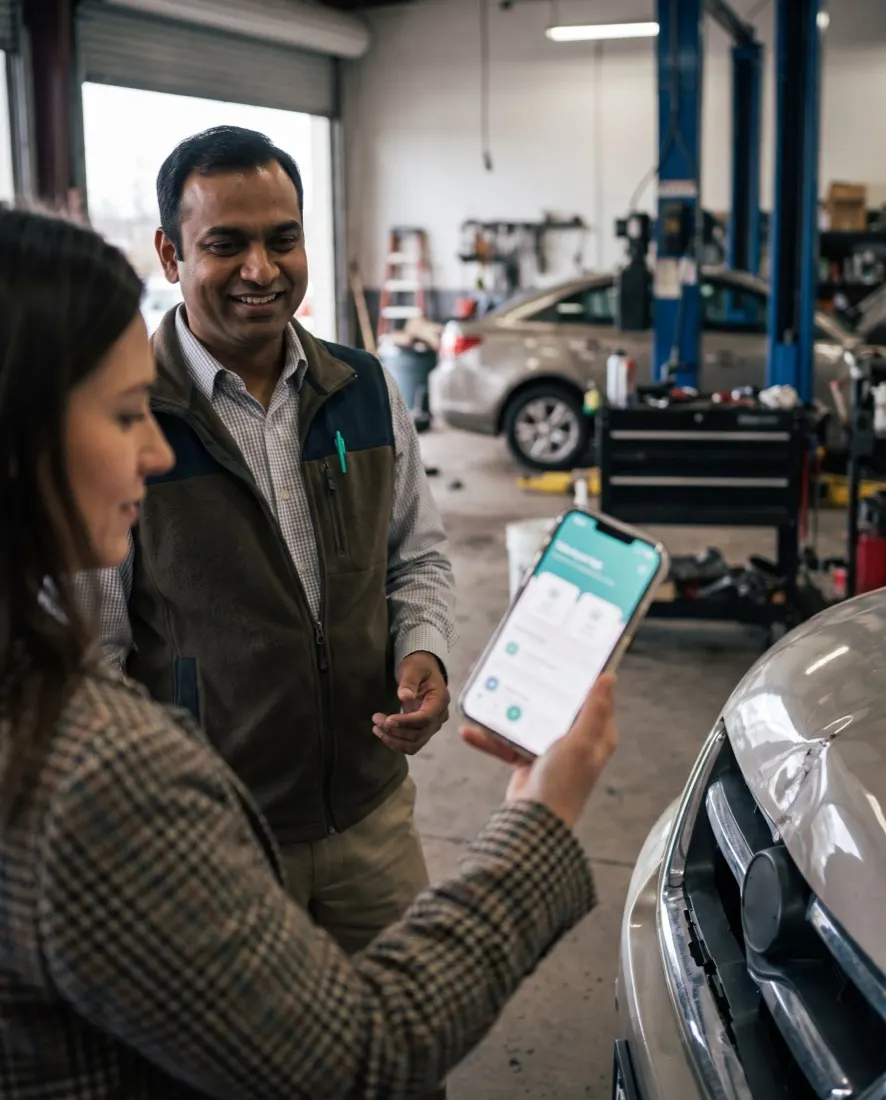

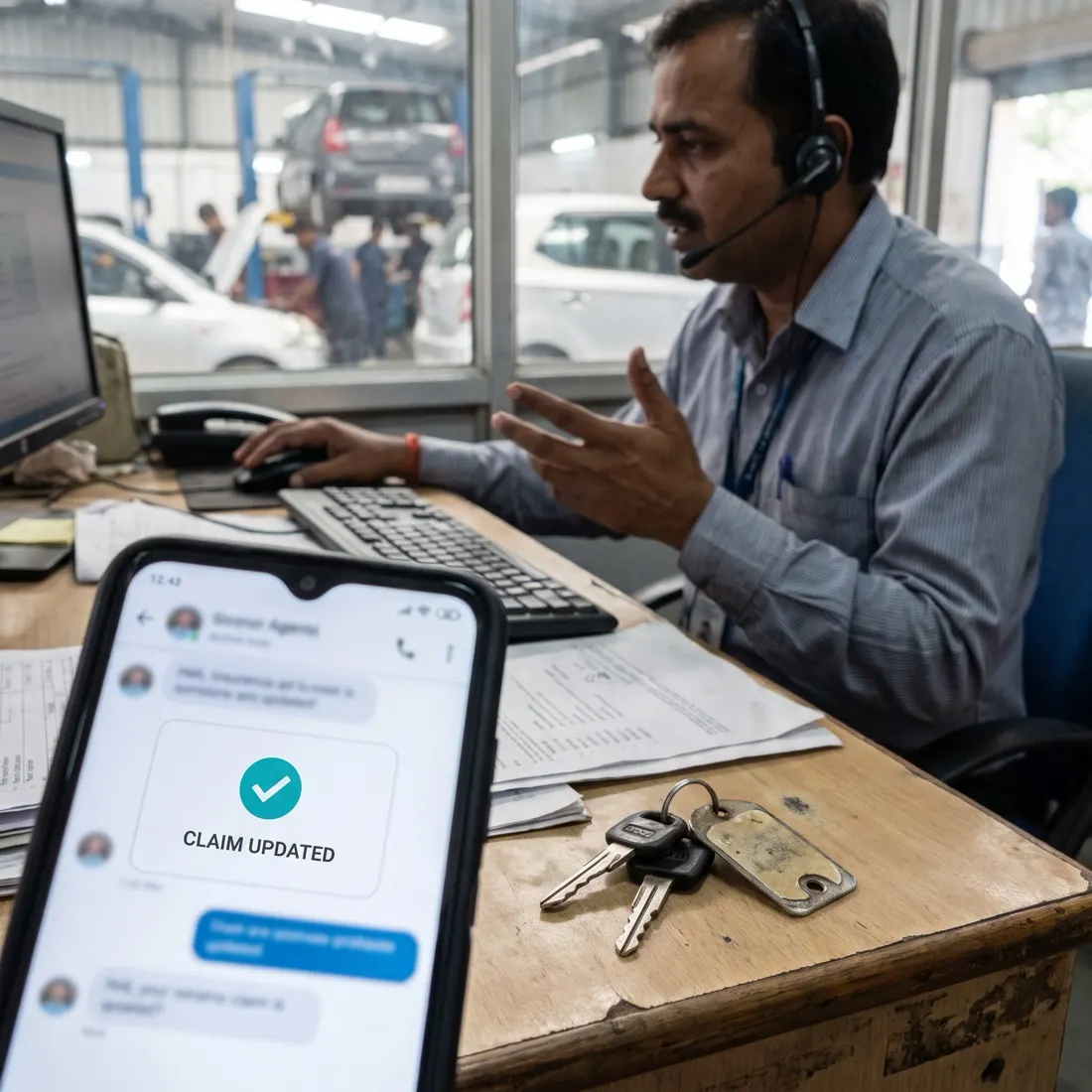
Photographs are illustrative — real customer sites are not shown.
01The screens
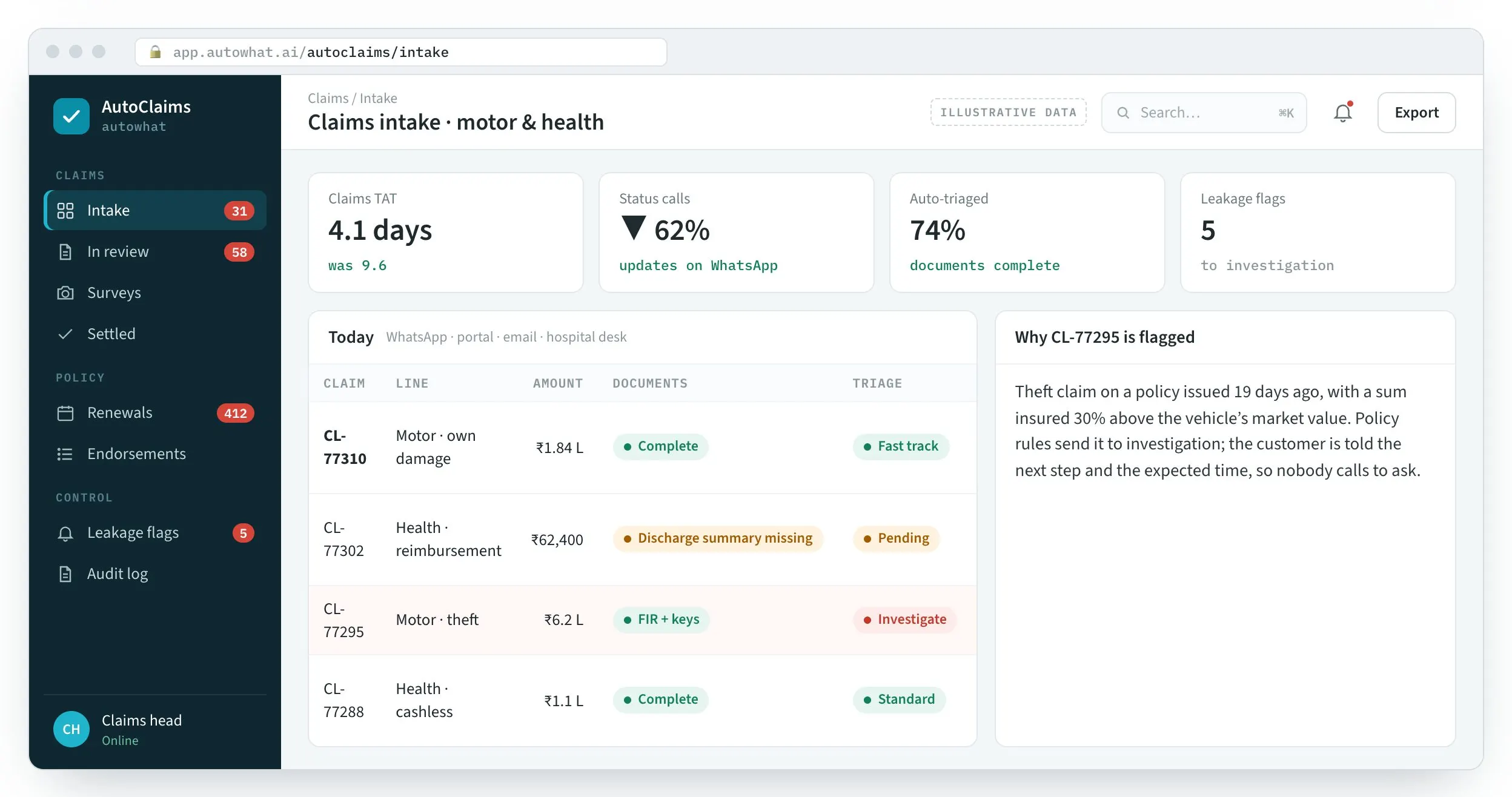
Intake and triage, the customer’s WhatsApp and the renewals queue.
Claims triaged by your rules — fast track, standard or investigate — with the reason.
Product screens with illustrative data — every name, place and figure is a placeholder.
02Before and after
Customers call to register, call to ask, call to chase. Every call is cost; every re-key is a chance of leakage.
| Area | Today | With AutoClaims |
|---|---|---|
| Registration | Call centre and forms | WhatsApp, documents read on arrival |
| Triage | By hand, by queue | Your rules: fast track, standard, investigate |
| Leakage | Found after payout | Flagged before, with the reason |
| Status | Customers call to ask | Pushed at every step |
| Renewals | Email and a last-minute call | Worked by segment, early |
03Register, triage, inform
Your rules decide; adjusters and investigators keep every judgement that needs a person.
WhatsApp · portal
First notice of loss where the customer already is.
Documents
Photos, bills, discharge summaries and FIRs structured on arrival.
Policy
Cover, waiting periods and limits checked against the policy.
Your rules
Fast track, standard or investigate — with the reason.
Network
Garages, hospitals and surveyors booked.
Status
Every step pushed to the customer.
Maker-checker
Payout approved by people, written through your APIs.
Retention
Renewals by segment, with the right nudge, before the lapse.
04The platform
Start with one line of business; others reuse the same spine.
05How we deliver
On the policy and claims systems you already run.
FAQQuestions we get about AutoClaims
AutoClaims is an Autowhat AI product for claims heads, TPAs and retention teams at insurers. Short, factual answers for buyers, procurement and the assistants people ask first.
In short. AutoClaims is an Autowhat AI product for claims heads, TPAs and retention teams at insurers. It is built for claims heads, TPAs and retention teams at insurers. It exists to remove the problems those teams describe in almost every first conversation: call-centre volume driven by “where is my claim?”; leakage found after payout; and renewals left to one email and a late call. With AutoClaims, teams get FNOL on WhatsApp; garage, hospital and surveyor booked, triage by rule — fast track, standard, investigate — with the reason, and renewal queue by segment with the right nudge. It connects to Policy admin, Claims system, WhatsApp and Network garages & hospitals, is used by Claims · investigators · retention, and runs on whatsapp + web. Like every Autowhat AI product, AutoClaims goes live on one site, lane or process first, usually within weeks, on managed cloud, in your own VPC or on-premises, and shares one operational record with the other products, so the second deployment reuses the data and integrations of the first.
Claims heads, TPAs and retention teams at insurers. Claims registered on WhatsApp with documents read on arrival, triaged by your rules, suspicious ones flagged before payout, every customer kept informed — and renewals worked by segment so fewer policies lapse.
call-centre volume driven by “where is my claim?”; leakage found after payout; renewals left to one email and a late call.
fNOL on WhatsApp; garage, hospital and surveyor booked; triage by rule — fast track, standard, investigate — with the reason; renewal queue by segment with the right nudge.
It connects to Policy admin, Claims system, WhatsApp, Network garages & hospitals. Users: Claims · investigators · retention. Channel: WhatsApp + web.
With a 30-minute working session on your own data — an engineer from the relevant sector, not a sales queue. The first wave is scoped in that call; most products go live on one site, lane or process within weeks and then scale.
On managed cloud, in your own VPC (AWS, Azure or GCP) or on-premises, with your keys. SOC 2 Type II and ISO 27001 controls, India data residency when required, and local or open-weight models when policy demands it. The data stays yours.
06Working session
Thirty minutes: your claim journey mapped, the steps that wait named, and a first scope.