OperationsUltraCold · ultra-cold chain control

−80 °C, all the way. Signed off at every step.

For pharma and biotech shipments that cannot warm up: every dispatch dual-signed, every degree logged, every handoff sealed — and every excursion escalated until someone acts.

  • 2 loggers on every shipment
  • 15 min to acknowledge an alert
  • 5 years of audit records
TowerTransitAlerts
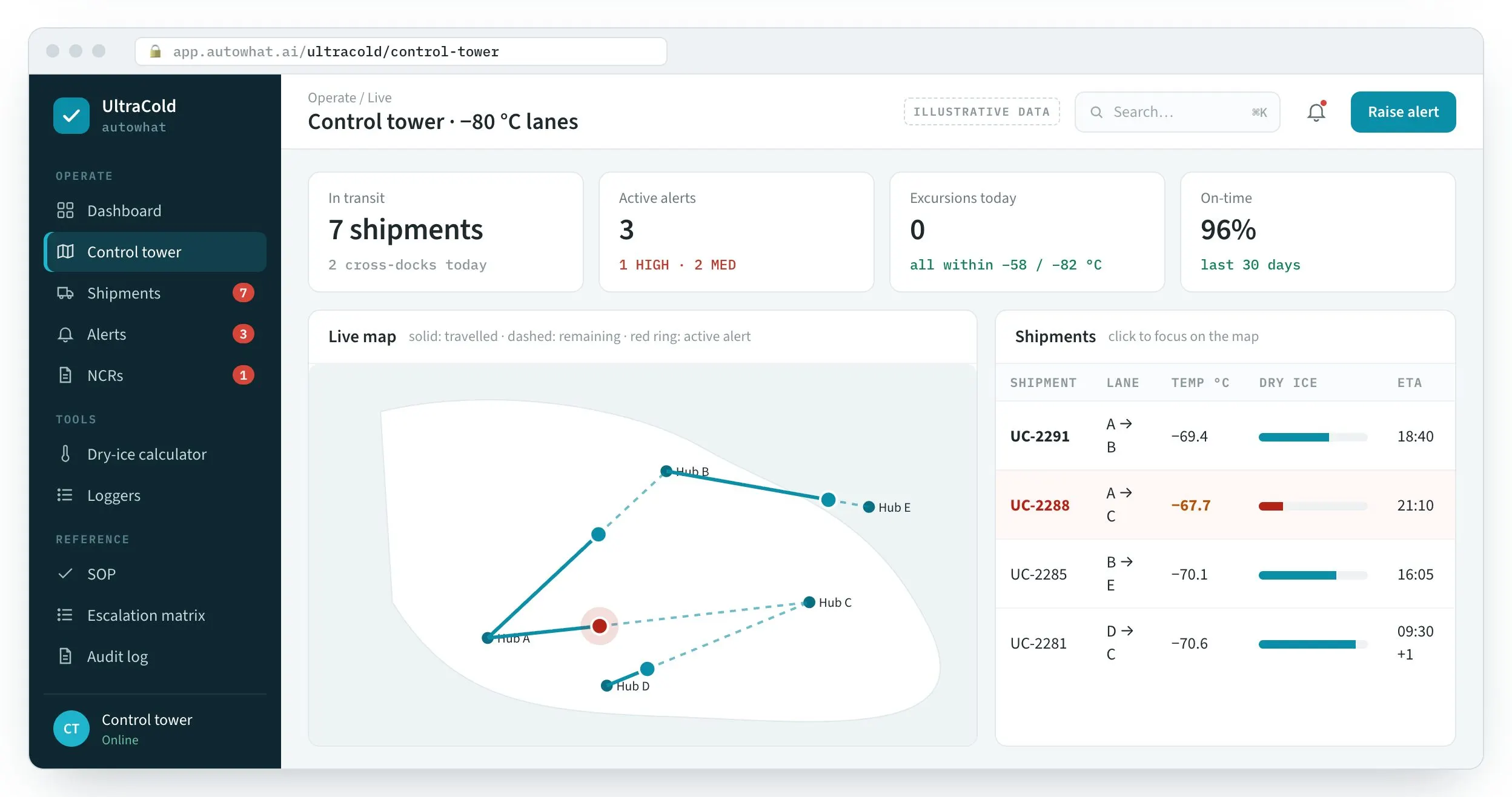
UltraCold: Every −80 °C shipment on one map with temperature, dry-ice cover and ETA.
Product screen with illustrative data.

WhySound familiar?

Three things we hear in every first conversation.

From QA heads, cold-chain managers and logistics leads moving −60 °C and −80 °C product. Composite quotes from discovery calls — the problems are real; the names are left out.

UltraCold: The problem, before UltraCold
Product that is worthless above −58 °C
  1. “We found the excursion when we downloaded the logger.”

    By then the shipment is already accepted, and the investigation starts with no live evidence.

    Head of QAExcursions found too late

  2. “The checklist was signed — by the same person twice.”

    Paper dispatch checks make it easy to release a shipment with a gap nobody independently verified.

    Quality managerReleases without real verification

  3. “The dry ice ran out two hours before the hub.”

    Ice is packed by habit, not by lane, and nobody is warned until the temperature climbs.

    Logistics managerShipments lost in transit

HowWhat changes with UltraCold

The same three problems, on the screens that solve them.

Product screens with illustrative data. In a briefing we load one of your ultra-cold lanes and its SOP.

01Logger read at the end

Two loggers live against the band and the hard limits.

  • Drift beyond ±2 °C raises an alert; beyond −58 / −82 °C for 30 minutes it becomes an NCR
  • Every top-up and cross-dock handoff on the same trace

Act while the product is still cold

UltraCold screen: Two loggers live against the band and the hard limits.

02Single-signature release

A release gate two different people must pass.

  • 22 dispatch controls; any FAIL holds the shipment
  • QA and warehouse sign independently — the system refuses the same person twice

Every release independently verified

UltraCold screen: A release gate two different people must pass.

03Silent alerts

An escalation ladder that keeps climbing.

  • 15 minutes to acknowledge, then logistics, QA, customer QA and senior management
  • Dry-ice exhaustion risk flagged at two hours of cover

No alert waits for the morning

UltraCold screen: An escalation ladder that keeps climbing.

FieldUltraCold in the field

The people, the phone, the place.

The workplace it runs in, the person who uses it on a phone, the team at the desk and the detail it reads.

UltraCold: Where UltraCold runs
Where UltraCold runs
UltraCold: On the phone, where the work happens
On the phone, where the work happens
UltraCold: The team at the UltraCold desk
The team at the UltraCold desk
UltraCold: The detail UltraCold reads
The detail UltraCold reads

Photographs are illustrative — real customer sites are not shown.

  • 22 + 22 + 24Controlsdispatch · transit · delivery
  • Dual sign-offRelease gateQA and warehouse — two different people
  • ±2 °CDrift alertaround target, from both loggers
  • 12 triggersEscalationT+0 to T+4 h, until someone acts
  • 4 hNCR deadlinewith QA disposition
  • 3 languagesInterfaceEnglish · Hindi · Spanish

01The screens

From the freezer at dispatch to the freezer at delivery.

The control tower, transit, the dispatch gate, alerts, the dry-ice calculator and the delivery gate.

autowhat · UltraCold / Control tower Illustrative data
UltraCold screen

Every −80 °C shipment on one map with temperature, dry-ice cover and ETA.

Product screens with illustrative data — every name, place and figure is a placeholder.

02Before and after

One warm hour can cost the whole shipment.

At −80 °C there is no margin for a missed alert, an unsigned checklist or a logger nobody read until after acceptance.

AreaTodayWith UltraCold
DispatchA paper checklist, one signature22 controls; a FAIL blocks release; two independent sign-offs
TemperatureLogger read at the destinationTwo loggers live against the band and the hard limits
Dry icePacked by habitCalculated per lane; exhaustion risk alerted at 2 h of cover
HandoffsVerbal, unrecordedChain of custody with seal and dwell time at every cross-dock
AlertsAn SMS someone may seeA ladder from T+0 to T+4 h, until acknowledged
RecordsFolders and emailEvery change in a five-year, inspection-ready audit log

03Dispatch, transit, delivery

Eight steps, from freezer to freezer.

Each phase has its own controls; nothing moves to the next phase until the last one is closed.

  1. 01

    Plan

    Dry-ice calculator

    Ice at dispatch and each hub, from lane time and ambient profile.

  2. 02

    Check

    Dispatch controls

    Container, loggers, loading time, DG documents, vehicle and driver.

  3. 03

    Release

    Dual sign-off

    QA and warehouse sign independently; any FAIL holds the shipment.

  4. 04

    Monitor

    Two loggers

    Every reading against ±2 °C and the −58 / −82 °C limits.

  5. 05

    Hand off

    Chain of custody

    Seal checked and dwell timed at every cross-dock.

  6. 06

    Escalate

    Alert ladder

    12 triggers; the clock climbs from control tower to senior management.

  7. 07

    Accept

    Delivery gate

    Both loggers downloaded first; a 10-minute clock into the freezer.

  8. 08

    Close

    NCR & audit

    Excursions go to QA disposition within 4 hours; everything is kept five years.

04The platform

Operate, plan, escalate and prove.

Built on a written operating brief — every control in the app maps to a line in the SOP.

Operate · 4

  • Control tower map
  • Shipments: dispatch · transit · delivery
  • Logger monitoring
  • Evidence and milestones

Plan · 4

  • Dry-ice calculator
  • Lane presets
  • Process flow
  • SOP by phase

Escalate · 4

  • 12-trigger alert engine
  • Time-based ladder
  • NCRs with 4-hour deadline
  • SLA tracking

Prove · 4

  • Five-year audit log
  • Shipment report and print
  • Customer share links
  • Roles and sign-off rules

05How we deliver

Your SOP, turned into the system.

We start from your operating brief and your lanes, then connect your loggers and GPS.

  1. Weeks 1–2 · MapYour SOP, lanes, roles and escalation contacts loaded.
  2. Weeks 2–4 · ConnectLoggers and vehicle GPS feeding the control tower.
  3. Month 2 · PilotOne lane run end to end with dual sign-off and live alerts.
  4. Then · ScaleEvery ultra-cold lane, customer share links and audit reports.

FAQQuestions we get about UltraCold

Straight answers, before the call.

UltraCold is an Autowhat AI product for QA heads, cold-chain managers and logistics leads in pharma and biotech. Short, factual answers for buyers, procurement and the assistants people ask first.

In short. UltraCold is an Autowhat AI product for QA heads, cold-chain managers and logistics leads in pharma and biotech. It is built for QA heads, cold-chain managers and logistics leads in pharma and biotech. It exists to remove the problems those teams describe in almost every first conversation: excursions discovered only when the logger is downloaded; releases signed twice by the same person; and dry ice that runs out before the next hub. With UltraCold, teams get dual-logger traces with drift and excursion alerts, live, a release gate two different people must pass; any FAIL holds it, and dry-ice calculator per lane, custody seals, escalation ladder and five-year audit log. It connects to Temperature loggers, Vehicle GPS, Escalation by email · SMS and Audit log & reports, is used by QA · warehouse · control tower · drivers, and runs on web + mobile. Like every Autowhat AI product, UltraCold goes live on one site, lane or process first, usually within weeks, on managed cloud, in your own VPC or on-premises, and shares one operational record with the other products, so the second deployment reuses the data and integrations of the first.

Who is UltraCold for?

QA heads, cold-chain managers and logistics leads in pharma and biotech. Ultra-cold chain control for −60 °C and −80 °C shipments: 22 dispatch controls with a dual sign-off release gate, two live loggers against the band and hard limits, dry-ice planning and top-ups, sealed chain of custody at every handoff, a 12-trigger escalation ladder and NCRs with a 4-hour deadline.

What problems does UltraCold remove?

excursions discovered only when the logger is downloaded; releases signed twice by the same person; dry ice that runs out before the next hub.

What do we get with UltraCold?

dual-logger traces with drift and excursion alerts, live; a release gate two different people must pass; any FAIL holds it; dry-ice calculator per lane, custody seals, escalation ladder and five-year audit log.

What does UltraCold connect to, and who uses it?

It connects to Temperature loggers, Vehicle GPS, Escalation by email · SMS, Audit log & reports. Users: QA · warehouse · control tower · drivers. Channel: Web + mobile.

How do we start with UltraCold?

With a 30-minute working session on your own data — an engineer from the relevant sector, not a sales queue. The first wave is scoped in that call; most products go live on one site, lane or process within weeks and then scale.

Where does UltraCold run, and who owns the data?

On managed cloud, in your own VPC (AWS, Azure or GCP) or on-premises, with your keys. SOC 2 Type II and ISO 27001 controls, India data residency when required, and local or open-weight models when policy demands it. The data stays yours.

06Briefing

Bring your SOP for one ultra-cold lane. We’ll show it running as a system.

A working session: your lane, your controls and your escalation matrix — set up and walked through.