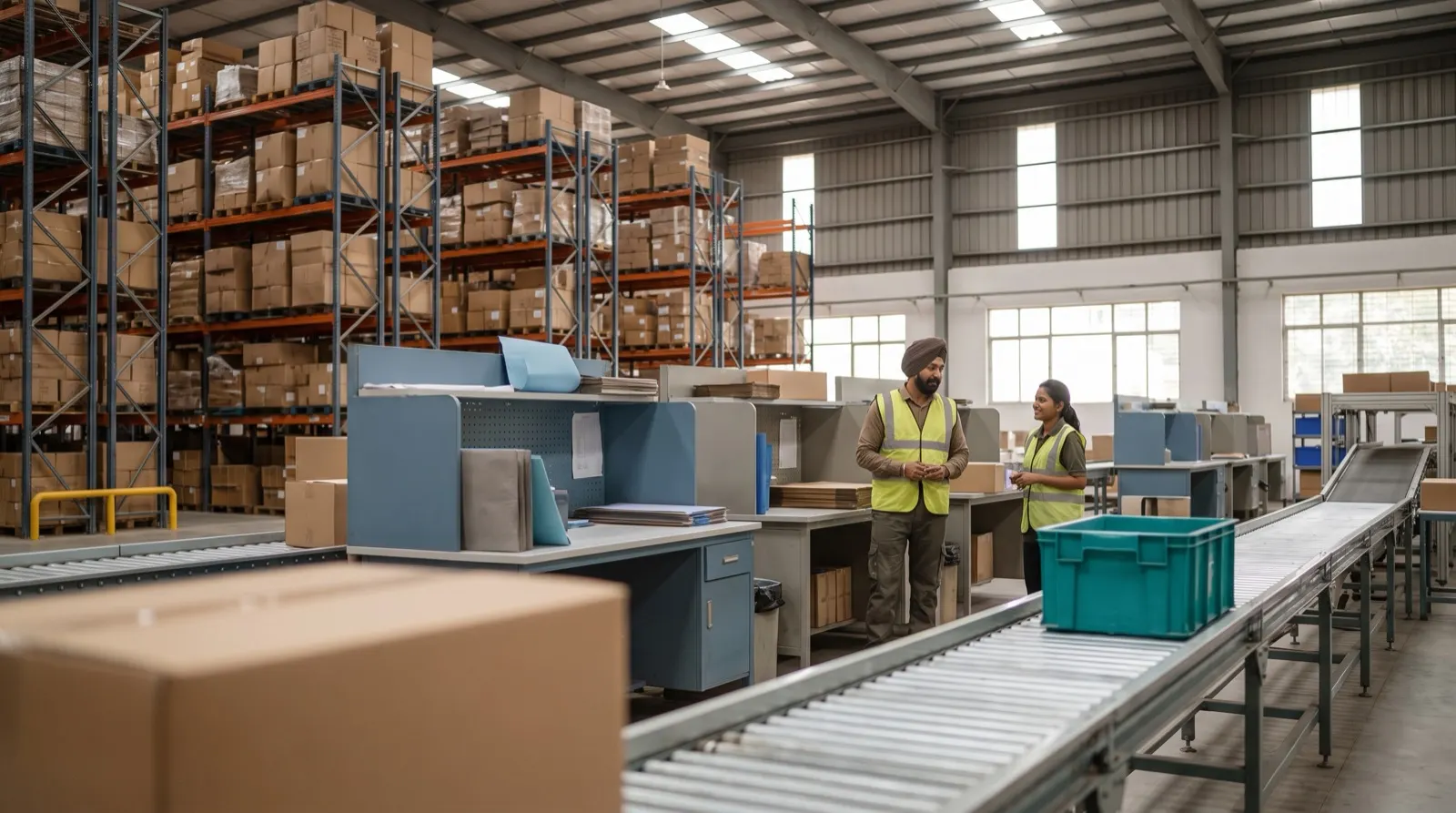
Start warehouse software with the step that hurts most.
Warehouse projects often try to switch everything on at once. We think the better order is to find the one step that costs the most each cycle, fix that, and build out from it on the same record.
A warehouse that fulfils thousands of small orders every cycle has a lot of moving parts: a purchase list arrives, stock is received and put away, member orders are loaded, bags are chosen, items are picked and packed, bags go into boxes and boxes go onto vans. It is tempting to buy a system and switch all of it on in one go. In our experience, that is the slowest way to get any of it working.
Why switching everything on at once struggles
When every step changes on the same day, every problem shows up on the same day too. Packers are learning a new screen while the purchase list is being read a new way and the boxes are being tracked for the first time. When something goes wrong, nobody can tell which change caused it. The team loses confidence, and the old spreadsheet quietly comes back.
Find the step that costs the most each cycle
Most warehouses already know where it hurts. The question is which pain costs the most time or the most complaints. Warehouse OS is built in modules across warehouse, inbound and outbound, and in practice we usually start with one of two:
If this is the pain
Start here
What changes first
People spend days retyping the purchase list, and typos cause stock-outs
Procurement list from PDF
AI reads every row, including merged columns, and splits quantities by hub, checked against the product master
Packers guess the bag at the table and repack when it does not fit
Bag allocation by weight
Every order is weighed into a small or large bag, or two, before packing starts
Boxes go missing and nobody knows whose they were
Barcode bag-to-box
Each permanent bag tag is scanned and linked to a durable dispatch box
A commissary kitchen version
Think of a restaurant group with a central commissary that sends prepared ingredients, sauces and dry goods to its outlets each day. If the biggest daily headache is that outlet orders get packed into the wrong crates and outlets call to say something is missing, the first fix is the crate-to-order link, not a new receiving process at the commissary gate. Once crates are traceable, the next most painful step becomes obvious, and the team already trusts the system because it solved the first problem.
Build out on the same record
The reason starting small does not create a mess later is that each module writes to one record. In Warehouse OS each step reads what the one before it wrote, so the box on the van traces back to the bag, the order, the rack and the line on the purchase list. Adding putaway in the 3D twin after bag allocation is live does not mean a second system; it means more of the same record is filled in. The ten steps from list to dispatch can be reached one module at a time.
How we would sequence it
Write down the steps of one cycle and what goes wrong at each.
Pick the step with the biggest cost in time, repacks or complaints.
Run one full cycle with that module live, with the old method as a fallback.
Fix what the cycle exposes, especially product master gaps.
Add the next module only when the first one runs without the fallback.
This is slower on paper and faster in practice. Each step that goes live is one the team actually uses, which is the only kind that counts.
The step that costs the most each cycle. For many small-order warehouses that is either the procurement list PDF, which is retyped every cycle, or bag allocation, where packers guess and repack.
Does starting with one module create a disconnected system later?
Not in Warehouse OS. Each module writes to one record, so the box on the van traces back to the bag, order, rack and purchase list line as modules are added.
Why not switch everything on at once?
Because every problem appears at the same time and nobody can tell which change caused it, which makes teams fall back to the old method.