

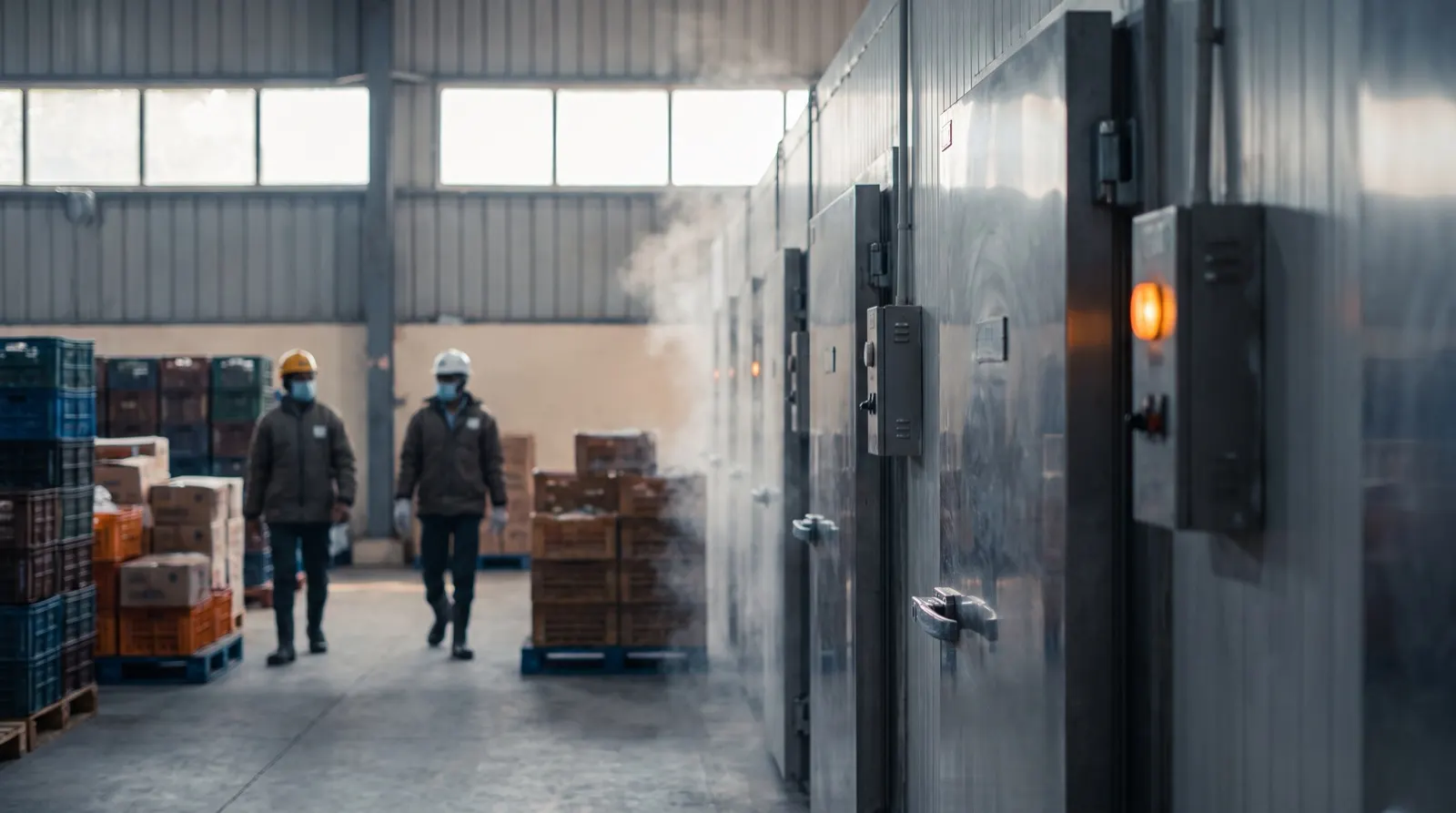
The vendor’s demo runs on a laptop in your conference room. Twelve tiles glow green, a graph scrolls, and someone opens a freezer door to make one tile turn amber. Everyone nods. Six months later a compressor trips on a Sunday night, the SMS goes to a supervisor whose phone is on silent, and the dashboard that looked so good in the demo records the excursion faithfully for six hours with nobody watching.
A cold chain monitoring system is not judged by how it shows a reading; it is judged by what it makes a person do when the reading goes wrong, and by what it can prove afterwards.
That sentence shapes every question below. They apply whether you buy from us, from another vendor or build on what your building-management team already runs. We have tried to keep them fair to all three.
The sensors you already own are the first question, not the last
Many cold rooms and freezers already carry probes wired to a building-management system or a controller. Before anyone quotes for new loggers, ask whether the system can read what is already there. Building equipment commonly speaks BACnet or Modbus, and a monitoring layer that polls those protocols can often start without new hardware.
New sensors are sometimes the right answer: a probe in the wrong place, a unit with no probe at all, or a reading you cannot trust. But that should be a finding from a site survey, not the default line on a quote. Ask the vendor to list, unit by unit, what they will reuse and what they will replace, and why.
An alarm that reaches one person is a hope, not a system
This is the question most buyers skip. Ask the vendor to walk through a 2 am failure, minute by minute. Who is told first, and how? What happens if that person does not respond in ten minutes? Who is next? Does the alarm keep repeating, or does it fire once and fall silent?
Then ask what “acknowledged” means. A tap on a phone is not enough for a regulated store. You want the acknowledgement to carry a name, a time and a comment saying what was done. Without that, the alarm log tells an inspector the system worked but says nothing about whether anyone acted. Our playbook on cold room alarms someone acts on at 2 am sets out one way to design that chain.
Also ask which alarm types exist. A high or low limit is the obvious one. Rate-of-change, a gap in communication and a failed sensor are just as important, because a probe that stops reporting looks exactly like a probe reporting a steady, safe temperature.
Reading frequency changes what you can investigate
Here is an illustrative comparison, not a customer result. Say a store has 12 units checked by hand every four hours, which is 6 rounds a day. That gives 12 × 6 = 72 readings a day across the site. A system polling each unit every minute records 12 × 1,440 = 17,280 readings a day.
The number itself is not the point. The point is what happens when a unit fails at 2:10 am, an hour after a round. With four-hourly rounds, the next check is at 5 am, so the excursion runs for up to about 3 hours before anyone knows, and the investigation has two data points: fine at 1 am, warm at 5 am. With minute readings you can see when the drift started, how fast it climbed, whether a door opened first and when it peaked. That is the difference between guessing at a root cause and showing one.
A probe that has stopped reporting looks exactly like a probe reporting a safe, steady temperature, unless the system treats silence as an alarm.
The audit trail should exist before the audit
Ask how readings, alarms and acknowledgements are stored. Can anyone edit or delete a record? If a limit changes, is the old value kept with who changed it and when? For GxP stores, the data should be attributable, time-stamped and append-only, in line with ALCOA+ principles. Our guide to what a GxP temperature monitoring system needs covers this in more depth.
Ask too about validation. Will the vendor supply installation, operational and performance qualification documents, or is that left to your QA team? Ask how long data is retained, and whether reports export in a form an inspector can read without your software. Calibration belongs here as well: due dates, reminders and an alarm when a sensor goes overdue. A reading from an uncalibrated probe is weak evidence.
A prediction is useful only if it is labelled as one
Many systems now offer some form of AI forecast: this unit is drifting and may breach in about two hours. That is valuable, because it moves the response from after the limit to before it. But ask how the forecast is shown. It should be a warning with an estimated time, kept separate from a confirmed alarm. A system that blurs the two will either cry wolf or teach people to ignore it.
Ask also what the forecast is based on, how it improves as history builds and what happens in the first weeks when there is little history. An honest vendor will say early predictions are rougher.
The case for keeping manual logs, and where it holds
A fair objection: a small site with two fridges, staffed around the clock, with a disciplined logging habit, may not need any of this. The cost of a system, its validation and its upkeep can outweigh the risk. Manual logs are also easy to understand and hard to break.
We agree that the answer depends on what a lost batch costs and how many hours a failure can go unseen. The case weakens as units multiply, as stock value rises, as nights and weekends go unstaffed and as inspectors ask for continuous evidence. If your honest answer to “how long could a failure go unnoticed?” is longer than your product can tolerate, manual logs are carrying more risk than they look.
How we answer these questions ourselves
ColdWatch reads existing sensors over BACnet/IP and Modbus TCP, checks five alarm types (high, low, rate of change, communication gap and sensor failure) and escalates by screen, email, SMS and push until someone acknowledges with a comment. It shows AI time-to-breach warnings separately from alarms, keeps an append-only ALCOA+ audit trail for five years, sends calibration reminders at 30, 15 and 7 days and includes IQ, OQ and PQ documents. Typical delivery is about four weeks. The ColdWatch guides go further on each point.
What to do this week
- List every freezer and cold room, its probe, and whether that probe is already wired to a controller or building system.
- Write down, for one unit, exactly who would learn of a failure at 2 am on a Sunday, and how long it would take.
- Pull your last excursion record and check how many data points the investigation had to work with.
- Take these questions to every vendor you speak to, including your own engineering team, and ask for answers in writing.
The right system is the one whose answers you would be comfortable reading out to an inspector. Start with the night shift and work backwards.