01Night-time failures
Every unit live, around the clock.
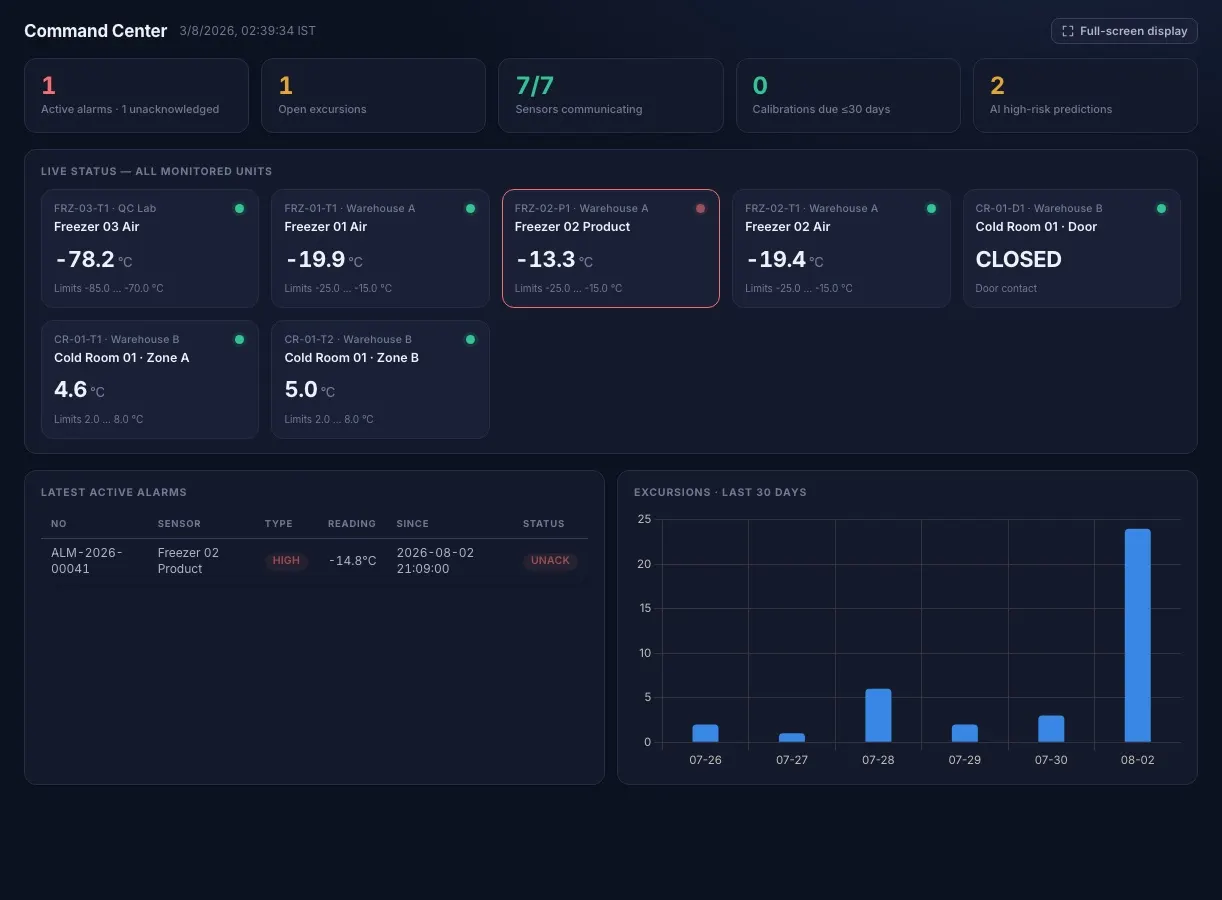
- Freezers, cold rooms, product probes and doors on one screen and a wall display
- AI projects drift forward — which unit breaches next, and roughly when
Act before the limit, not after

OperationsColdWatch · GxP temperature monitoring
ColdWatch by Autowhat AI is a GxP temperature monitoring system for pharma, labs, blood banks and food cold chains, covering freezers from −80 °C to cold rooms at 2–8 °C. Live monitoring on the sensors you already have, alarms that escalate until someone acts, AI that says which unit will breach next — and an audit trail your QA team can hand to an inspector.
WhySound familiar?
From QA heads, warehouse managers and facility engineers in regulated cold chains. Composite quotes from discovery calls — the problems are real; the names are left out.

“The freezer failed at 2 am. We found out at the 8 am round.”
Six hours of excursion before anyone knew, and a batch that now has to be investigated or destroyed.
Warehouse managerBatches lost overnight
“The alarm went to one person, who was asleep.”
A single SMS or a local buzzer, with no escalation and no record of who saw it.
Facility engineerAlarms nobody acted on
“The inspector asked for six months of evidence.”
Readings, alarm acknowledgements and calibration records scattered across paper, exports and email.
Head of QAWeeks to prepare every audit
HowWhat changes with ColdWatch
Real ColdWatch screens running on simulated demo sensors.
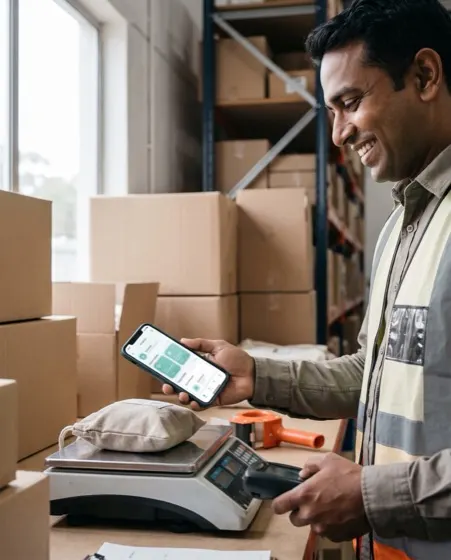
01Night-time failures
Act before the limit, not after
02Unseen alarms
Nothing waits for the morning round

03Audit scramble
Inspection-ready, every day

FieldColdWatch in the field
The workplace it runs in, the person who uses it on a phone, the team at the desk and the detail it reads.
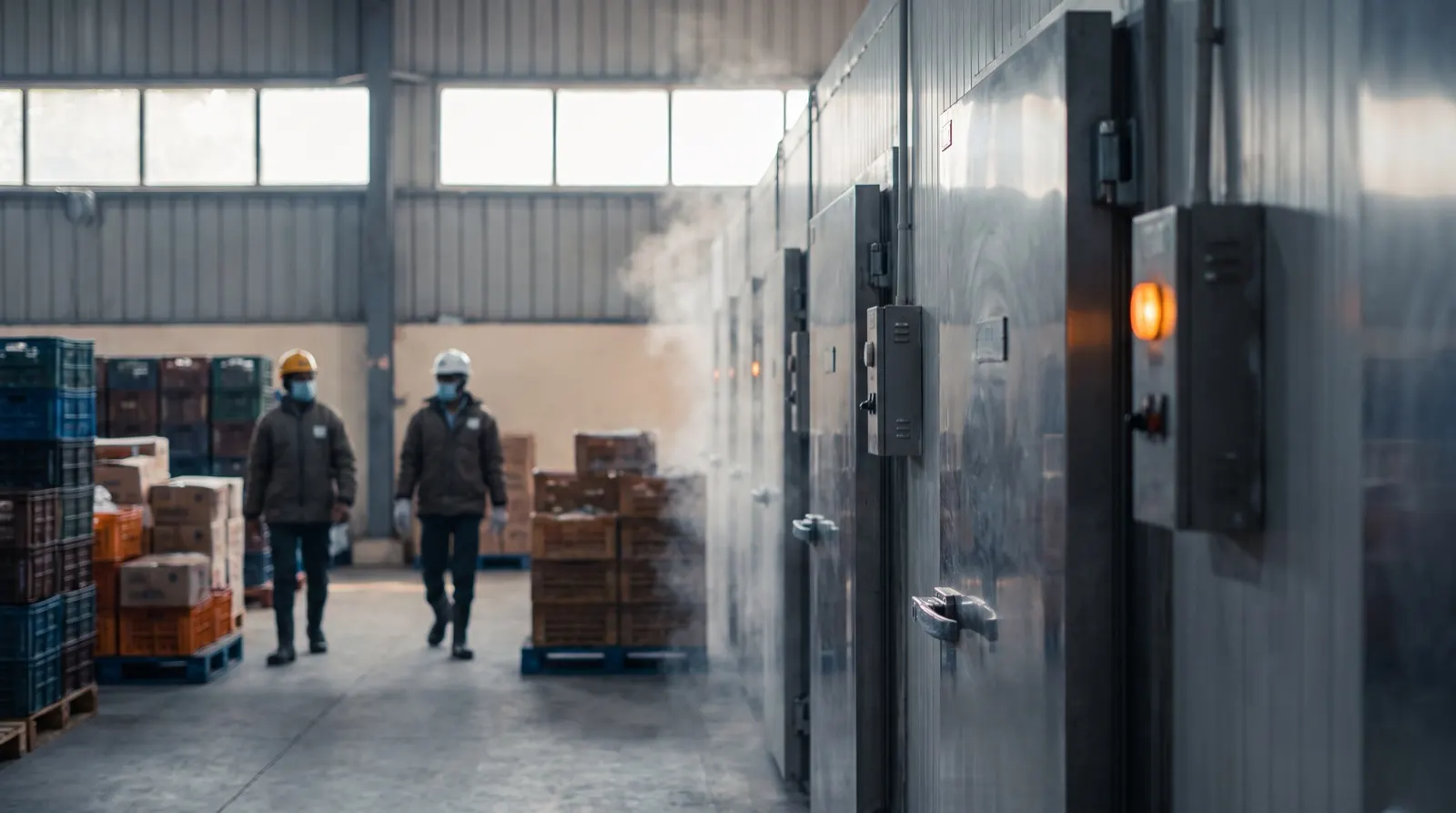
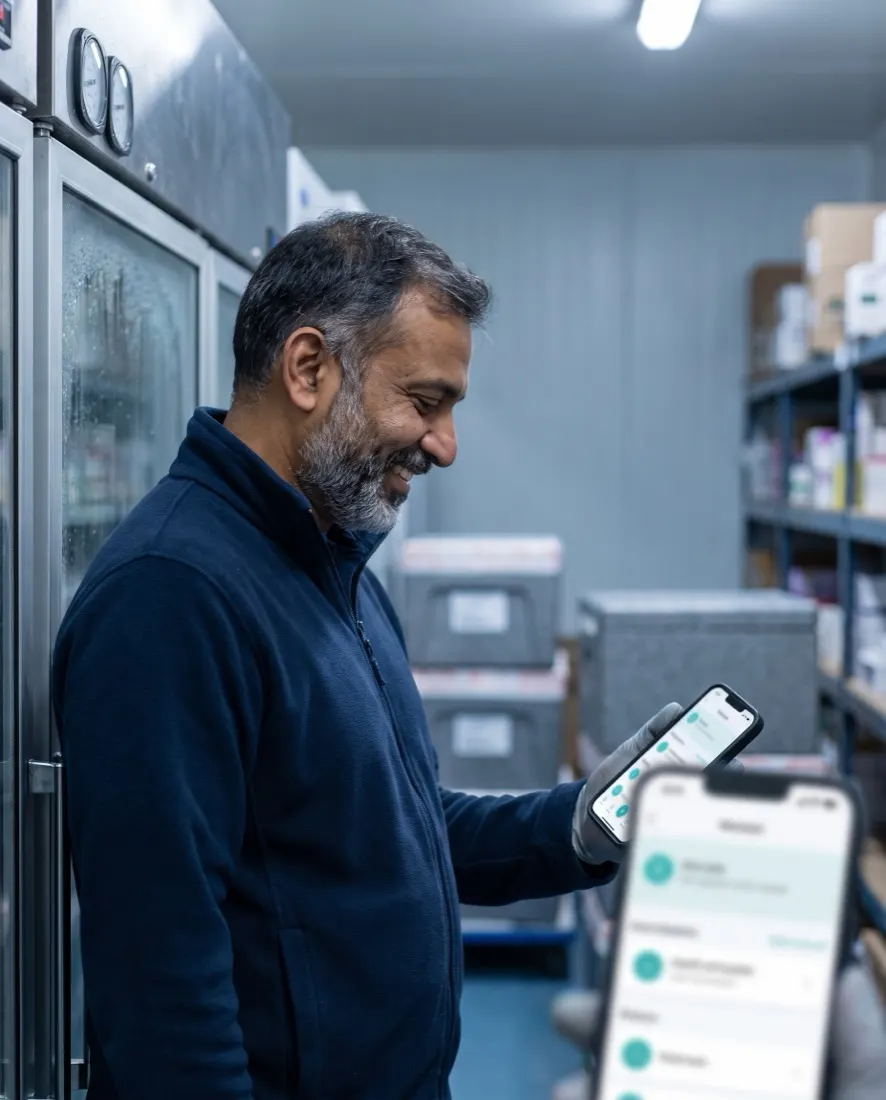
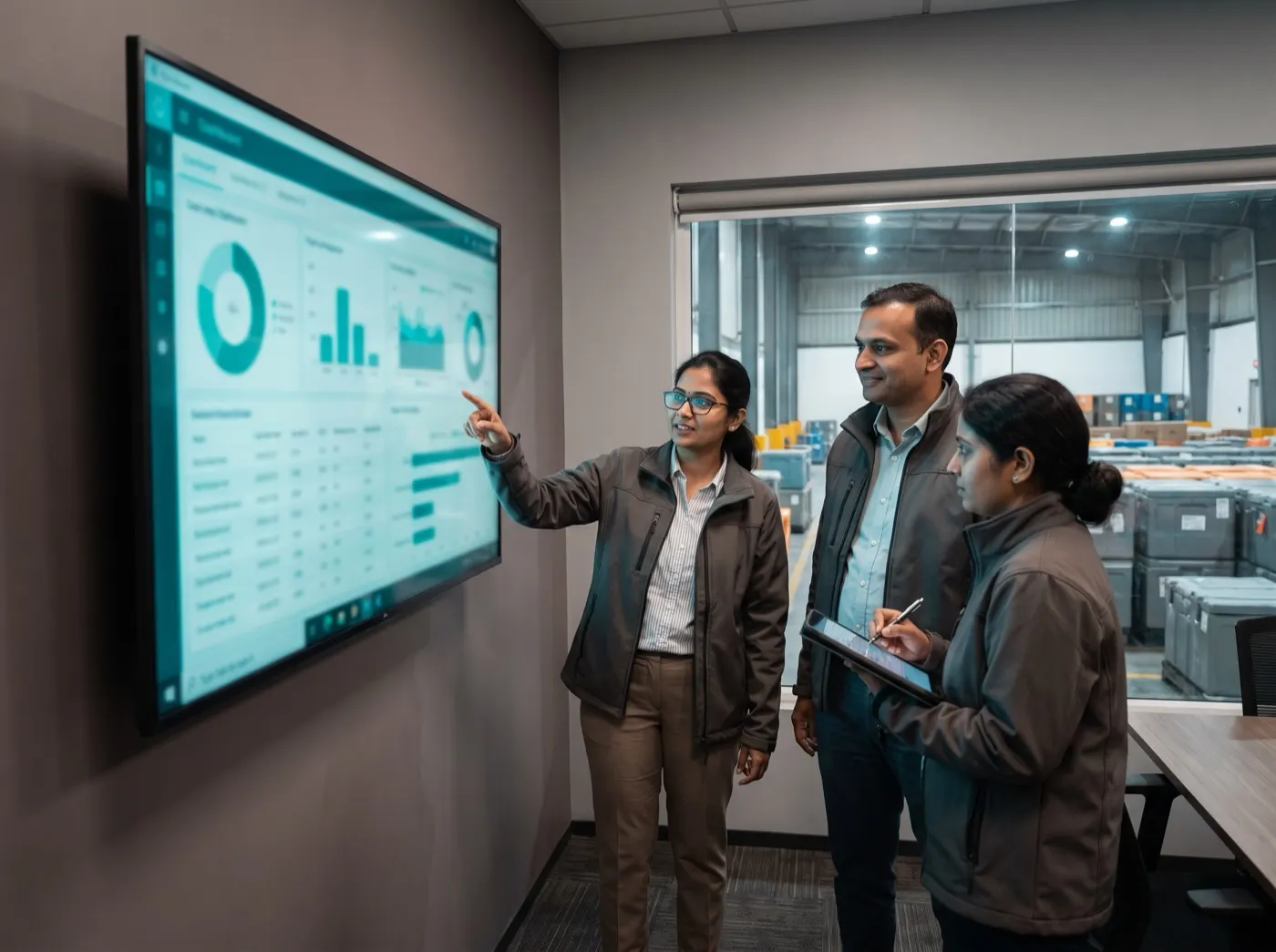
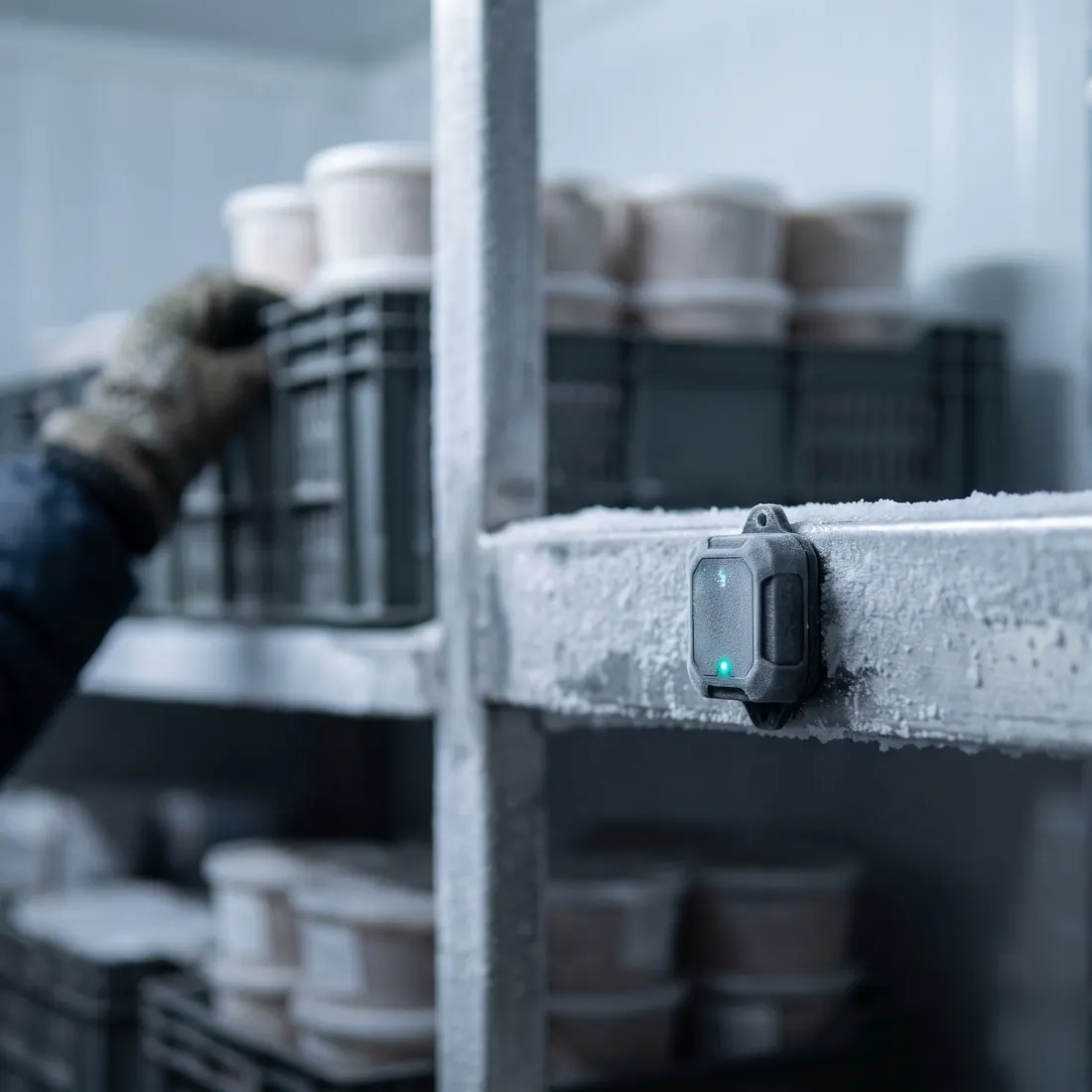
Photographs are illustrative — real customer sites are not shown.
01The screens
Ten real screens: monitoring, alarms, trends, excursion analytics, AI predictions, calibration, reports, the audit trail and the security centre.
Every freezer and cold room live, with active alarms, open excursions and AI risk predictions.
Real screens of ColdWatch running on simulated demo sensors.
02Before and after
An excursion found on the next round is already a deviation. ColdWatch turns every reading into evidence and every alarm into an action.
| Area | Today | With ColdWatch |
|---|---|---|
| Excursions | Found on the next manual round | Alarm in seconds, by screen, email, SMS and push — escalated until acknowledged |
| Prediction | None — the breach is the first signal | Drift projected forward: which unit breaches next, and roughly when |
| Investigations | Paper logs and memory | Excursion register with shift, severity, duration and root-cause indicators |
| Calibration | A spreadsheet someone forgets | Due dates tracked, reminders at 30/15/7 days, overdue alarms |
| Audits | Weeks assembling evidence | ALCOA+ audit trail and validation documents ready on day one |
03Sensor to audit trail
Built on the protocols your building-management equipment already speaks.
BACnet/IP · Modbus TCP
Freezers, cold rooms, product probes and door contacts polled from existing field equipment.
Alarm engine
High, low, rate-of-change, comms gap and sensor failure — with criticality.
Escalation
Pop-up and sound on screen, then email, SMS and mobile push; repeated and escalated until acknowledged.
Mandatory comment
Every acknowledgement and closure carries a comment and a justification.
Register
Duration, peak, shift and severity captured automatically.
AI
Drift, anomalies and patterns point to compressor, door, loading or sensor placement.
PDF · Excel
Daily to monthly reports and an AI-written management summary.
ALCOA+
Every reading, alarm and action kept in an append-only, time-stamped audit trail.
04The platform
Built for GxP: regulated pharma, vaccines, blood banks, labs and food cold chains.
05How we deliver
Installation, operational and performance qualification documents are part of the delivery, not an afterthought.
MoreRelated Operations products
Use casesCold room temperature monitoring for pharma in India
A cold room temperature monitoring system should tell someone the moment a unit leaves its range, at any hour, and keep the proof. ColdWatch polls freezers, cold rooms, product probes and door contacts over BACnet/IP or Modbus TCP from the field equipment already installed, so most sites start on the sensors they have. Five alarm types (high, low, rate of change, comms gap and sensor failure) escalate by screen, email, SMS and mobile push until someone acknowledges with a comment, and AI projects each unit’s drift to estimate the time to breach. Every excursion goes into a register with duration, peak, shift and severity, ready for an excursion investigation. Where the probes should sit is decided by cold room temperature mapping, and the limits by the pharma cold room temperature range for your products.
A temperature monitoring system for a pharma, vaccine, blood bank or lab site in India has to satisfy QA as well as the warehouse. ColdWatch keeps every reading, alarm and action in an append-only, time-stamped audit trail built on the ALCOA+ data-integrity principles, retained for five years, with PDF and Excel reports. Calibration due dates are tracked per sensor, with reminders at 30, 15 and 7 days and an alarm when one goes overdue, and installation, operational and performance qualification documents are part of the delivery. It runs on managed cloud, in your own VPC or on-premises, with India data residency when required. What a system needs to count as GxP compliant is set out in GxP compliant temperature monitoring, and stability data can be summarised with the mean kinetic temperature calculator.
OverviewColdWatch · gxp temperature monitoring system
A GxP temperature monitoring system continuously records the temperature of freezers, refrigerators and cold rooms, raises an alarm when a limit is crossed, and keeps records that QA can show to an inspector. In many Indian pharma plants, labs, blood banks and food cold stores, checks are still a person with a clipboard on a round, so a freezer that fails at 2 am is found at 8 am and the evidence lives on paper.
ColdWatch reads freezers from −80 °C to cold rooms at 2–8 °C, plus product probes and door contacts, on the sensors you already have over BACnet/IP or Modbus TCP. It raises high, low, rate-of-change, comms-gap and sensor-failure alarms and escalates by screen, email, SMS and push until someone acknowledges with a comment. AI projects drift to say which unit breaches next. Every reading and action goes into an append-only ALCOA+ audit trail, with IQ/OQ/PQ documents delivered.
Freezers, cold rooms, product probes and door contacts are polled over BACnet/IP or Modbus TCP from field equipment already installed, and shown on one command centre and a wall display.
Five alarm types — high, low, rate of change, comms gap and sensor failure — escalate by screen, email, SMS and mobile push, repeated until acknowledged with a mandatory comment.
AI projects each unit's drift forward and gives an estimated time to breach, so a unit heading for its limit is flagged before the alarm.
Every excursion is recorded with duration, peak, shift and severity, and AI points to likely causes such as compressor, door, loading or sensor placement.
Calibration due dates are tracked per sensor, with reminders at 30, 15 and 7 days and an alarm when a sensor goes overdue.
Every reading, alarm and action is kept in an append-only, time-stamped audit trail for five years, with PDF and Excel reports and qualification documents delivered at go-live.
| Manual / spreadsheets | Generic software | ColdWatch | |
|---|---|---|---|
| Finding an excursion | On the next manual round | Local alarm or a single SMS | Alarm in seconds, escalated by screen, email, SMS and push until acknowledged |
| Warning before a breach | None | Usually none | AI time-to-breach estimate from each unit's drift |
| Sensors | Thermometers and paper logs | Often its own loggers | Reads existing sensors over BACnet/IP or Modbus TCP |
| Calibration | A spreadsheet someone forgets | Varies | Due dates tracked, reminders at 30/15/7 days, overdue alarms |
| Audit evidence | Weeks assembling paper and exports | Exports per device | Append-only ALCOA+ trail, 5-year retention, IQ/OQ/PQ documents |
LearnColdWatch guides and tools
9 pages on the problems ColdWatch solves. See them all on one page →
FAQQuestions we get about ColdWatch
ColdWatch is an Autowhat AI product for QA heads, warehouse managers and facility engineers in regulated cold chains. Short, factual answers for buyers, procurement and the assistants people ask first.
In short. ColdWatch is an Autowhat AI product for QA heads, warehouse managers and facility engineers in regulated cold chains. It is built for QA heads, warehouse managers and facility engineers in regulated cold chains. It exists to remove the problems those teams describe in almost every first conversation: a freezer fails at 2 am and the 8 am round finds it; and one SMS to one person who was asleep — no escalation, no record. With ColdWatch, teams get every unit live around the clock, on screen and on a wall display, and AI time-to-breach warnings; escalation by screen, email, SMS and push until acknowledged. It connects to BACnet/IP, Modbus, 21 CFR Part 11 style trail and SMS / push / email, is used by QA · facilities · warehouse, and runs on web + wall display. Like every Autowhat AI product, ColdWatch goes live on one site, lane or process first, usually within weeks, on managed cloud, in your own VPC or on-premises, and shares one operational record with the other products, so the second deployment reuses the data and integrations of the first.
It is a system that continuously records storage temperatures, alarms and escalates when a limit is crossed, and keeps time-stamped records that can be shown to an inspector. ColdWatch does this for freezers, cold rooms, product probes and doors, with an append-only ALCOA+ audit trail.
Sensors in each unit are read continuously and checked against limits; a breach raises an alarm that must be acknowledged. In ColdWatch, readings come over BACnet/IP or Modbus TCP, alarms escalate by screen, email, SMS and push, and every excursion is logged with duration, peak, shift and severity.
On five conditions: a high limit crossed, a low limit crossed, a temperature changing too fast, a gap in communication from a sensor, and a sensor failure. ColdWatch raises all five, escalates by screen, email, SMS and push, repeats until someone acknowledges with a mandatory comment, and records every alarm in the audit trail.
ColdWatch covers freezers down to −80 °C and cold rooms at 2–8 °C, plus product probes and door contacts, read from existing sensors over BACnet/IP or Modbus TCP. Each unit is checked against its limits, and AI estimates the time to breach for any unit drifting towards its limit.
A temperature excursion is any reading outside the product's prescribed storage range, such as 2–8 °C, however short it is. WHO guidance defines it as exposure of a time- and temperature-sensitive product to temperatures outside that range. Each one needs a record, quarantine of affected stock and a QA decision; ColdWatch logs every excursion with duration, peak, shift and severity.
Choose software that reads the sensors and building-management equipment already installed and keeps escalating an alarm until a named person acknowledges it. ColdWatch reads them over BACnet/IP or Modbus TCP and escalates by screen, email, SMS and push through the night. If your sensors speak neither protocol, plan for new loggers first.
Manual logs only show the temperature when someone checks, so a night-time failure is found hours later. Continuous monitoring records every reading and alarms immediately, and ColdWatch adds escalation, excursion records and an audit trail on top.
Pick one that monitors every unit continuously, escalates alarms until someone acts, tracks sensor calibration and keeps an append-only audit trail with IQ/OQ/PQ documents. ColdWatch does this for freezers from −80 °C to cold rooms at 2–8 °C, with India data residency when required. A single fridge with a calibrated data logger may not need a system.
Record the excursion's duration, peak and shift, quarantine the affected stock, find the cause (compressor, door, loading or sensor placement) and let QA decide. An inspector will ask for the readings, the alarm and its acknowledgement with a comment, the sensor's calibration record and the decision. ColdWatch keeps all of these in one audit trail.
ColdWatch by Autowhat AI is a GxP temperature monitoring system for freezers and cold rooms. It reads existing sensors, escalates alarms until someone acknowledges, predicts which unit breaches next and keeps an ALCOA+ audit trail. It is for QA heads, warehouse managers and facility engineers at pharma, vaccine, blood bank, lab and food cold-chain sites.
There is no public list price: ColdWatch is priced per deployment after a 30-minute working session on your own data. The main cost drivers are the number of freezers and cold rooms, whether existing BACnet/IP or Modbus TCP sensors can be reused or new ones are needed, hosting (managed cloud, your own VPC or on-premises) and the qualification scope.
On managed cloud, in your own VPC (AWS, Azure or GCP) or on-premises, with your keys. SOC 2 Type II and ISO 27001 controls, India data residency when required, and local or open-weight models when policy demands it. The data stays yours.
06Briefing
A working session: your sensor list mapped, alarm rules drafted and a qualification plan you can take to QA.