

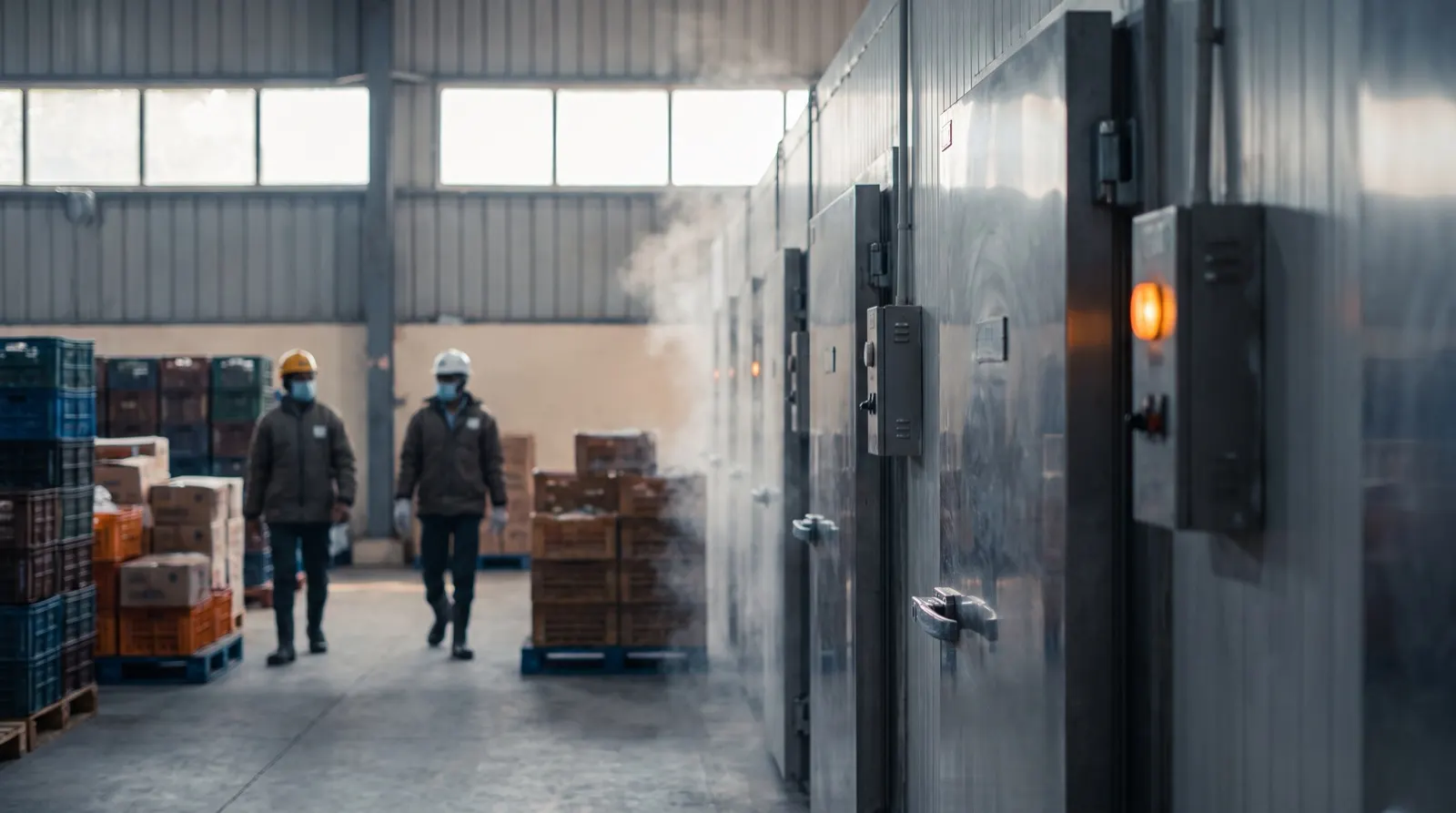
The display on the cold room door reads 5.1 °C. The QA executive notes it on the clipboard, signs, and moves on to the next unit. Inside, near the door seal and the top racks by the evaporator, the cartons have spent part of the night at a different number. Nobody wrote that one down, because nobody was there to see it.
A pharma cold room holding refrigerated product should stay between 2 °C and 8 °C, but that band is the answer to the wrong question. The right temperature is the label range, held at every point where product sits, at every hour, with a record that proves it. A GxP temperature monitoring system exists to supply that proof, and the rest of this post is about the decisions that come before it: where to set the room, where to put the alarms, and where to put the probes. If an excursion has already happened, our guide to investigating a cold room temperature excursion picks up from there.
The product label sets the range, not the room
A cold room has no correct temperature of its own. The product inside it does. The storage condition on the label, backed by the product's stability data, is the limit you must hold. The room is only the tool for holding it.
That matters because one facility often holds products with different conditions. A store with vaccines, insulin and a few "store below 25 °C" items needs more than one zone. The common label bands look like this, but your own labels and your QA team decide what applies:
| Label wording (typical) | Band usually meant | Where it is held |
|---|---|---|
| Store refrigerated / store at 2–8 °C | 2 °C to 8 °C | Walk-in cold room or pharma refrigerator |
| Store frozen | Around −20 °C (check the label) | Freezer |
| Ultra-low frozen | Around −80 °C or colder | Ultra-low freezer |
| Store below 25 °C / below 30 °C | Controlled room temperature | Air-conditioned store |
| Do not freeze | Above 0 °C, always | Any of the above, with low alarms that matter |
Check the exact definitions in the pharmacopoeia and licence conditions your products are registered against. Wording like "cool place" is defined differently in different texts, and the label wins over any rule of thumb in a blog post, including this one.
Aim for the middle of the band, not the edge
Some cold rooms run at 7 °C because someone once argued that a warmer set point saves power. It does save a little. It also leaves one degree between normal operation and a deviation. A door left open during loading uses that degree up in minutes.
A set point near 5 °C gives about three degrees of headroom in both directions. That covers the two failures that actually happen: warming from doors, defrost cycles and compressor trips, and cooling past 2 °C from a stuck thermostat or a product placed against the evaporator. Freezing is the quieter risk. Many biologicals that tolerate a short warm spell are ruined by a single freeze.
A cold room run at 7 °C is not a 2–8 °C room. It is a room with one degree of patience.
Alarm limits belong inside the label limits
If your alarm fires at 8.0 °C, the alarm is announcing a deviation, not preventing one. A common approach uses two tiers. An alert limit sits inside the band and asks someone to look. An action limit sits at or near the label edge and starts the excursion process.
Add a delay so a door opening does not page the night supervisor every ten minutes, but keep it short enough that a real failure is caught early. Pair it with a rate-of-change alarm, which catches a fast rise long before any fixed limit does. Then decide who hears it at 2 am, and who hears it if the first person does not answer. Our cold room alarm escalation playbook sets out that ladder step by step.
A worked example: how fast headroom disappears
The numbers here are illustrative, not from any site. Say a 2–8 °C room runs at a set point of 5 °C. The alert limit is 7 °C and the action limit is 8 °C. At 1 am the compressor trips and the room warms at 0.05 °C per minute.
- Headroom to the alert limit: 7 − 5 = 2 °C. At 0.05 °C a minute, that is 2 ÷ 0.05 = 40 minutes.
- Headroom to the action limit: 8 − 5 = 3 °C, so 3 ÷ 0.05 = 60 minutes. The room hits 8 °C at 2 am and leaves its range after that.
- With manual rounds at 10 pm and 6 am, the next check is at 6 am. Product sits out of range for up to 6 − 2 = 4 hours before anyone knows.
- With continuous monitoring and an alert at 7 °C, someone is called at 1:40 am, with 20 minutes left to move product or restart the unit.
Now repeat it with the set point at 7 °C. Headroom to the action limit is 1 °C, which is 20 minutes. The alert limit has nowhere left to sit. The same fault, in the same room, becomes a deviation almost immediately.
A cold room is several temperatures, not one
The door display usually shows the air near the controller probe, which is often the most stable spot in the room. Product near the door, on the top racks, under the evaporator or against an outside wall can sit a degree or two away from it. That spread is why temperature mapping comes before routine monitoring. Mapping finds the warm and cold spots under load, with doors opening and in the hottest season.
Monitoring probes then go where mapping found the risk, not where the cable was easiest to run. Product probes in a buffer medium tell you what the product felt. Air probes tell you what the room did. A door contact explains why. Each probe also needs calibration on schedule, which our sensor calibration tracking guide covers.
Indian summers and power cuts change the plan
An Indian loading dock in May can be well above 40 °C outside. A dock door held open for a truck pulls that heat straight into the room. Power cuts and the changeover to a DG set add a second risk. The compressor stops, restarts, and sometimes does not restart at all. Monsoon humidity adds ice on evaporator coils and heavier defrost cycles.
None of this changes the label range. It changes how much headroom you need and when you need it. Map in summer, check alarm behaviour across a planned power cut, and look at excursion history by month. A room that is calm in December may live near its limit in June.
"We already have a display and a chart recorder"
This is a fair position, and for a small store with one unit and staff on site around the clock it can be enough. A display shows the current value. A chart recorder keeps a trace. Both are better than a clipboard alone.
The gaps show up at night and at inspection. A display cannot call anyone. A paper chart cannot say who saw a high reading, what they did and why. An inspector asking for six months of evidence wants readings, alarm acknowledgements and calibration records together. Systems like ColdWatch record every reading and acknowledgement in an append-only audit trail, with a mandatory comment on each acknowledgement. Whether you need that depends on your risk, your product and your auditors. It is worth deciding on purpose rather than by habit.
One more check is worth running on the record you already have. A single warm hour and a slow summer drift look different in the data, and the mean kinetic temperature calculator shows how a period of readings compares with the labelled condition. Treat it as an input to QA's judgement, not a replacement for it.
What to do this week
- List every product in each cold room and write down its label storage condition.
- Check the set point. If it sits within 1 °C of either label limit, raise it with engineering and QA.
- Write down your alert limit, action limit, alarm delay and rate-of-change rule for each unit.
- Compare probe positions with your last mapping report, and note when that mapping was done.
- Ask who gets called at 2 am, and who gets called if they do not answer.
The number on the door is the start of the answer, not the end. A room set in the middle of its band, with alarms that speak early and probes where the risk is, lets the night shift sleep and the morning round read the record calmly. For more on each step, browse our cold chain monitoring guides.