InsightEduWatch · education control tower

Every child seen. Every rupee counted. Every school accountable.

For state and district education departments. One portal and one record for eight roles — from the minister’s single delivery score to a parent’s daily voice digest — with 25 modules across classroom, kitchen, field and governance.

  • 8 roles one shared record
  • 25 modules classroom to cabinet
  • India-only data, government-owned
State commandDistrictsSchools
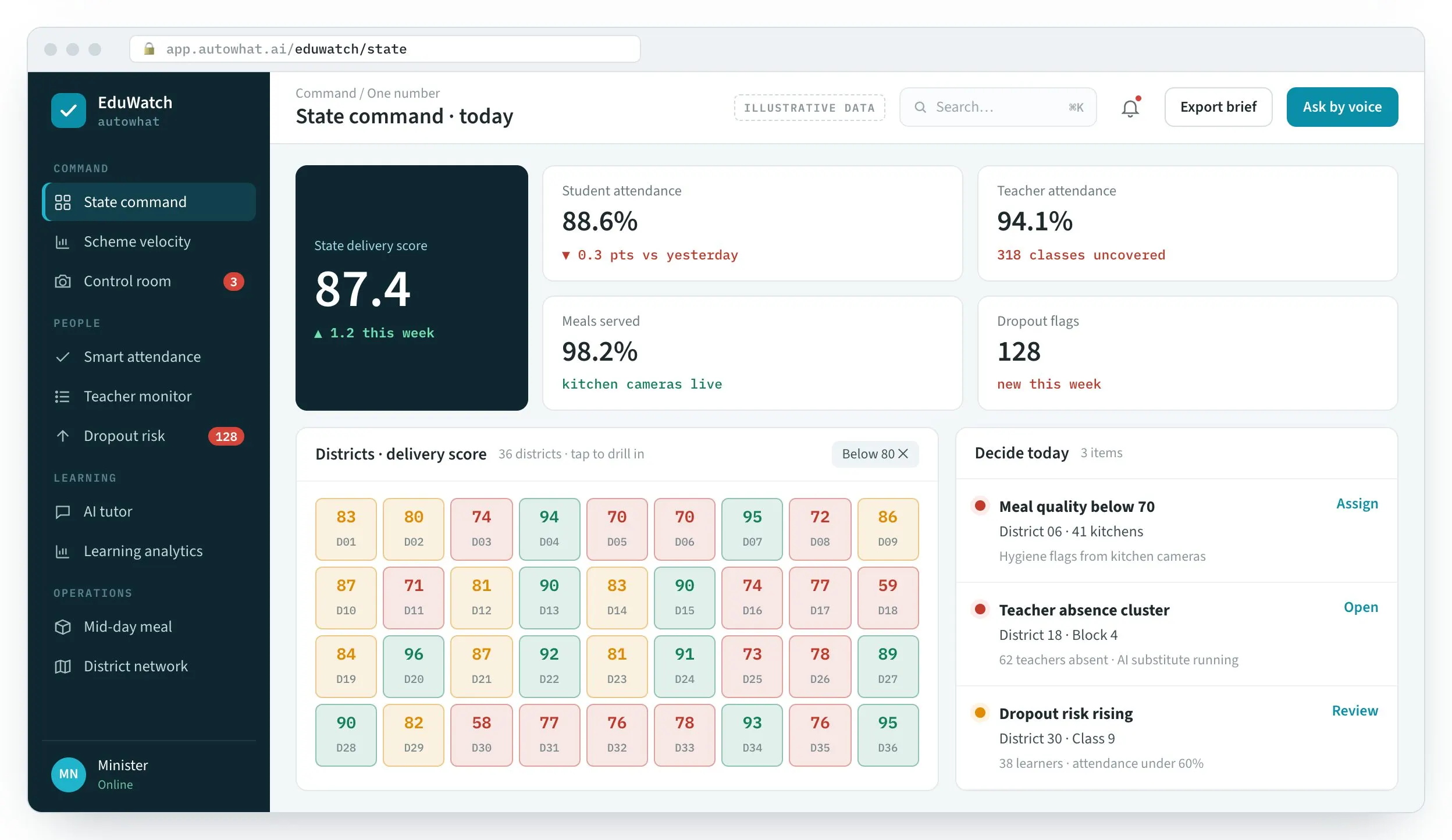
EduWatch state command: a single delivery score, district health grid and today's decisions
Product screen with illustrative data.

WhySound familiar?

Three things we hear in every first conversation.

From education secretaries, district officers and school leaders. Composite quotes from discovery calls — the problems are real; the names are left out.

EduWatch: The problem, before EduWatch
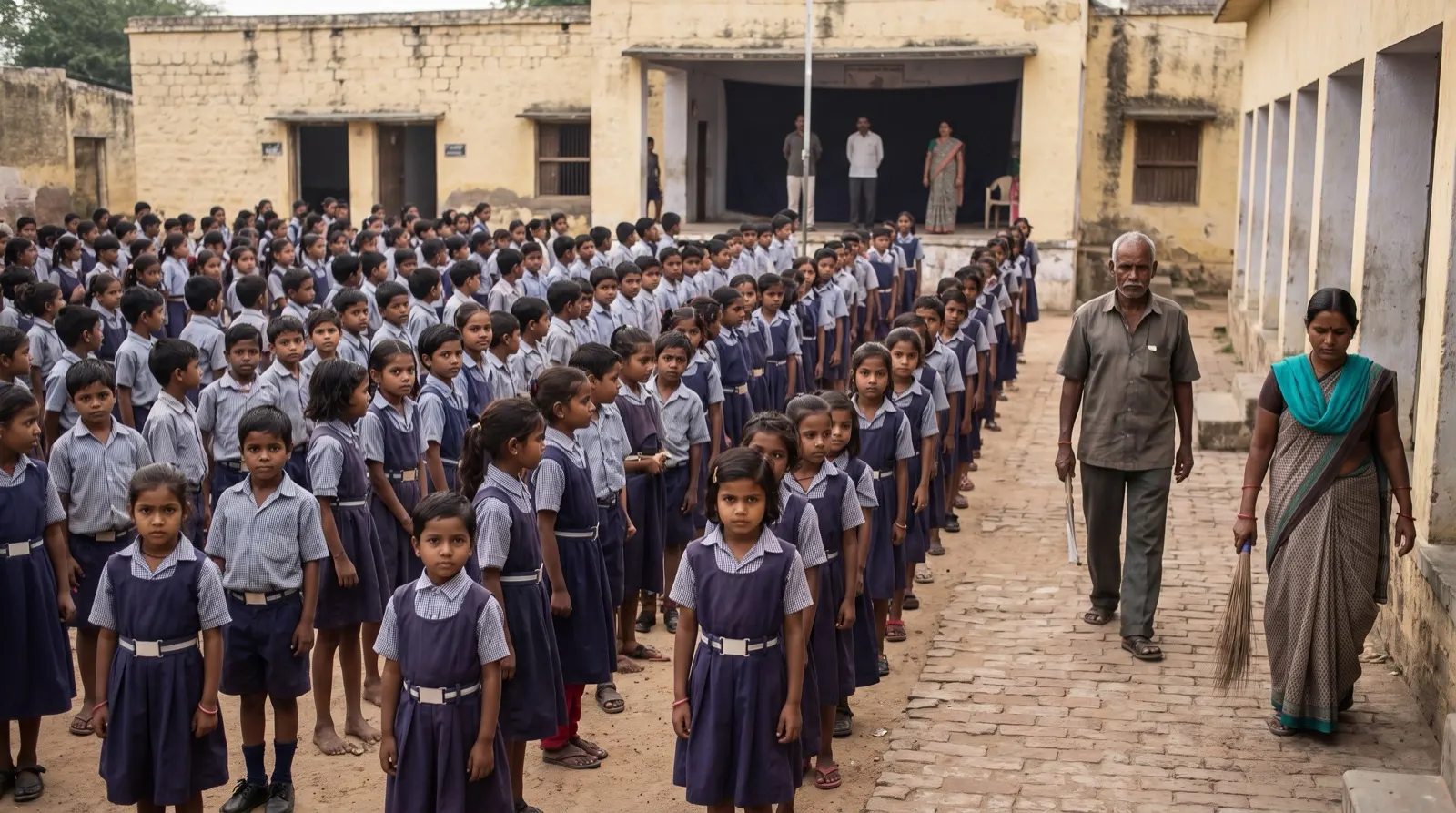
A district education office on a Monday morning
  1. “By the time I hear about it, it’s already in the papers.”

    A meal-quality failure or a cluster of absent teachers reaches the top after the damage is done.

    Education minister~14 days from signal to decision

  2. “A complaint every hour — answer one and the next arrives.”

    Two thousand schools, visits planned by rota, and no way to know which school to go to first.

    District officerMost visits find nothing to fix

  3. “I want to teach. Half the day I’m a clerk.”

    Registers, returns and forms take the time that should go to the children who are falling behind.

    TeacherHours of admin every week

HowWhat changes with EduWatch

The same three problems, on the screens that solve them.

Product screens with illustrative data. In a briefing we load one of your districts.

01Hearing it last

One number for the state — and only the decisions that are yours.

  • A delivery score with every district’s health band beneath it
  • The red list shows only what needs a decision today: meals, teacher absence, dropout risk

Signal in about 2 days, not 14 (pilot target)

EduWatch screen: One number for the state — and only the decisions that are yours.

02Visits by rota

Schools ranked by risk, and a route for the day.

  • Complaints, attendance, meals and data gaps combined into one risk ranking
  • A field route that starts with the school that needs it most

Most visits find something to fix

EduWatch screen: Schools ranked by risk, and a route for the day.

03Teachers as clerks

Attendance by voice. The paperwork files itself.

  • Say who is absent; parents are told by SMS
  • Learners at risk flagged each morning, with a lesson plan that works offline

+18 minutes of teaching a day (pilot target)

EduWatch screen: Attendance by voice. The paperwork files itself.

FieldEduWatch in the field

The people, the phone, the place.

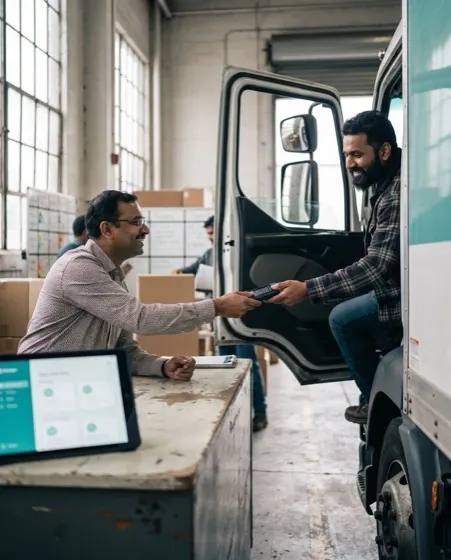
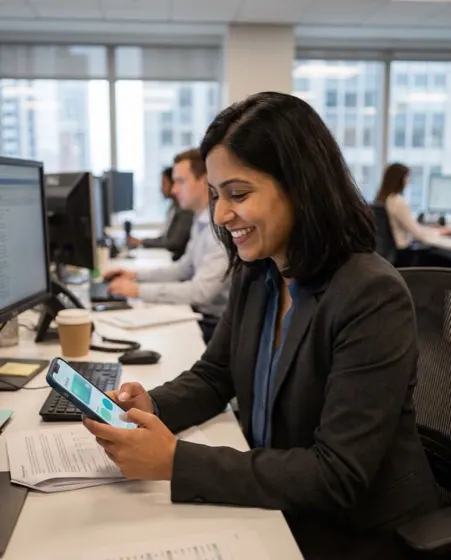
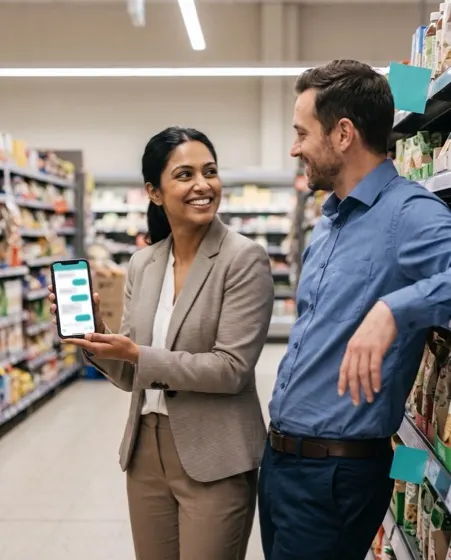
The workplace it runs in, the person who uses it on a phone, the team at the desk and the detail it reads.

EduWatch: Where EduWatch runs
Where EduWatch runs
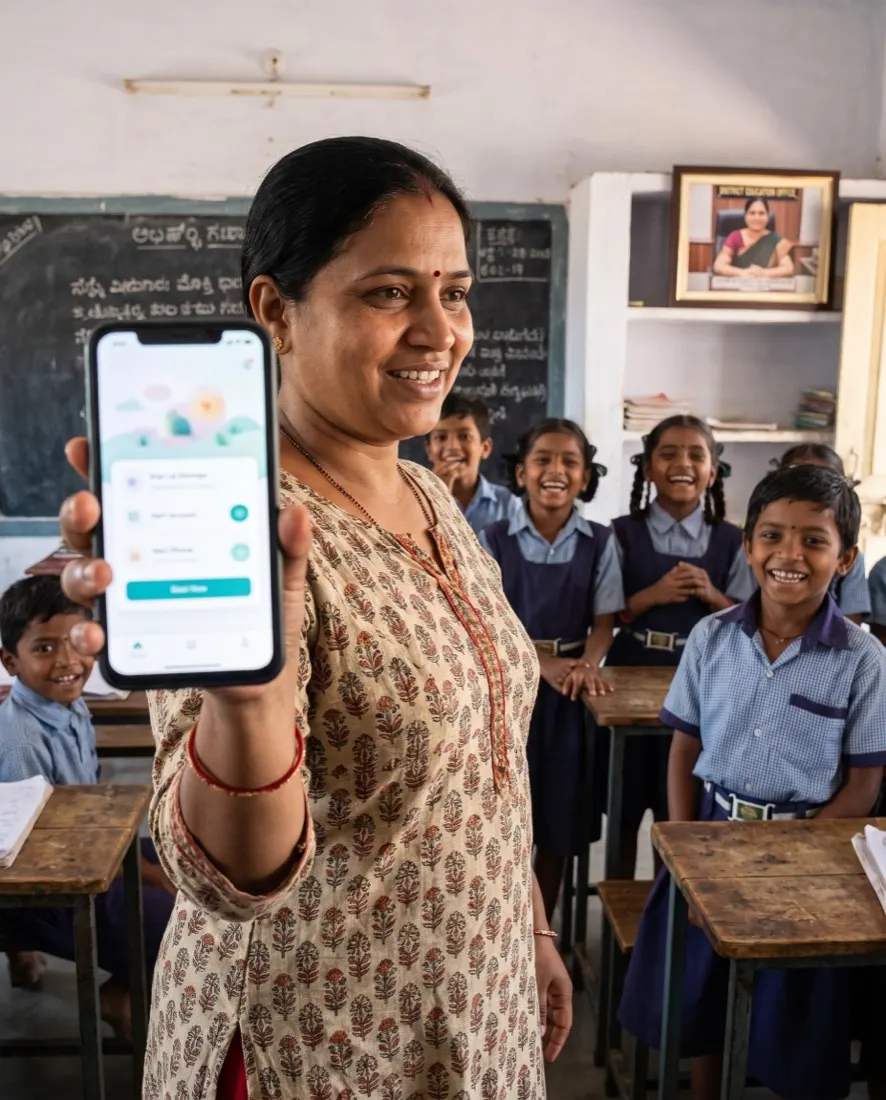
EduWatch: On the phone, where the work happens
On the phone, where the work happens
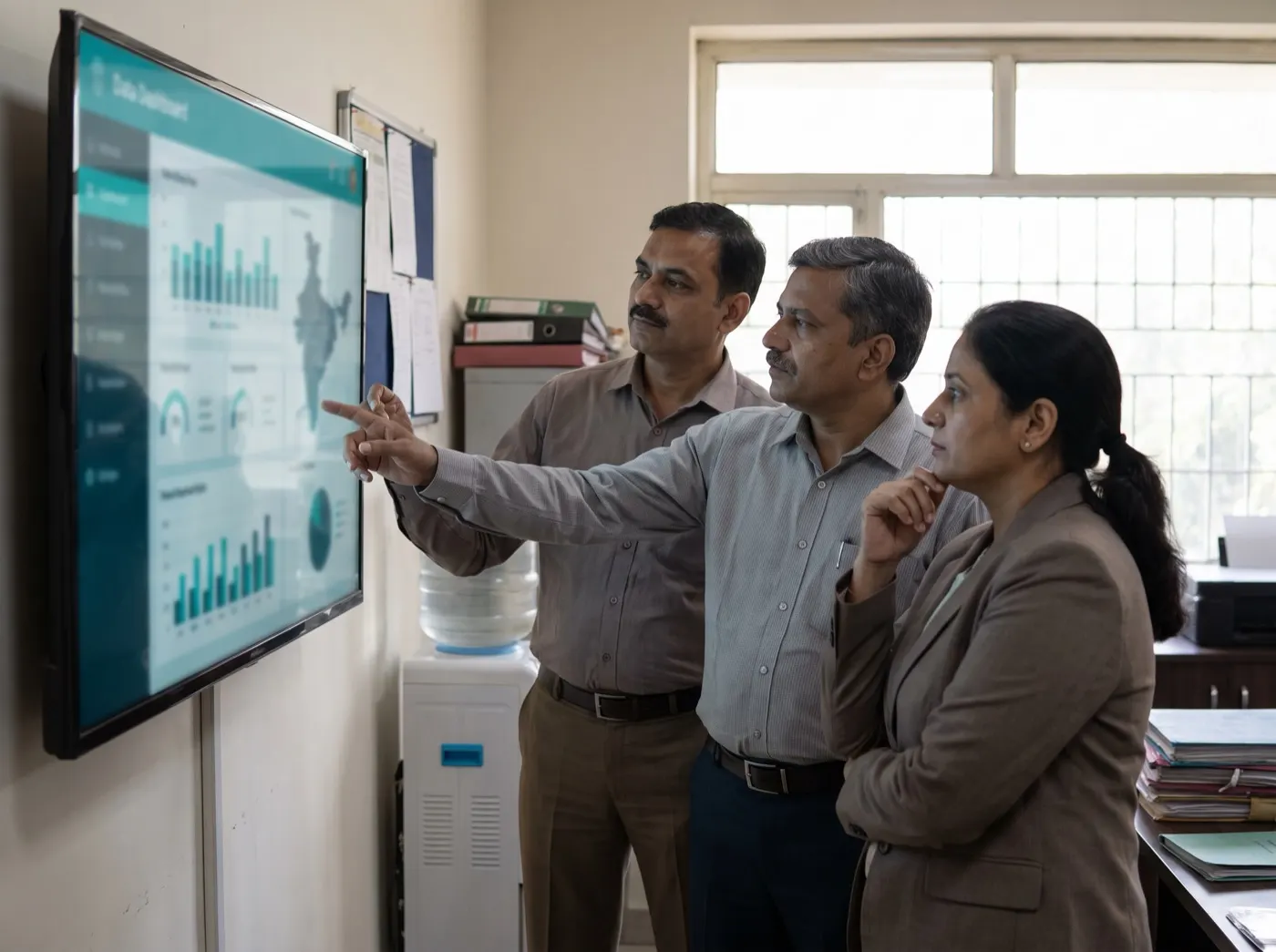
EduWatch: The team at the EduWatch desk
The team at the EduWatch desk
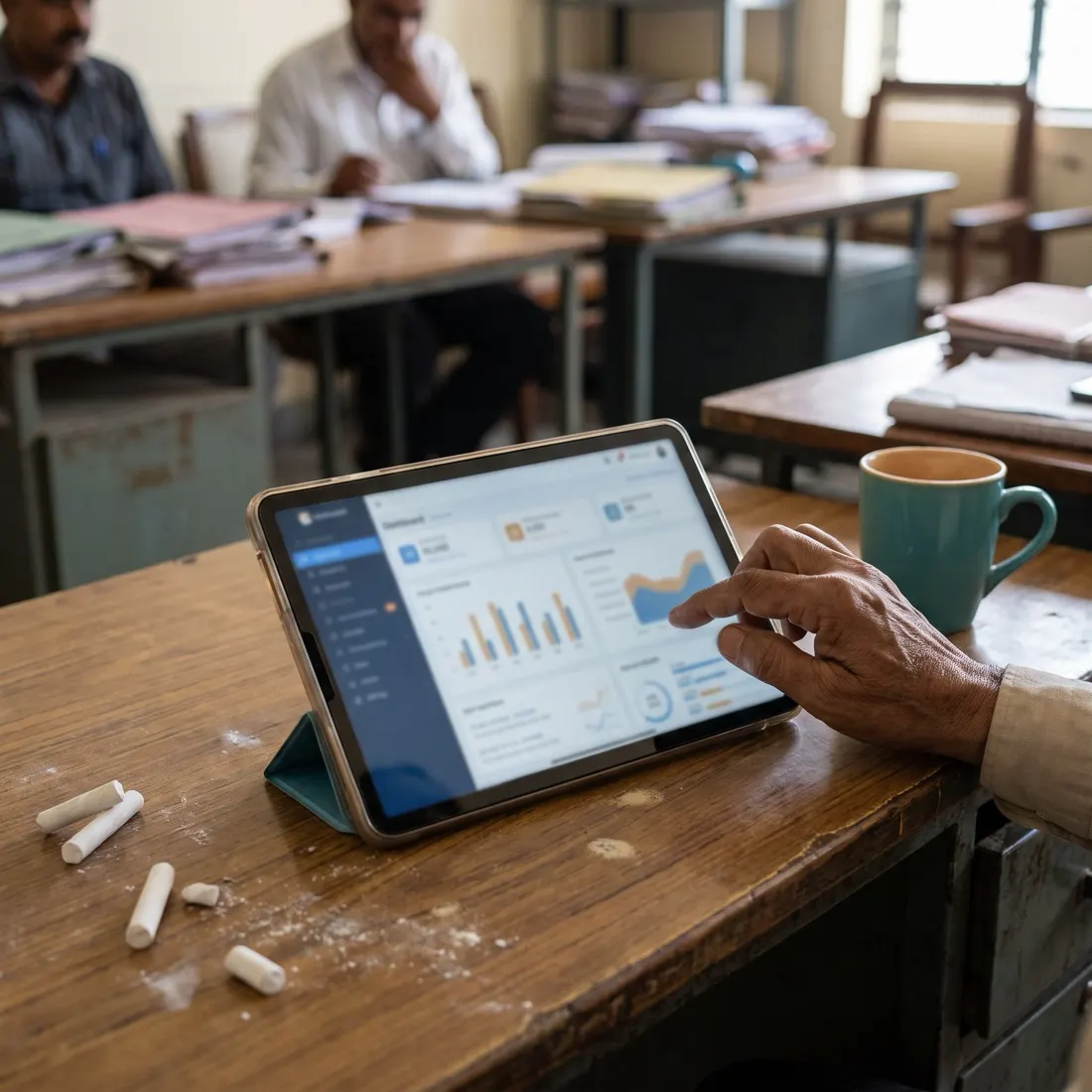
EduWatch: The detail EduWatch reads
The detail EduWatch reads

Photographs are illustrative — real customer sites are not shown.

  • 14 → 2 daysCrisis signalreaches the minister
  • 90 → 21 daysOrder to classroomscheme velocity
  • 18 → 6 hPrincipal adminper week
  • +18 minTeacher timeback every day
  • 12 → 70%Field visitsthat find a real issue
  • 11 → 64%Parent engagementwith a daily digest

Pilot targets, measured by an external evaluator — not results from a live deployment.

01The screens

From the minister’s desk to a parent’s phone.

Five of the screens, one per layer: the state command, scheme velocity, a district’s field triage, a teacher’s phone and a parent’s daily digest.

autowhat · EduWatch / State command Illustrative data
EduWatch screen

One delivery score, every district’s health, and only the decisions that need the minister today.

Product screens with illustrative data — districts, schools and people are placeholders.

02Eight roles, one record

Everyone sees only their problem. The data comes from one place.

Access is by role. A teacher sees their class, a district officer their district, the minister the state — and every number traces back to the same record.

  • Education minister

    “By the time I hear about it, it’s already in the papers.”

    One delivery score for the state, a health band for every district, and only the decisions that are theirs to make.

    Crisis signal14 days → 2
  • Secretary

    “I sign hundreds of orders. I can’t tell which one moves the needle.”

    Scheme velocity — how long each order takes to reach a classroom, where funds are stuck, a cabinet pack that assembles itself.

    Order to classroom90 days → 21
  • District officer

    “A complaint every hour — answer one and the next arrives.”

    A heat-map of every school, a complaint triage queue and a field-visit route ranked by risk.

    Visits that find an issue12% → 70%
  • Block officer

    “On paper every school looks the same.”

    A walk-and-tap field app: checklist, GPS pin, photo evidence, offline sync.

    Records verified41% → 78%
  • Principal

    “Three hours a day in spreadsheets.”

    One screen for attendance, staff register, meals and returns — filed automatically.

    Admin time a week18 h → 6 h
  • Teacher

    “I want to teach. Half the day I’m a clerk.”

    Attendance by voice, a list of learners at risk, lesson plans that work offline.

    Time back each day+18 min
  • Student

    “Everyone goes at one speed — I’m ahead in some things, behind in others.”

    A personal learning path from foundational literacy and numeracy to skills, in six languages.

    Learning pathOwn pace
  • Parent

    “I find out what my child learnt only at exam time.”

    A daily digest by voice or SMS in their language — attendance, homework, the day’s meal.

    Parent engagement11% → 64%

03A school day, instrumented

From the kitchen at six to the state brief at eight.

Every hour of the school day produces a signal — and each one is acted on by the person closest to it.

  1. Kitchens openCameras check hygiene and weighing before cooking starts.
  2. ArrivalFace, RFID or voice attendance; absent learners’ parents get an SMS.
  3. TeachingIf a teacher is absent, an AI-supported lesson runs and the principal is told.
  4. Mid-day mealPortion and quality checked on camera; a quality score per school.
  5. Skills & sportYoga, sport, arts and vocational sessions logged against each learner.
  6. Parent digestWhat was learnt, homework and the meal — by voice or SMS.
  7. State briefTomorrow’s decisions, ranked, on the minister’s and secretary’s screens.

0425 modules

Sorted by attention, not by department.

The control room opens on what needs action today, then what is under watch, then what is running normally.

Needs action today 8

  • Student smart attendance
  • Teacher attendance & class log
  • Mid-day meal quality camera
  • Kitchen camera
  • CCTV with on-site face match
  • State control room
  • AI substitute for absent teachers
  • Discipline ladder · human sign-off

Under watch 8

  • Teacher monitor · tokenised IDs
  • Grievance & RTI
  • Dropout risk
  • Learning analytics
  • AI tutor · six languages
  • Online study
  • Teacher 360 & HR
  • Behavioural support

Operating normally 9

  • Skills, sport & yoga
  • Block field app
  • School management committee
  • District network
  • Budget & ROI
  • Parent voice digest
  • Minister voice briefings
  • AI model registry
  • Secure infrastructure

05Trust by design

Children’s data is sensitive. The safeguards are in the architecture.

Written into the contract and checked from outside — not promised in a slide.

  • Data stays in IndiaOn government-empanelled servers. Nothing leaves the country.
  • Consent, no ads, no profilingParental consent built in; learners’ data is never sold or used to target.
  • Faces never leave the schoolMatching happens on site; images are blurred before anything is uploaded.
  • Every access loggedWho looked at what, and when — open to external audit every year.
  • The government owns the dataOpen formats, export at any time, no lock-in.
  • Names tokenisedLearner IDs are tokenised in logs; no personal data in plain text.

Six risks, six answers

  • Teachers new to digital toolsVoice-first, in their language; a learning centre in every block.
  • Weak connectivityOffline first, SMS and IVR fallbacks, block-level sync.
  • Resistance to changeNo penalties during the pilot; time handed back to teachers first.
  • Scale shock3 districts → 10 → all — each phase only after the last is green.
  • Poor data qualityAutomatic checks and alerts; one source of truth.
  • PrivacyConsent, on-site face matching, public audit.

06120-day pilot

Three districts, about 600 schools. A dashboard live by day 45.

Each phase moves on only when the last one is green, and an external evaluator measures the change.

  1. Days 1–30Agreement, baseline data audit, teacher learning centres.
  2. Days 31–60200 schools live; the minister’s dashboard live by day 45; parent voice line.
  3. Days 61–90600 schools; an external evaluator measures the change.
  4. Days 91–120Review, decision on the next phase, a 10-district scale plan.

OverviewEduWatch · school monitoring system

School monitoring system for education departments: how EduWatch works

A school monitoring system brings attendance, teacher presence, mid-day meals, complaints, inspections and scheme progress for every school into one record. In India, a state or district department may run thousands of schools, and problems such as a meal-quality failure or a cluster of absent teachers often reach the top weeks later, after the damage is done. Field visits planned by rota spread officers evenly, while problems are not spread evenly, so most visits find nothing to fix.

EduWatch gives one portal and one record to eight roles, from the education minister and secretary to district and block officers, principals, teachers, students and parents, across 25 modules. The state sees one delivery score with a health band for every district and a red list of today's decisions. District officers get schools ranked by risk and a route for the day. Teachers take attendance by voice, parents of absent learners get an SMS, and principals' returns file themselves.

Education dashboard for government: one delivery score for the state

The state command screen shows one delivery score, a health band for every district beneath it, and a red list of only the decisions that need leadership today: meals, teacher absence and dropout risk.

School inspection app with risk-ranked visits

Complaints, attendance, meals and data gaps are combined into one risk ranking, and each officer's field route starts with the school that needs it most. Block officers use a walk-and-tap app with checklist, GPS pin, photo evidence and offline sync.

Teacher and student attendance monitoring by voice

Teachers say who is absent and the parents of absent learners are told by SMS. Face, RFID or voice attendance is supported, and teacher attendance and the class log are tracked in the same record.

Mid-day meal monitoring from kitchen to plate

Cameras check kitchen hygiene and weighing before cooking starts, and portion and quality are checked at serving, giving each school a meal-quality score. Faces are matched on site and images are blurred before anything is uploaded.

Dropout early warning for learners at risk

Learners at risk are flagged each morning on the teacher's phone, alongside a lesson plan that works offline. Dropout risk sits in the control room's watch list so it is reviewed before it becomes a lost learner.

Scheme monitoring: order-to-classroom velocity

The secretary's view tracks how long each order takes to reach a classroom and where funds are stuck, and assembles a cabinet pack automatically from the same record.

Who it is for

  • State education departments (minister and secretary): one delivery score, district health bands and only the decisions that are theirs to make.
  • District and block education officers: a risk-ranked list of schools, a complaint triage queue and an offline field app with GPS and photo evidence.
  • Principals and teachers in government schools: attendance by voice, learners at risk flagged each morning, and returns filed automatically instead of hours of registers.

Read next

EduWatch compared

Manual / spreadsheetsGeneric softwareEduWatch
How problems reach the stateThrough weekly returns and phone calls, often after the damage is doneDashboards of compiled data, usually reviewed periodicallyA red list of today's decisions on the minister's and secretary's screens
Planning school visitsBy rota; most visits find nothing to fixVisit logs, but the order of visits is still chosen by handSchools ranked by risk from complaints, attendance, meals and data gaps, with a route for the day
Teacher workloadRegisters and forms filled by handSeparate apps and portals to updateAttendance by voice; returns file themselves from one record
Mid-day meal checksPaper registers, rarely reviewedMeal-served counts reported by SMS or appKitchen hygiene, weighing and portion checks with a quality score per school
Children's dataPaper files with no access logVaries by vendor and hostingData in India, government-owned, tokenised learner IDs, faces matched on site, every access logged

FAQQuestions we get about EduWatch

Straight answers, before the call.

EduWatch is an education control tower: one record for eight roles from the secretary to the parent — attendance, meals, learning and field visits — with schools ranked by risk so the day's visits go where they matter. Short, factual answers for buyers, procurement and the assistants people ask first.

In short. EduWatch is an education control tower: one record for eight roles from the secretary to the parent — attendance, meals, learning and field visits — with schools ranked by risk so the day's visits go where they matter. It is built for education secretaries, district officers and school leaders. It exists to remove the problems those teams describe in almost every first conversation: about two weeks from a signal to a decision; and visits planned by rota, most finding nothing to fix. With EduWatch, teams get a delivery score for the state, with every district's health band beneath it, and risk-ranked schools and a route for the day. It connects to Voice attendance, SMS to parents, Risk ranking and Role-based dashboards, is used by Secretariat · district · school · parents, and runs on web + voice + sms. Like every Autowhat AI product, EduWatch goes live on one site, lane or process first, usually within weeks, on managed cloud, in your own VPC or on-premises, and shares one operational record with the other products, so the second deployment reuses the data and integrations of the first.

What is a school monitoring system?

Software that brings attendance, teacher presence, mid-day meals, complaints, inspections and scheme progress for every school into one record, with a view for each level of the department. EduWatch does this for eight roles, from the minister to the parent, on one shared record.

How does a school monitoring system work for district education officers?

It combines signals such as complaints, attendance, meal issues and data gaps into a risk ranking of schools, so visits go where they are needed. In EduWatch the district officer gets a heat-map, a complaint triage queue and a field route that starts with the highest-risk school.

What is the difference between a school monitoring system and a school management system?

A school management system runs one school's office work, such as admissions, fees, timetables and report cards. A school monitoring system like EduWatch collects attendance, teacher presence, mid-day meals, complaints, inspections and scheme progress from every school into one record, so state, district and block officers can see which schools need attention.

Can a school monitoring system track teacher attendance?

Yes. In EduWatch, face, RFID or voice attendance is supported, and teacher attendance and the class log are tracked in the same record as student attendance. Teachers say who is absent, parents of absent learners are told by SMS, and teacher absence appears on the state's red list of decisions.

How is mid-day meal quality monitored in EduWatch?

Kitchen cameras check hygiene and weighing before cooking, and portion and quality are checked at serving, giving each school a daily meal-quality score. Parents can receive the day's meal in their daily digest by voice or SMS.

Does EduWatch work in schools with weak internet connectivity?

Yes. It is offline-first, with SMS and IVR fallbacks and block-level sync, and the block officer's field app syncs visits when there is a signal.

How is children's data protected in a school monitoring system?

In EduWatch data stays in India on government-empanelled servers and the government owns it. Parental consent is built in, there is no advertising or profiling, faces are matched on site, learner IDs are tokenised and every access is logged and open to external audit.

How much does a school monitoring system like EduWatch cost?

EduWatch is priced per deployment after a 30-minute working session on your own data; there is no public list price. The usual start is a 120-day pilot in three districts, scoped in that session.

Who is EduWatch for?

Education secretaries, district officers and school leaders. An education control tower: one record for eight roles from the secretary to the parent — attendance, meals, learning and field visits — with schools ranked by risk so the day's visits go where they matter.

What problems does EduWatch remove?

About two weeks from a signal to a decision; visits planned by rota, most finding nothing to fix; teachers spending hours a week as clerks.

What do we get with EduWatch?

A delivery score for the state, with every district's health band beneath it; risk-ranked schools and a route for the day; attendance by voice; parents told by SMS; returns file themselves.

What does EduWatch connect to, and who uses it?

It connects to Voice attendance, SMS to parents, Risk ranking, Role-based dashboards. Users: Secretariat · district · school · parents. Channel: Web + voice + SMS.

How do we start with EduWatch?

With a 30-minute working session on your own data — an engineer from the relevant sector, not a sales queue. The first wave is scoped in that call; most products go live on one site, lane or process within weeks and then scale.

Where does EduWatch run, and who owns the data?

On managed cloud, in your own VPC (AWS, Azure or GCP) or on-premises, with your keys. SOC 2 Type II and ISO 27001 controls, India data residency when required, and local or open-weight models when policy demands it. The data stays yours.

07Briefing

Bring one district’s data. We’ll show you its schools on one screen.

A working session with the team that builds it: your district loaded, the delivery score computed, and a pilot plan you can take to review.