

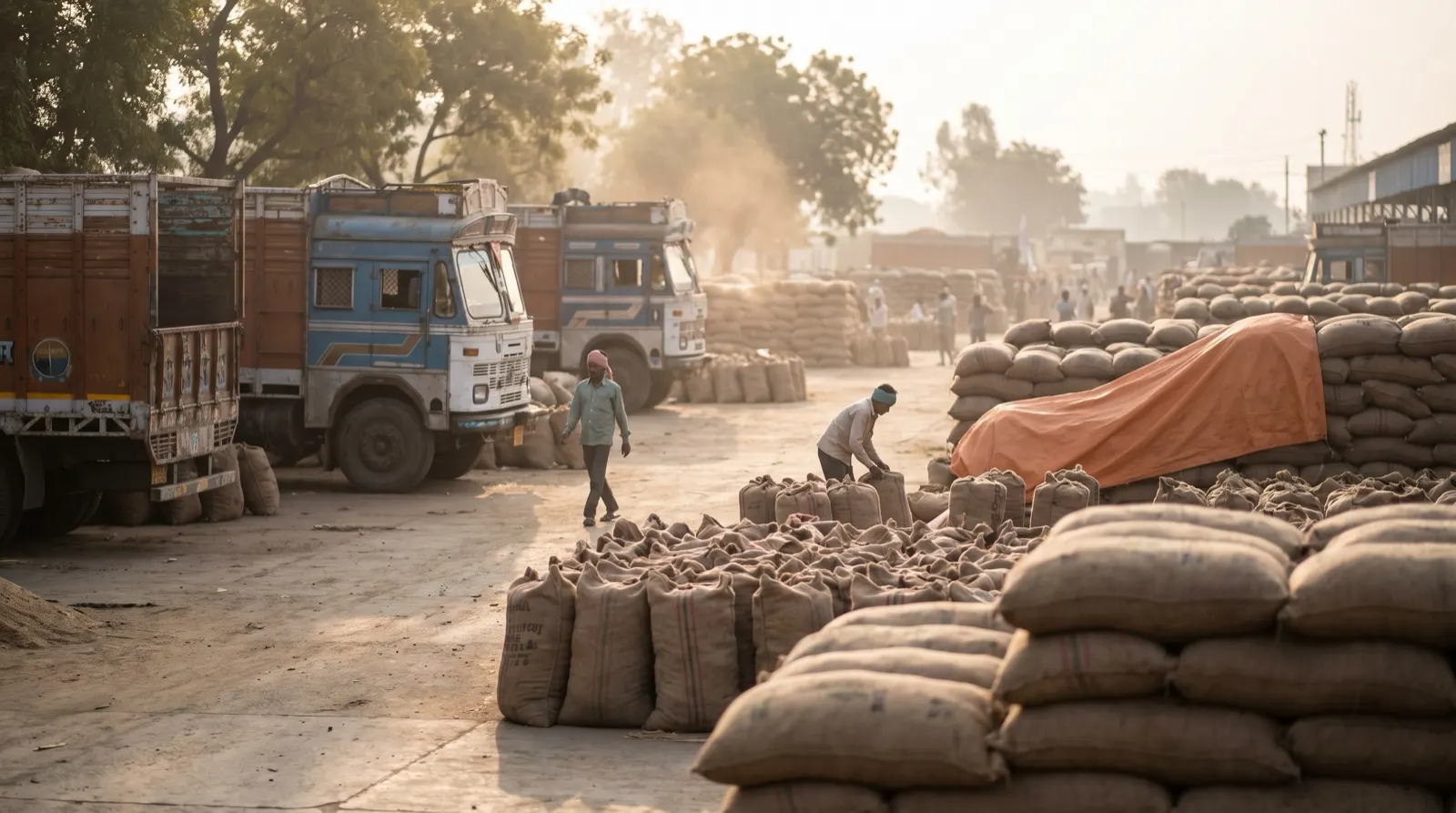
Forty bags of wheat sit under a mandi shed in late April, dust hanging in the afternoon light. The buyer pushes a hollow probe into the nearest bag, pours a handful into his palm, rubs it and sniffs it. The grain is plump and amber. He names a price. Two days later the mill rings: one bag near the bottom of the stack held mud clods and chana, and the lot failed intake.
Our view on how to check wheat quality is simple: it is mostly a question of how you take the sample, and only then a question of what you measure. A sieve set, a lab or a phone-based wheat quality analyzer will all give a confident wrong answer if the grain in front of it does not represent the lot. The short version: draw small amounts from many bags, mix and divide them down to a working sample, read moisture with a meter, then separate foreign matter, other grains and damaged, shrivelled and broken grain by weight. Compare each against the spec you are buying on, such as FCI FAQ, and take a second sample whenever a result sits close to a limit.
The handful from one bag is not a sample
Wheat is not uniform inside a lot. Bags filled from the top of a heap differ from bags filled at the bottom, where dust and stones settle. A farmer may mix grain from two fields. A trader may top up a load from another source. None of that shows in the bag nearest the buyer.
A fair sample takes a little grain from many bags, spread across the stack: top, middle and bottom, front and back. For loose grain in a truck, draw from several points and several depths. Your procurement agency or contract may fix the exact number of bags to probe and the size of each draw. If it does, follow it. If it does not, write your own rule down and use it on every lot.
Mixing and dividing decide more than the sieve does
The draws from many bags make a large composite sample, often a few kilograms. Nobody grades all of it. It has to come down to a working sample of a few hundred grams or less, and the way it comes down matters.
The traditional method is coning and quartering. Pour the composite onto a clean sheet into a cone, flatten it, cut it into four, keep two opposite quarters and discard the other two. Repeat until the sample is the size you need. A mechanical divider does the same job more evenly. What you must not do is scoop the working sample off the top, because heavy stones and fine dust drift to the bottom and sides of a heap.
Moisture comes first, and only a meter can read it
Read moisture before the sample sits in the sun or under a fan for an hour. Grain dries as it waits, and a reading taken late flatters the lot. The FCI FAQ limit for wheat is 14% moisture.
No amount of looking, biting or rubbing tells you moisture to a percentage point. Wheat at 13% and wheat at 15% look the same on a tray. A calibrated moisture meter is the only practical check at the point of purchase, and the reading belongs on the slip with the rest of the result.
Defects are judged by weight against a written spec
Once moisture is recorded, the working sample is weighed and then separated by hand and with sieves. Foreign matter and other foodgrains are picked out. Damaged, slightly damaged, shrivelled and broken grains are separated. Each pile is weighed and expressed as a percentage of the sample weight.
| What you check | FCI FAQ limit | How it is usually checked |
|---|---|---|
| Moisture | ≤ 14% | Moisture meter, read first |
| Foreign matter (stones, straw, chaff) | ≤ 0.75% | Picked out and weighed |
| Other foodgrains (mustard, paddy, chana) | ≤ 2% | Picked out and weighed |
| Damaged grain | ≤ 2% | Visual inspection, then weighed |
| Slightly damaged grain | ≤ 4% | Visual inspection, then weighed |
| Shrivelled and broken grain | ≤ 6% | Sieving and visual inspection, then weighed |
Mills and exporters often apply their own intake or contract limits on top of FAQ. Whatever the spec, write it as a table everyone at the gate can see. A limit that lives only in one grader's head becomes an argument the first time two people disagree.
A note on scale: a 50 g working sample at the 0.75% foreign matter limit allows just 0.375 g of stones and straw. That is a few small pebbles. A kitchen scale that reads in whole grams cannot tell a pass from a fail at that size, so use one that reads to at least a hundredth of a gram.
One bad bag in ten can fail a whole lot
Here is an illustrative example with simple numbers, not a measured result. Say a lot has 200 bags of 50 kg each, so 10,000 kg in all. Most bags are clean: 180 bags carry 0.4% foreign matter. Twenty bags, one in ten, came from a different heap and carry 4%.
The clean bags hold 180 × 50 × 0.004 = 36 kg of foreign matter. The dirty bags hold 20 × 50 × 0.04 = 40 kg. The lot holds 76 kg in 10,000 kg, which is 0.76%. That is just over the 0.75% FAQ limit.
A buyer who probes only the front row, all clean bags, reads 0.4% and pays for a lot that fails. A buyer who probes bags spread across the stack has a fair chance of catching some of the dirty bags and seeing a number close to the limit. Close to the limit is exactly the moment to draw a second sample before agreeing a price.
The sieve can only judge the grain you give it. The lot is decided when you choose which bags to open.
A result is only useful if it is written down with its range
Picture the after. The buyer walks the stack with a probe and a written rule for which bags to draw. The composite is quartered on a clean sheet. Moisture is read within minutes. The defect percentages go on a slip next to the limits, the seller sees the same numbers, and a borderline lot goes for a second sample instead of a shouting match.
Every method has error, so a result near a limit should be shown with how far it could be off. This is the idea behind the photo-based tool we are building. GrainGrade is in development, with grain counting built and measured. It is designed to coach the photo before analysis, refuse a bad one with a reason in Hindi or English, show every number with a range, take moisture from a meter reading, and save each sample to its lot. It does not replace good sampling. A photo of a badly drawn sample is still a badly drawn sample.
The case for the experienced hand
The strongest objection is that experienced buyers have checked wheat by hand for generations, and they are good at it. A grader with twenty seasons behind him can spot shrivelled grain, smell mustiness and feel damp wheat faster than any procedure. Writing down sampling rules can feel like paperwork for its own sake.
We agree that the trained eye is valuable, and we would not take it out of the gate. The trouble is that experience does not travel. It varies between people and between shifts, and it leaves no record when a seller disputes a value cut. A written sampling rule, a meter reading and weighed percentages give that experience something to stand on. Grading terms and value cuts are commercial decisions, so confirm your own rules with your quality and legal advisers.
What to do this week
- Write down how many bags you probe per lot and where in the stack they come from.
- Quarter the composite on a clean sheet for every lot, and stop scooping from the top.
- Check that your moisture meter is calibrated and that every lot gets a reading on its slip.
- Replace any whole-gram scale at the gate with one that reads to 0.01 g.
- Agree a borderline band around each limit where a second sample is drawn automatically.
For each FAQ limit and how disputes arise, read FCI FAQ wheat specification explained. For running the same checks at a mill, see wheat intake at the mill gate, and the full parameter list is in wheat quality parameters. The GrainGrade guides page has the rest. Checking wheat well is calm, repeatable work. Most of it happens before the first grain touches a sieve.