

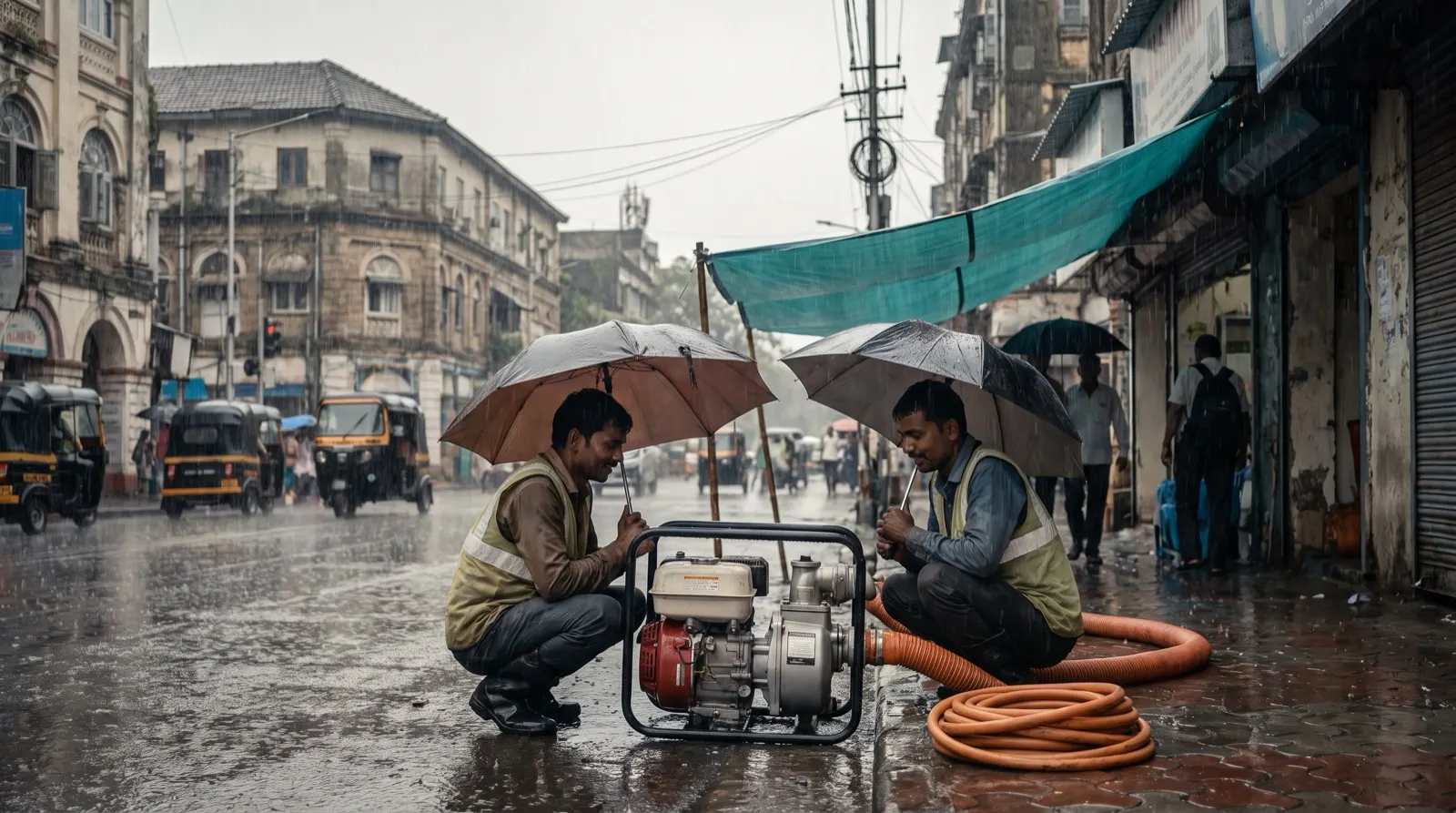
It is 8:15 on a wet Monday at a ward office. Two register entries describe the same blocked drain under different addresses. A photo of knee-deep water sits on the clerk's personal phone, and a shopkeeper calls a third time.
A complaint management system for a municipal corporation is not a portal that stores grievances; it is a promise that every complaint reaches one owner, at one place on the network, and closes with proof the citizen can see.
In practice that means six things: intake on WhatsApp, the helpline and the web; location to the asset, such as the drain segment; grouping of duplicates; one owner and an ETA; a closing photo; and a review by ward. That is how our flood control room software for cities treats drainage and waterlogging complaints, and the rest of this post explains why each item matters.
The test is the street, not the dashboard
Many corporations already have a grievance portal, a call centre and an app. The numbers on the dashboard look fine: complaints received, complaints closed, average days. Yet the same streets flood every July and the same residents stop calling.
The gap is usually not software. It is that a complaint is filed against a ward or a department, not against the thing that is broken. A ticket that says "Ward 14, drainage" cannot be routed, grouped or proven. A ticket that says "drain segment behind the bus depot, photo attached" can.
| Must do | What it looks like on the ground | Why it matters |
|---|---|---|
| Take complaints where citizens already are | One WhatsApp number, the helpline and a web form feed one queue | Nobody has to learn a new app in the rain |
| Locate to the asset | The photo or pin is matched to the drain segment, not just the ward | Routing and repeat analysis need a place, not a postcode |
| Group duplicates | Ten reports of one blocked drain become one ticket with ten citizens on it | Crews go once; counts stop lying |
| Name one owner and an ETA | The nearest crew with the right equipment is assigned and the time shared | A ticket without an owner is a wish |
| Close with a photo | The crew sends a geotagged after photo to the citizen on the same chat | Closure is something the citizen sees, not a status change |
| Review by ward every morning | Open tickets and acknowledgement times ranked by ward | The commissioner sees where the system is failing, early |
Intake belongs on WhatsApp, the helpline and the web, in one queue
Citizens in Indian cities already send photos on WhatsApp. Older residents call. Resident welfare associations email or use the web. A system that accepts only one of these will lose the others to personal phones and paper.
The rule we push for is one queue. Whatever the channel, the complaint becomes the same kind of ticket with the same fields. If a councillor forwards a photo, it goes into that queue too, not into a side conversation with the executive engineer. Our playbook for a WhatsApp civic complaint desk covers the number, the opening message and the confirmation question in detail.
A complaint without a location on the network cannot be routed or proven
Ward is too coarse. A ward can hold forty drain segments, three pumping points and two underpasses. The crew needs to know which one, and the engineer needs to know whether the same segment has failed four times this season.
So the system should take the GPS from the photo or the pin, match it to the nearest asset on the drainage layer, and ask the citizen one short question if it is unclear. Once complaints sit on segments, the pattern shows itself. The segment with nine complaints in a week is not a citizen problem. It is a desilting or capacity problem.
A worked example: what grouping does to one evening's queue
Here is an illustrative case with simple numbers; it is not a customer result. Say a ward receives 60 waterlogging complaints between 6 pm and 9 pm on a heavy-rain evening. Once each is located, they fall on 15 drain segments.
Without grouping, the ward has 60 tickets. If each crew visit takes 40 minutes including travel, that is 60 × 40 = 2,400 minutes, or 40 crew-hours of work on paper. With four crews, the last ticket is reached after ten hours, long after the water has gone.
With grouping, the same evening holds 15 tickets. Fifteen visits at 40 minutes is 600 minutes, or 10 crew-hours. Four crews split it as 4, 4, 4 and 3 visits, so the list is clear in 4 × 40 = 160 minutes, under three hours, inside the evening. Every one of the 60 citizens still gets the ETA and the closing photo, because they are attached to the ticket for their segment.
Sixty complaints about fifteen drains is not sixty jobs. A system that cannot tell the difference sends crews in circles and tells residents nothing.
The after picture is ordinary, and that is the point. The ward officer opens the queue at 9 pm and sees four open tickets, each with a crew and a time. The shopkeeper who called three times has a message with the crew's ETA, and later a photo of the cleared grate.
An owner, an ETA and a closing photo are the whole promise
Citizens rarely expect instant repair. They expect to know that someone has it, and when they will come. The nearest crew with the right equipment should be assigned, and that ETA should go back on the same channel the complaint came in on.
Closure should be a geotagged after photo, sent to the citizen and kept on the ticket. A status that says "resolved" with no photo is the root of most repeat complaints. The citizen looks out of the window, sees water, and calls again. For the same logic applied to drain cleaning, see desilting proof of work with photos, not registers.
A good benchmark from central government is CPGRAMS, the Centralized Public Grievance Redress and Monitoring System, where a citizen can track a grievance with a registration ID and appeal if unsatisfied with the outcome. A city's own system should offer at least that much: a number to track, and a way to say "this is not fixed".
The strongest objection: we already have a grievance portal
This is fair. Many corporations and smart city teams have spent years on portals, call centres and command centres, and nobody wants a second system that splits the record again.
Our answer is that the six tests above are a checklist, not a product pitch. Run your current system against them. If it already locates complaints to the drain segment, groups duplicates and closes with a photo the citizen receives, keep it. If it stores complaints by department and closes them with a status change, the gap is real, and it shows up on the street every monsoon.
Where the gap is in drainage and waterlogging, we start there. In CityWatch those complaints come in on WhatsApp, the helpline and the web, and become tickets located to the drain segment with duplicates grouped. After the monsoon, the same record extends to waste, roads and water supply, rather than adding a new portal for each department.
The morning review should rank wards, not count tickets
Totals hide failure. A city that closed 900 complaints yesterday may still have one ward where nothing was acknowledged for two days. The morning view should rank wards by open tickets and acknowledgement time, so the commissioner's first question lands on the right desk.
That same record answers the harder questions later: which segments failed repeatedly, which crews were sent where, and how long citizens waited. More checklists and playbooks for ward teams are on the CityWatch guides page.
What to do this week
- Pull last monsoon's waterlogging complaints and count how many name a specific drain, junction or underpass rather than just a ward.
- Take one heavy-rain evening and group its complaints by location by hand; compare the ticket count with the grouped count.
- Check whether citizens get an ETA and a closing photo on the channel they used. Ask five of them.
- Agree that every channel, including councillor forwards, feeds one queue with one owner per ticket.
- Start a morning review that ranks wards by open tickets and acknowledgement time.
A complaint system earns trust slowly, one drain and one photo at a time. Get the six basics right on drainage this season, and the citizen with the WhatsApp photo stops being a caller and starts being an early warning.