

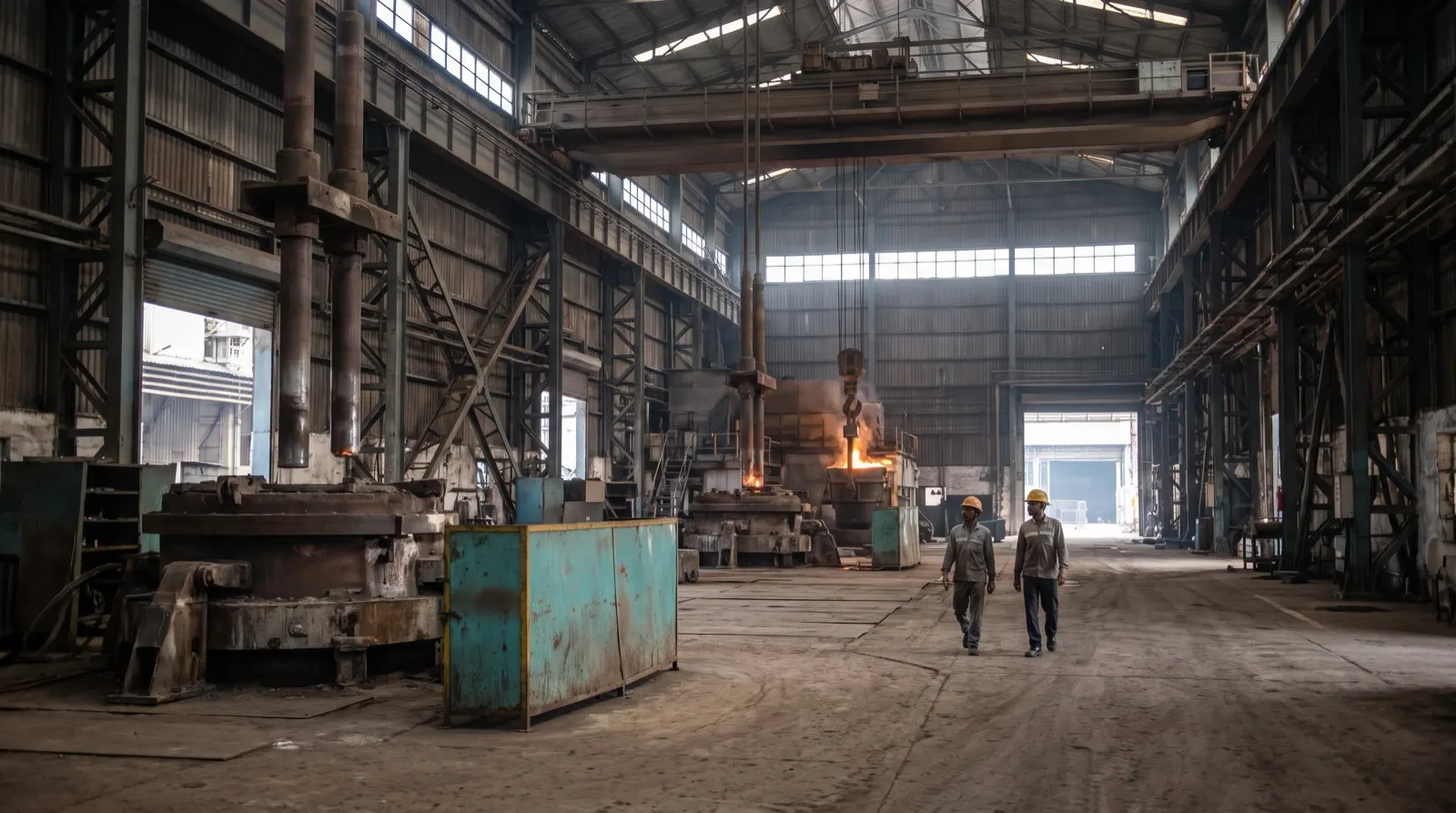
The lab sheet comes back at 2:40 am. Tapped slag basicity is 0.66 against a target of 0.75, for the third tap running. The furnace in-charge knows the fix is more dolomite in the batch. The question is how much. Last month someone added a full bag extra, the slag went stiff, and the tap after that took twice as long to clear.
Our view: the flux addition is a calculation, not a feel, and it takes five numbers you already have. Multiply the silica that actually reaches the slag by the target ratio, subtract the base oxides already coming in, and divide by the useful fraction of the flux. That is the whole method. A furnace digital twin runs the same balance every heat, but the arithmetic is worth doing by hand first so you know what the model is doing.
The ratio you control has to be named before the flux can be calculated
Basicity has more than one definition. Binary basicity is CaO divided by SiO2. Ternary adds MgO to the top. Quaternary also adds Al2O3 to the bottom. The same slag gives a different number in each form, which our slag basicity guide works through with a sample analysis.
Pick the form that matches your flux. If the plant adds dolomite, MgO is a large part of what the flux brings, so a CaO-only ratio will hide half its effect. In that case ternary basicity, (CaO + MgO) / SiO2, is the honest target. If alumina from ore or coke ash swings from lot to lot, the quaternary form is safer. Write the chosen form on the shift sheet so the lab, the in-charge and the plant head mean the same thing.
Five numbers decide the flux, and four of them are in your assays
For a target ratio R, the flux needed per batch is:
Flux (kg) = (R × acid oxides to slag − base oxides already charged) ÷ (base fraction of flux − R × acid fraction of flux)
The inputs are simple:
- Acid oxides to slag: SiO2 (and Al2O3, if you use the quaternary form) from ore, reductant ash and quartzite, in kg per batch.
- Base oxides already charged: CaO and MgO that arrive with the ore and reductant before any flux.
- Base fraction of flux: CaO plus MgO in the flux, from its assay, as a fraction.
- Acid fraction of flux: the silica the flux itself carries. Small, but it counts against you.
- Target R: the ratio your process and ore call for.
The bottom line of the formula is why flux quality matters. A dolomite lot with more silica does less work per kilogram, so the same bag count gives a lower basicity.
Silica that goes into the metal does not count
This is the step most hand calculations skip. In silicomanganese, ferrosilicon and similar alloys, part of the charged silica is reduced to silicon and leaves in the metal. Only what remains reaches the slag. If you divide by all the silica charged, you will overdose flux every time.
The fraction that goes to metal comes from your own balance: silicon in the tapped metal, converted back to SiO2, compared with SiO2 charged. It is not fixed. It moves with temperature, reductant and basicity itself, which is why a one-off number from an old trial drifts out of date. Our guide to mass and energy balance for a smelting furnace shows how to trace each tonne of charge to metal, slag and gas.
A worked example, with illustrative numbers
These numbers are illustrative only. They are not from any plant and not a recommended recipe.
Say a silicomanganese batch carries 1,000 kg of ore at 8% SiO2, 2% CaO and 1% MgO, plus 300 kg of coke at 12% ash with half the ash as silica, plus 100 kg of quartzite at 97% SiO2. The target is ternary basicity of 0.75, and the flux is dolomite at 30% CaO, 20% MgO and 2% SiO2. To keep the sums short, we ignore the small CaO and MgO in the coke ash.
| Step | Arithmetic | Result |
|---|---|---|
| SiO2 charged | 80 (ore) + 18 (coke ash) + 97 (quartzite) | 195 kg |
| SiO2 to metal (assume 40% from your own balance) | 195 × 0.40 | 78 kg |
| SiO2 to slag | 195 − 78 | 117 kg |
| CaO + MgO already charged | 20 + 10 | 30 kg |
| Base oxides needed | 0.75 × 117 | 87.75 kg |
| Useful fraction of dolomite | 0.50 − (0.75 × 0.02) | 0.485 |
| Dolomite per batch | (87.75 − 30) ÷ 0.485 | about 119 kg |
Check it: 119 kg of dolomite brings 59.5 kg of base oxides and 2.4 kg of silica. Base becomes 89.5 kg, acid becomes 119.4 kg, and 89.5 ÷ 119.4 = 0.75.
Now the ore lot changes and silica rises from 8% to 10%. That is 20 kg more SiO2 charged, and with 40% going to metal, 12 kg more reaching the slag. Keep 119 kg of dolomite and basicity falls to 89.5 ÷ 131.4, about 0.68. Rerun the formula and the batch needs (0.75 × 129 − 30) ÷ 0.485, about 138 kg. One assay change, about 19 kg more flux per batch, and a shift that keeps the old number runs low on basicity until someone notices.
The flux number is only as current as the last ore assay it was calculated from.
Senior operators already know the number, and they are often right
The strongest objection is fair. An experienced in-charge who has run the same furnace on the same mine's ore for years usually lands close to the right flux without a formula. Their eye on the tap stream and the slag colour is real information that no assay sheet holds.
The trouble is that the habit is calibrated to one ore, one coke and one silica-to-metal fraction. When the lot changes, or that operator is on leave, the habit has nothing to adjust from. The formula does not replace their judgement. It gives the night shift the same starting point, and it makes a disagreement easy to settle: either an input is wrong or the target is. Writing it down is also the first step in capturing furnace operator knowledge before it leaves the plant.
Hand calculation sets the dose; a model shows the trade-off
The formula answers one question: how much flux hits the ratio. It does not tell you what the new slag does to viscosity, to metal lost in slag, or to specific energy. More flux is more slag to melt, and that costs power. Lower basicity can leave more manganese or chrome in the slag.
That is where a calibrated model earns its place. Furnace Twin computes basicity, viscosity and how much metal is co-reduced from thermodynamics, and compares basicity, reductant and feed changes side by side, so a new flux target can be screened before it reaches a real heat. The hand calculation stays useful as a check on what the model suggests.
What to do this week
- Agree on one basicity form for the plant and write it on the shift sheet.
- Collect the latest assays for ore, coke ash, quartzite and flux in one place.
- Work out your own silica-to-metal fraction from recent tap analyses.
- Put the formula in a shared sheet and recalculate the flux every time an assay changes.
- Compare the calculated flux with what the shift actually charged on the last ten taps.
More on slag, energy and models is on the Furnace Twin guides page. Once the flux number comes from the assay rather than memory, a low-basicity tap at 2:40 am becomes a quick recalculation instead of a guess.