

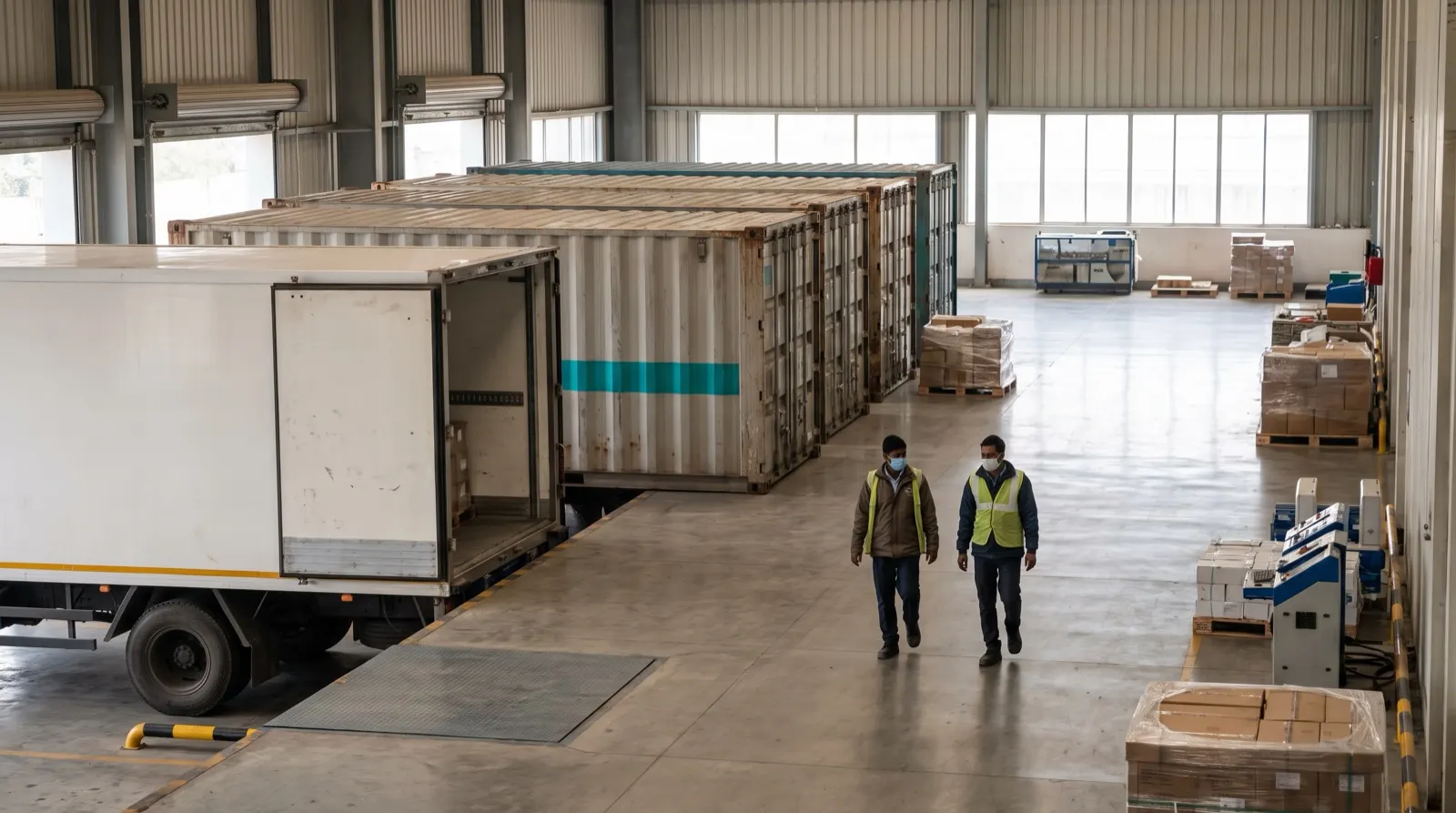
The QA head at a biotech in Hyderabad has a new product on the launch plan, and the draft label says store at −70 °C or below. Her team has run 2–8 °C shipments for years, with reefer trucks, gel packs and a logger in every carton. Someone in the review meeting says the cold chain is already in place. She is not sure it is, and she is right to doubt it.
An ultra cold chain is the storage, packing, transport and records that keep a product at roughly −60 °C to −80 °C from the dispatch freezer to the receiving freezer, and it differs from an ordinary cold chain less in degrees than in how little room it leaves to recover. Running one well takes ultra cold chain monitoring that sees drift and dry-ice cover while the box is still on the road, not a logger read after delivery.
Ultra cold chain means −60 °C to −80 °C, usually on dry ice
In plain terms, a cold chain covers any product that has to stay inside a temperature range for its whole journey. The ultra cold chain is the deep end of that range. Product is held in ultra-low freezers at both ends, often set near −80 °C, and travels in between in insulated shippers packed with dry ice.
Dry ice is the reason the band sits where it does. It sublimes at about −78.5 °C at normal pressure, so a well-packed shipper settles close to that temperature with no power supply at all. Colder still is the cryogenic chain, which uses liquid nitrogen for material such as cell therapies.
| Chain | Typical band | Cooling in transit | What failure looks like |
|---|---|---|---|
| Standard cold chain | 2 °C to 8 °C | Reefer truck, or a passive box with gel packs | Warming over hours; a unit fault can often be fixed on the road |
| Frozen | Around −20 °C | Freezer truck or passive box | A slower thaw, with product-specific limits |
| Ultra cold | About −60 °C to −80 °C | Dry ice in an insulated shipper | A fast climb once the ice is gone |
| Cryogenic | Far below −100 °C | Liquid nitrogen dry shipper | A specialist chain, outside the scope of this post |
Treat these bands as orientation, not specification. The product's label and stability data set the real limits, and your QA and regulatory advisers should confirm them.
The difference is recovery time, not the number on the thermometer
A 2–8 °C team is used to problems that can be fixed. A reefer alarm goes off, the driver pulls over, a technician resets the unit, and the load is back in band within the hour. The trace shows a blip and a recovery.
The ultra cold chain has no compressor to reset. Its cooling is a consumable that runs out. Once the dry ice is gone, the only fix is more dry ice, and it has to be physically present at the next hub. The fix is hours away while the problem moves in minutes.
So the ultra cold chain behaves less like a temperature problem and more like a fuel problem. You plan the ice for the lane, you watch how much cover is left, and you act on the forecast rather than the reading.
One illustrative lane shows why the forecast beats the reading
The numbers here are illustrative, picked to keep the arithmetic easy. They do not describe any real product, shipper or lane.
Say a 2–8 °C load sits at 5 °C and its reefer unit fails. It warms at 1 °C every 30 minutes. The upper limit of 8 °C is 3 degrees away, so the team has 3 × 30 = 90 minutes. A technician 45 minutes away fixes it with 45 minutes to spare.
Now say a −80 °C shipper runs out of dry ice on a hot afternoon road leg. It warms faster, at 1 °C every 10 minutes, because the gap between the product and the outside air is far larger. The hard limit is −58 °C, 22 degrees away, so the team has 22 × 10 = 220 minutes. That sounds like more time. But the nearest hub with dry ice is 4 hours, or 240 minutes, down the road.
| 2–8 °C load | −80 °C shipment | |
|---|---|---|
| Degrees to the limit | 8 − 5 = 3 | −58 − (−80) = 22 |
| Warming after failure | 1 °C per 30 min | 1 °C per 10 min |
| Time to the limit | 3 × 30 = 90 min | 22 × 10 = 220 min |
| Time to the fix | 45 min | 240 min |
| Acting on the reading | Saved, 45 min to spare | Lost, 20 min short |
Acting on the reading fails the ultra-cold shipment even with a fast team. Acting on the forecast saves it. If the system warns when ice cover falls to two hours, as UltraCold does, the top-up is booked before the temperature has moved at all. Our guide to dry-ice planning for ultra-cold shipments covers how to size the ice per lane so that warning rarely fires.
A 2–8 °C chain is managed by reading the temperature. An ultra cold chain is managed by reading what is left in the box.
In India, the ultra cold chain is mostly a road and handoff problem
Many Indian ultra-cold lanes are not a single flight between two airport freezers. They include a road leg to the airport, a cargo terminal, a second road leg and often a cross-dock in a city nobody on the team has visited. Each leg adds a handoff and a dwell, and each dwell eats dry ice.
Summer heat on long road legs shortens cover. Dry ice may not be on hand at every hub, so a top-up has to be booked in advance rather than assumed. Dry ice is also treated as a dangerous good in transport, so its paperwork travels with the box. Confirm the current rules for each mode with your logistics and regulatory advisers.
None of this is exotic. It means the ultra cold chain in India is won or lost at the handoffs, so seal checks and dwell times belong on the record at every one. Our step-by-step guide to shipping pharma product at −80 °C sets out the dispatch, transit and delivery checks in order.
Ultra cold chain monitoring has to watch four things, not one
A temperature logger answers one question: how cold was it? An ultra cold chain needs answers to four, while the shipment is still moving.
- Temperature against the band and the limits. Two loggers read live, so drift is seen early and one faulty device does not decide the outcome.
- Dry-ice cover. Hours of cooling left, set against the time to the next hub.
- Custody. Who held the box, whether the seal was intact, and how long it sat.
- Response. Whether anyone acknowledged the alert, and how fast.
Miss any one and the others cannot make up for it. A perfect trace with no custody record leaves an inspector asking who opened the box at the hub. A live alert that nobody acknowledges is a log entry, not a response.
The fair objection: the 2–8 °C system can stretch to cover it
The strongest pushback we hear is sensible. The team already has loggers, a monitoring dashboard and an SOP. Why not add a −80 °C probe and a dry-ice line to the checklist? Volumes may be small at first, and a separate setup for a handful of shipments feels like overkill.
For a pilot of a few shipments, with an experienced person watching every leg, that can work. Close personal attention covers a lot of gaps. The trouble arrives with the tenth lane and the first night shift. A 2–8 °C setup is built around excursions that develop slowly and can be fixed. It rarely tracks dry-ice cover, rarely forces a second signature at release, and rarely escalates past the first phone. Those are the exact gaps where ultra-cold shipments are lost.
Our view is to stretch the existing system for the pilot and write down every manual workaround. When the list of workarounds is longer than the SOP, the chain needs its own controls.
What to do this week
- For each ultra-cold product, write the band and hard limits from its label and stability data in one place.
- Map one lane leg by leg, with every handoff, dwell and the nearest dry-ice top-up point.
- Work out how many hours of cover your shipper holds and compare it with the longest gap between top-ups.
- Decide who acts when cover falls to two hours, and who they call if they cannot.
- Check that the dangerous-goods paperwork for dry ice is current for every mode on the lane.
An ultra cold chain is not a colder copy of the one you already run. Its cooling runs out, so the work moves from watching the thermometer to managing what is left. More on each step in the UltraCold guides.