

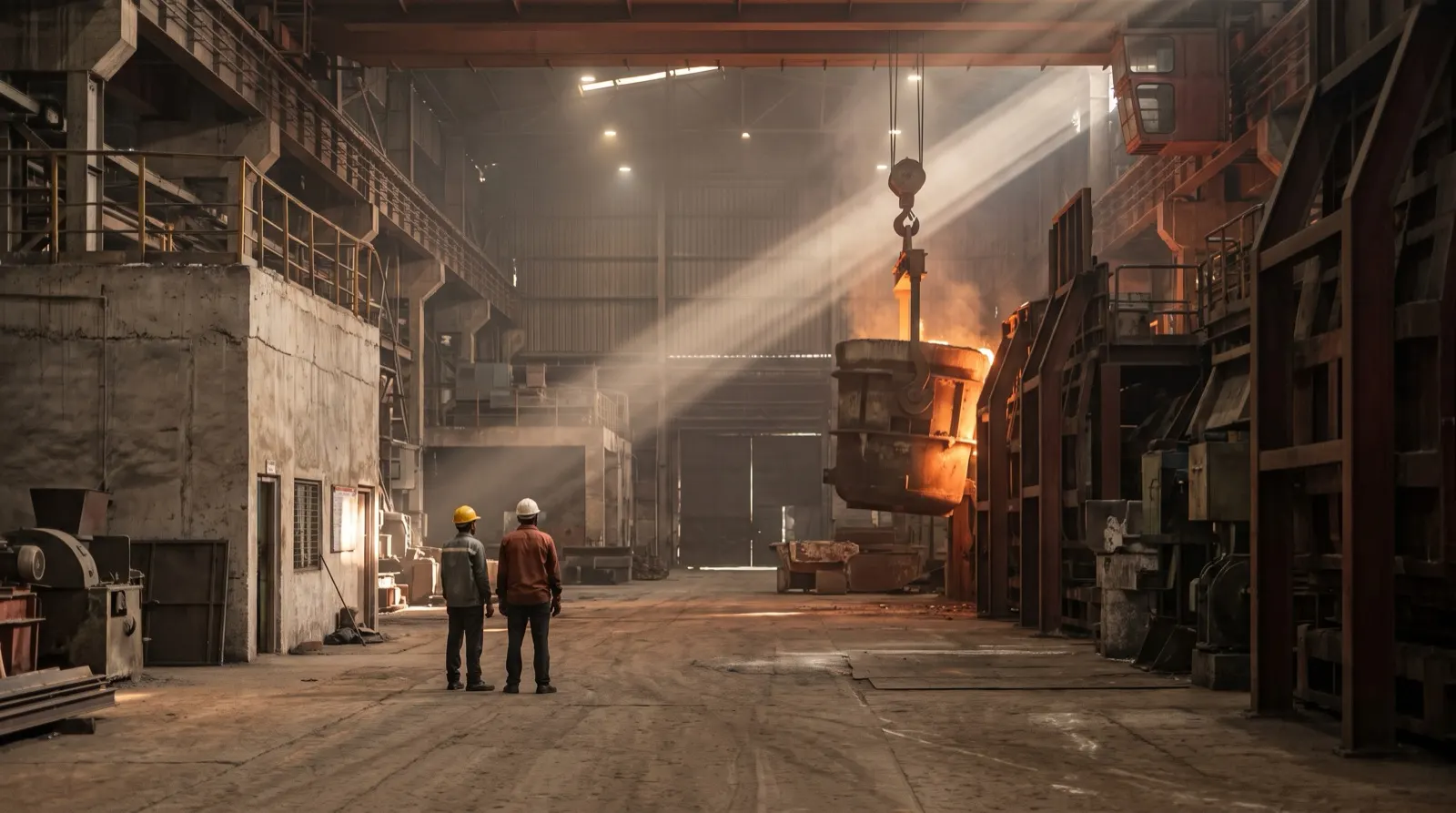
The morning meeting goes well for forty minutes. The converter reports its best tap-to-tap of the month. The caster reports sequence length on target. The mills report throughput up. Then dispatch speaks: an export order slipped because the caster broke sequence overnight, waiting on heats that arrived in the wrong grade order. Every shop was green. The plant was not.
Our argument is direct: in an integrated plant, margin is lost at the boundaries between shops, so decisions need one queue across the plant, ranked by what each problem costs.
Shop targets measure the links, not the chain
An integrated plant is a chain: blast furnace, converter, ladle, caster and mills. Each shop has targets, and most are measured well. Tap-to-tap time, sequence length and mill throughput are real numbers that matter.
The trouble is that each target rewards the shop for what it controls alone. A converter can hit tap-to-tap by sending whichever heat is ready, not the grade the caster needs next. That target is met on paper and missed in the plant.
The costliest problems sit on the boundaries
The information each shop needs about the others lives in different systems: process data in the historian, heat and slab genealogy in MES, chemistry and holds in LIMS, orders in ERP, asset health in EAM. Everything is measured, but in systems that do not share a clock. So each shop optimises the part it can see.
| What each shop sees | What it cannot see | What it costs the plant |
|---|---|---|
| Converter: its own tap-to-tap | Whether the caster needs this grade next | A heat that waits, or a sequence that breaks |
| Caster: its own sequence | A chemistry hold forming upstream | A slab cast that will be held at the gate |
| Quality: today’s holds | Which sales order each hold affects | A regrade decided without knowing the order at risk |
| Energy: yesterday’s report | Which unit and shift drifted | An overrun nobody could correct in time |
A broken sequence shows how the maths works
Here is an illustrative example with round numbers. It is not plant data or a customer result.
Say the converter saves 4 minutes on one heat by tapping out of grade order. Across a day that looks like progress. But the caster, casting about 150 tonnes an hour, has to break sequence and lose 45 minutes to turnaround. That is 0.75 × 150 = about 112 tonnes of casting time lost. At an illustrative contribution of ₹4,000 a tonne, the break costs around ₹4.5 lakh, before any delay penalty on the order.
The converter’s 4 minutes, valued the same way, might be worth a few thousand rupees. The shop report shows a gain. The plant books a loss roughly a hundred times larger, and it appears in nobody’s shop numbers, because the cost landed one boundary downstream.
Now look at the same night as a queue. Three items need attention: a converter delay worth perhaps ₹40,000, an energy variance worth ₹1.2 lakh, and a chemistry hold on a heat tied to an export order worth ₹6 lakh at risk. If the order of attention follows whichever shop calls loudest, the hold waits. If it follows rupees, the hold goes first.
A shop target met by handing the next shop a problem was never really met.
One queue, ranked in rupees, not in volume
The fix we argue for is not another dashboard per shop. It is one ranked list of what needs a decision, across the plant. In Steel Twin, every heat is traced from charge to coil, joined on heat_id across MES, LIMS, ERP and the historian, with its grade, sales order, route, chemistry and stage attached.
Holds, constraints and energy variances are ranked by cost and urgency in one action queue. Each hold shows its options, such as re-treat or regrade, priced against the order it affects. Alerts reach the shift controller while the shift can still act, and one tap logs the decision to the genealogy. That is how a controller makes a plant call instead of a shop call.
The case for keeping shops on their own numbers
The strongest objection is accountability. Shop heads can control their own shop. Judge them on a plant-wide number and every failure becomes someone else’s fault. Clear shop targets have built real discipline in many plants, and nobody should throw that away.
We agree, and we would not stop tracking tap-to-tap or sequence length. The point is that shop numbers are inputs to a plant decision, not the decision itself. Keep them. Add one shared queue where boundary problems are visible, priced and owned, so the shift has a way to make the trade-off that no single shop target can.
Start at the boundary that causes the most blame
Pick the boundary where problems are most often blamed on the other side. In most plants that is steelmaking to casting. Join the heats across it on one key, put holds and sequence risks for both shops in one queue with a cost on each, and review the queue in the shift, not the next morning.
That order matches how Steel Twin is delivered: MES, LIMS and the historian joined for one shop first, then the heat queue and action queue in daily use, then energy, asset health and iron-making, then mills and dispatch.
What to do this week
- List the last ten order delays and mark which shop boundary each one started at.
- Check whether heats can be joined across MES, LIMS and ERP on one heat number today, or only by hand.
- For tonight’s open holds, write the sales order and rupee exposure next to each.
- In one shift meeting, rank open issues by cost instead of by shop, and see what moves to the top.
For how heats are traced end to end, read heat genealogy in steel plants, and for how a twin control room differs from MES, see steel plant MES vs a digital twin control room. More is on the Steel Twin guides page. A plant is paid for coils that ship, not for shops that finished first.