

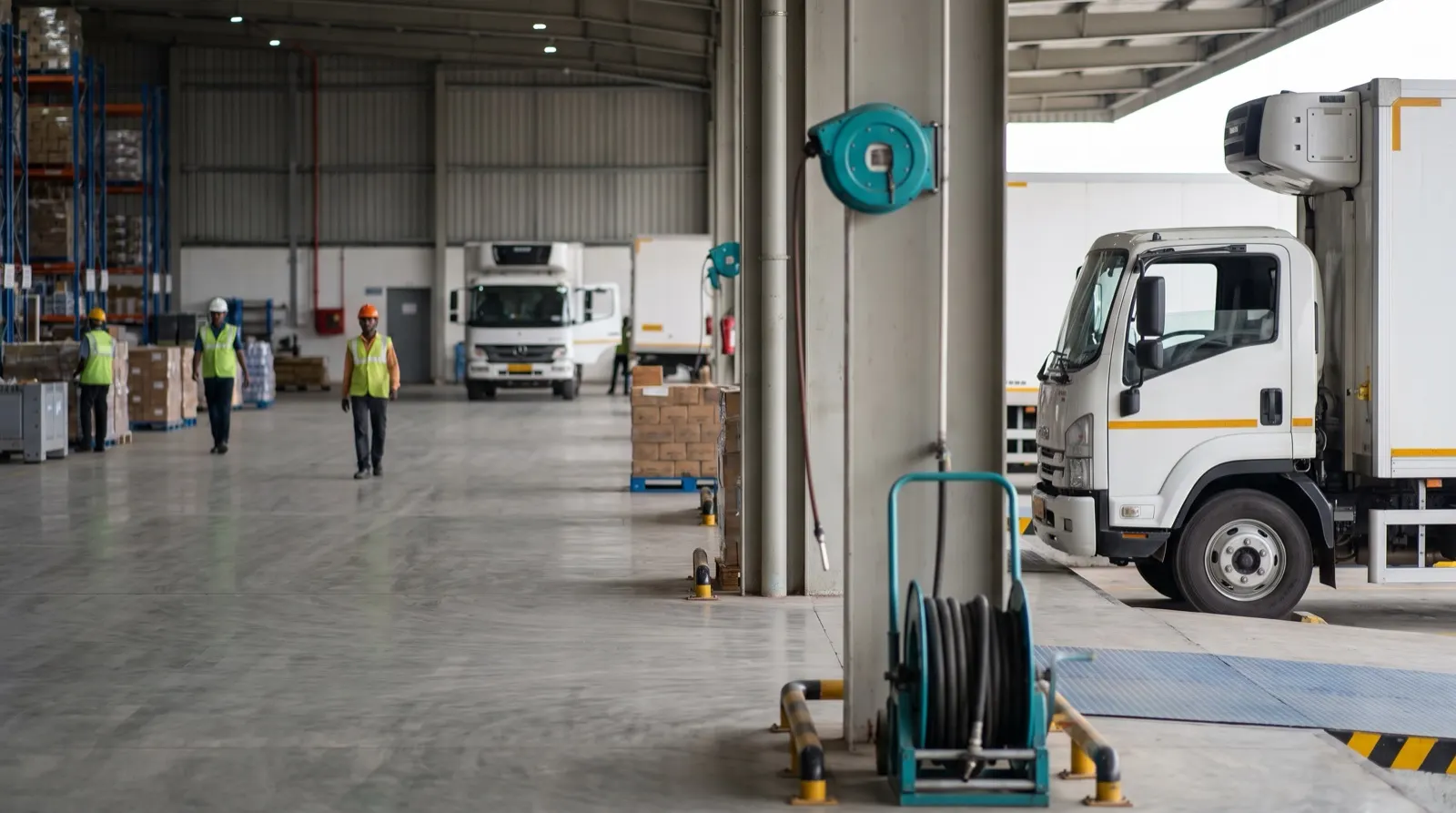
At 7 am there are eleven trucks parked on the service road outside the plant. Two drivers are asleep in their cabins, one is arguing with the security guard, and the dispatch supervisor is on the phone asking the gate whether the Pune truck has come in yet. The gate register says it arrived at “7-ish”. Nobody knows which dock it is waiting for.
Most Indian plants that think they need a yard management system first need a gate that timestamps every stage of a truck’s visit, because you cannot manage a yard you have not measured.
A YMS solves a specific, large-site problem
A yard management system tracks trailers and trucks inside a large yard: where each one is parked, which dock it should move to, when it is due, and who moves it. It shines at sites with many docks, pools of parked trailers, appointment scheduling and dedicated yard tractors shuttling between parking and docks.
Many manufacturing plants in India look different. Trucks arrive with their own drivers, wait outside the gate rather than in a managed yard, and load at a handful of docks. The yard, such as it is, is often the road. The pain is real, but its cause is usually somewhere a YMS does not look.
The gate register hides where the time goes
A paper or spreadsheet gate register usually records two moments: in and out. The difference is called turnaround time, and it is the number everyone argues about. Two stamps cannot tell you why it is long.
A truck’s visit has more stages than that. It arrives outside, is let in after document and safety checks, waits for a dock, starts loading, finishes loading, gets its papers and leaves. Each gap between two stages has a different owner: security, the dock planner, the loading crew, the dispatch desk. Our guide to plant gate turnaround time walks through the stages in detail.
A worked example: where five hours went
Here is an illustrative plant, not a customer’s. Say 30 trucks a day are loaded, and the average gate-in to gate-out time is reported as 3 hours. Once every stage is stamped for a fortnight, the averages look like this.
| Stage gap | Average | Owner |
|---|---|---|
| Arrived outside → let in | 2.0 h | Security, document checks |
| Inside → at dock | 1.2 h | Dock planning |
| At dock → loaded | 1.3 h | Loading crew |
| Loaded → gate out | 0.5 h | Dispatch paperwork |
| Total visit | 5.0 h |
The register said 3 hours because it started the clock at gate-in: 1.2 + 1.3 + 0.5 = 3.0. The real visit was 5.0 hours, and the largest single block, 2 hours, happened before the truck was even inside. Across 30 trucks that is 30 × 2.0 = 60 truck-hours a day spent waiting on the road.
Now the remedy is visible. The outside wait is mostly documents and safety checks done one truck at a time, plus trucks arriving before a dock is free. A YMS would track where those trucks are parked. A better gate would shorten the check and stagger arrivals.
A turnaround number that starts at gate-in leaves out the hours the truck spent on the road outside, which is often the biggest block of all.
What a better gate actually means
- Eight stamps, not two. Arrival outside, inside, at dock, loading started, loaded, gate out, and the unloading and completion stamps at the far end.
- One tap per hop. The supervisor stamps each stage on a handheld, with photos, the loading sheet and a safety checklist attached.
- A live dock board. Every vehicle inside the plant and the next free dock, visible to the dispatch desk.
- Norms by operation type. Loading, unloading, customer pickup and export each get their own dwell norm.
- Bottleneck views. Dwell turned into a funnel and a congestion heatmap by plant, shift and hour.
This is how the gate module of SCM for Manufacturers works, and it is the part of our product already live in production. If you later add camera-based number plate reads or RFID at the gate, our note on ANPR and RFID gate integration covers how those plug into the same stamps.
Where a dedicated YMS is the right call
We would not talk a buyer out of a YMS when the site genuinely needs one. Large distribution centres with dozens of docks, drop-trailer operations where trailers are parked without tractors, and sites that run yard tractors to shuttle trailers all have problems a gate log cannot solve. They need slot booking, parking-location tracking and move tasks for yard drivers.
Even then, the gate stamps come first. A YMS assigns docks and parking spots well, but it relies on accurate arrival and departure events. Sites that buy a YMS before fixing gate capture often find the yard map is only as current as the last manual update.
Measure first, then decide what to buy
A fortnight of stage-level stamps tells you which kind of problem you have. If most of the time is outside the gate, the fix is check-in speed and arrival scheduling. If it is between inside and dock, the fix is dock planning, which a dock board may handle. If trucks and trailers are piling up in a large internal yard, a YMS earns its cost.
The measurement also settles arguments that otherwise run for months. Security stops being blamed for slow loading, and the loading crew stops being blamed for a dock that was never assigned.
What to do this week
- Ask the gate to note the time each truck arrives outside, not only when it enters.
- Stamp at-dock and loading-complete times by hand for one shift and compare them with the register.
- Split one day’s visits into the four stage gaps above and name the owner of the largest.
- Only then list what a YMS would add that a stamped gate and a dock board would not.
Whatever you decide, decide it on measured stages, not on the length of the queue at 7 am. More guides on plant logistics are in our SCM for Manufacturers guides.