01Hand-built files
The file assembles itself.
- Statements, GST, ITR, bureau and account-aggregator data in one place
- The same calculations for every analyst
Analyst time down by half

CommercialAutoCredit · loan file, credit memo & field verification
AutoCredit is credit appraisal software for the credit and operations teams at banks and NBFCs. Statements, GST returns, ITRs, bureau and account-aggregator data assembled into one file; a memo drafted against your policy bands with every line cited; field verification filed the same day. Credit officers decide — faster, and with the evidence in front of them.
WhySound familiar?
From credit heads, credit officers and operations teams at lenders. Composite quotes from discovery calls — the problems are real; the names are left out.

“Our analysts spend two days building a file.”
Statements, GST and ITRs are collected over email and spread into spreadsheets by hand.
Credit headSlow sanction TAT
“Every analyst writes the memo differently.”
Committees read uneven notes and ask the same questions every week.
Credit committee memberUneven credit notes
“The field report arrives three days after the visit.”
Photos sit on a phone; the file waits.
Operations managerFiles stuck on verification
HowWhat changes with AutoCredit
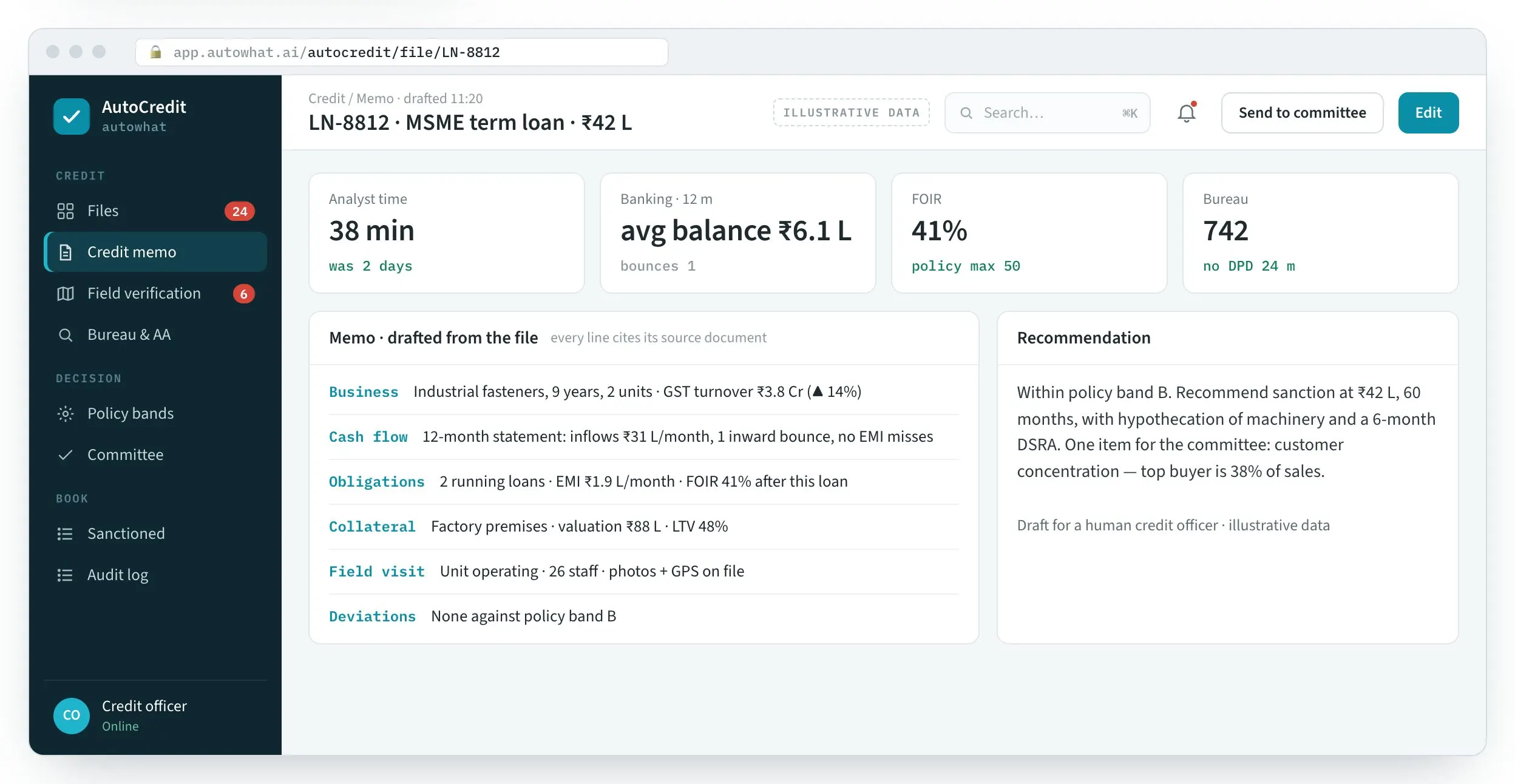
Product screens with illustrative data. In a working session we draft memos from your anonymised files.
01Hand-built files
Analyst time down by half
02Uneven memos
Committees read the same format

03Late field reports
No file waits on a visit

FieldAutoCredit in the field
The workplace it runs in, the person who uses it on a phone, the team at the desk and the detail it reads.


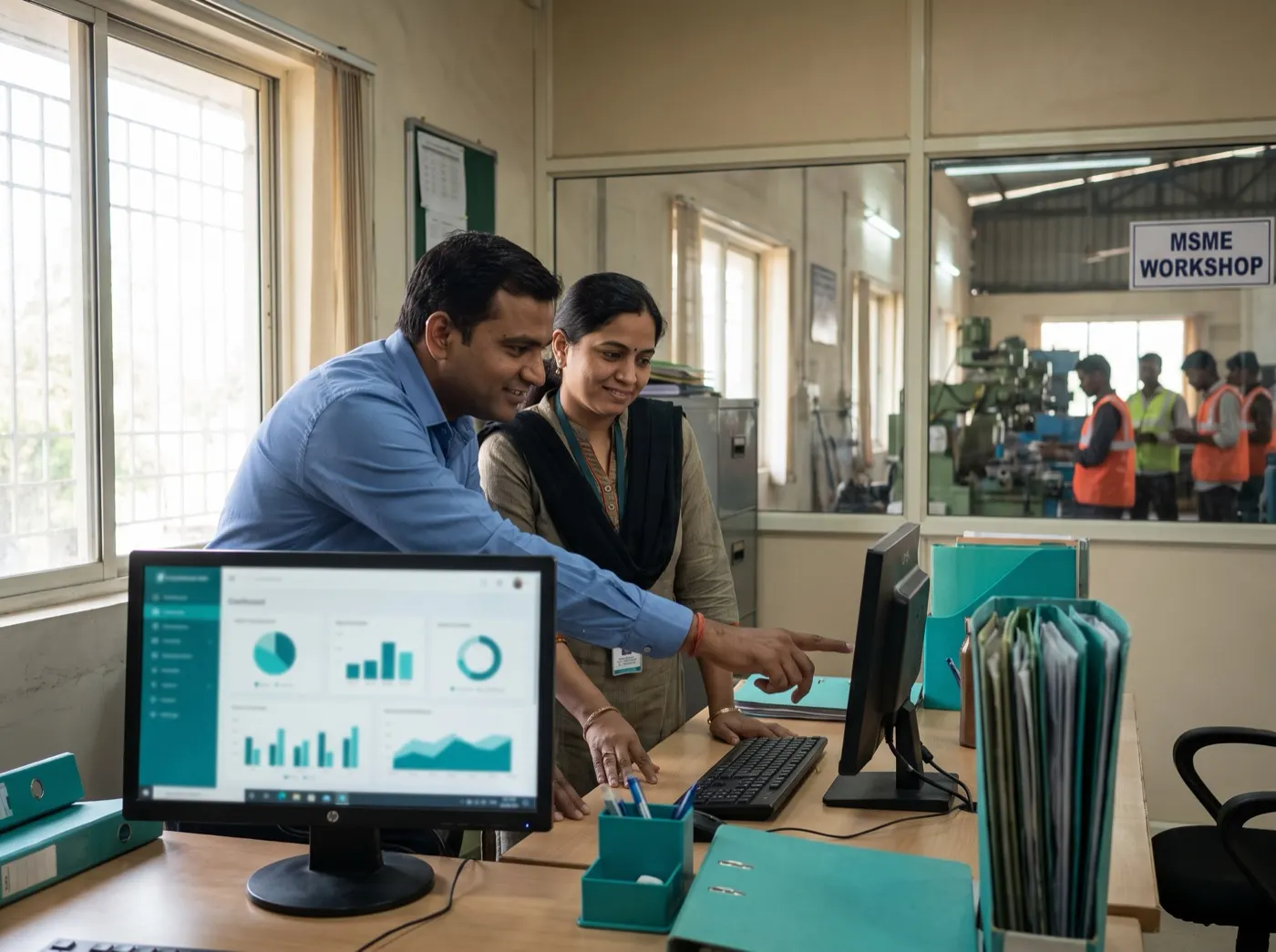

Photographs are illustrative — real customer sites are not shown.
01The screens
The memo, the file queue and field verification.
A memo drafted from the file against policy, with a recommendation for a credit officer.
Product screens with illustrative data — every name, place and figure is a placeholder.
02Before and after
Hand-built files and free-text memos make turnaround slow and notes uneven between analysts.
| Area | Today | With AutoCredit |
|---|---|---|
| File | Collected over email | Assembled from statements, GST, ITR, bureau, AA |
| Analysis | Spreadsheets per analyst | The same calculations every time |
| Memo | Written from scratch | Drafted against policy, every line cited |
| Field visit | Report days later | Photos and GPS on file the same day |
| Deviations | Found in committee | Flagged in the draft with the policy reference |
03Draft, cite, decide
AutoCredit prepares; your credit officers decide. Nothing is sanctioned by a model.
Documents
Statements, GST, ITR and KYC collected on WhatsApp or the portal.
Bureau · AA
Bureau and account-aggregator data where consent allows.
Cash flow
Banking, obligations, FOIR and GST trends computed the same way every time.
Field
Agent visits with checklist, photos and GPS; report same day.
Your policy
The file placed in your policy bands; deviations flagged.
Credit memo
A memo with every line cited to its source.
Committee
Credit officers and committee decide; comments kept.
Your LOS / LMS
Sanction written through the APIs you open.
04The platform
Start with one product; others reuse the same spine and policy engine.
05How we deliver
On the LOS and LMS you already run.
MoreRelated Commercial products
Use casesCredit underwriting for NBFCs
Credit underwriting software for an NBFC in India has to work with the files Indian lenders actually receive: bank statements, GST returns, ITRs, bureau reports and account-aggregator data. AutoCredit collects the documents on WhatsApp or the portal, pulls bureau and account-aggregator data where consent allows, and computes banking, obligations, FOIR and GST trends the same way on every file. The file is placed in your policy bands, deviations are flagged with the policy reference, and the field agent’s report, with photos and GPS, is on file the same day. Credit officers and the committee decide; nothing is sanctioned by a model. The sanction is written to the LOS and LMS you already run, through the APIs you open, and the terms go into the sanction letter as your process sets.
Credit appraisal software for NBFCs prepares the credit appraisal memo the sanctioning authority reads. AutoCredit drafts it in your memo format from the assembled file, with every line cited to its source, so a committee member can check a figure without opening the PDFs, and the analyst starts from a draft rather than a blank sheet. What stays with people: the credit decision, any exception to policy, judgement on mitigants a ratio cannot capture, and doubtful field reports or borrower explanations, including what was said in the personal discussion (PD). Start with one loan product and one metric; other products reuse the same file, policy bands and memo engine. Why the line between preparing and deciding matters is set out in manual vs automated credit underwriting.
OverviewAutoCredit · credit appraisal software
Credit appraisal memo (CAM) software helps a lender turn a loan application into a decision-ready file: documents collected, cash flows analysed and the CAM drafted for the credit officer or committee. At many Indian banks and NBFCs, analysts still gather bank statements, GST returns and ITRs over email, spread them into spreadsheets by hand and write each memo in their own format, while field verification reports arrive days after the visit.
AutoCredit assembles statements, GST returns, ITRs, bureau and account-aggregator data into one file and runs the same calculations every time: banking, obligations, FOIR and GST trends. It drafts the credit appraisal memo in your format against your policy bands, with every line cited to its source and deviations flagged. Field agents file checklists, photos and GPS from their phone the same day, and the memo updates when the report lands. Credit officers and committees decide; nothing is sanctioned by a model.
Statements, GST, ITR and KYC are collected on WhatsApp or the portal, and bureau and account-aggregator data is pulled where consent allows, into one file.
Banking, obligations, FOIR and GST trends are computed the same way for every analyst, so files are comparable across the desk.
The CAM is drafted in your format against your policy bands, and each line links to the document it came from.
Files are placed in your policy bands, and any deviation is flagged with the policy reference before the committee reads it.
Agents complete a checklist with photos and GPS from their phone; the memo updates as soon as the report lands.
Sanctions are written through the APIs you open, on managed cloud, your own VPC or on-premises.
| Manual / spreadsheets | Generic software | AutoCredit | |
|---|---|---|---|
| Loan file | Collected over email | Uploads into a form | Assembled from statements, GST, ITR, bureau and AA |
| Analysis | A spreadsheet per analyst | Score or output without the working | The same calculations every time, shown in the file |
| Credit memo | Written from scratch, uneven | Template filled by hand | Drafted against your policy, every line cited |
| Deviations | Found in committee | Hard to trace | Flagged in the draft with the policy reference |
| Field verification | Report days after the visit | Separate app, separate file | Photos and GPS on file the same day |
LearnAutoCredit guides and tools
9 pages on the problems AutoCredit solves. See them all on one page →
FAQQuestions we get about AutoCredit
AutoCredit is an Autowhat AI product for credit heads, credit officers and operations teams at lenders. Short, factual answers for buyers, procurement and the assistants people ask first.
In short. AutoCredit is an Autowhat AI product for credit heads, credit officers and operations teams at lenders. It exists to remove the problems those teams describe in almost every first conversation: two days of analyst time to build each file; memos written differently by every analyst; and field reports that arrive days after the visit. With AutoCredit, teams get one file from statements, GST, ITR, bureau and AA, a cited memo placed in your policy bands, deviations flagged, and same-day field reports with photos and GPS. It connects to bank statements, bureau and account-aggregator data, your LOS and LMS, and a field app; credit officers, operations teams and field agents use it on web and mobile. Like every Autowhat AI product, AutoCredit goes live on one site, lane or process first, usually within weeks, on managed cloud, in your own VPC or on-premises, and shares one operational record with the other products, so the second deployment reuses the data and integrations of the first.
AutoCredit is credit appraisal software by Autowhat AI for credit heads, credit officers and operations teams at banks and NBFCs. It assembles the loan file from statements, GST, ITR, bureau and account-aggregator data, drafts the credit memo against your policy bands with every line cited, and files field verification the same day. Credit officers decide.
It is software that assembles a borrower's documents and data, analyses them and prepares a credit appraisal memo for a credit officer. AutoCredit does this for banks and NBFCs, with every memo line cited to its source and the decision left to people.
Credit appraisal usually runs in eight steps: collect the documents, pull bureau and account-aggregator data, analyse cash flow, verify in the field, place the file in policy bands, draft the credit appraisal memo, decide in committee and book the sanction in the LOS. AutoCredit prepares the file and memo; credit officers and the committee decide.
FOIR, the fixed obligations to income ratio, is the share of a borrower's net monthly income already committed to EMIs and other fixed payments, including the proposed loan. Lenders compare it with the limit set in their credit policy. AutoCredit computes obligations and FOIR the same way for every file and shows each figure's source in the memo.
A CAM, or credit appraisal memo, is the note a lender's credit team prepares to recommend or decline a loan, covering the borrower, financials, obligations and policy fit. AutoCredit drafts it in your format against your policy bands.
CAM writing is the work of assembling a borrower's file and writing the credit appraisal memo the sanctioning authority reads. Analysts often do it by hand in spreadsheets. AutoCredit collects the documents, computes banking, obligations, FOIR and GST trends, and drafts the memo in your format with every line cited, for an analyst and credit officer to review.
In Excel, each analyst keeps a spreadsheet and writes the memo in their own format, so committees read uneven notes. With AutoCredit, the same calculations run on every file, the memo follows your format and policy bands, each line links to the document it came from, and deviations are flagged before the committee reads it.
Statements and account-aggregator data are read into one file, and banking behaviour, obligations, FOIR and GST trends are computed the same way every time. The results feed the memo, with each figure traceable to its source.
No. AutoCredit drafts the file and memo and flags deviations; credit officers and the committee decide. Nothing is sanctioned by a model.
Choose software that reads bank statements, GST returns, ITRs, bureau and account-aggregator data into one file, cites each memo line to its source and writes to your LOS and LMS. AutoCredit does this and leaves the decision to credit officers. If you want a model to sanction loans on its own, it is not the right fit.
There is no public list price. AutoCredit is priced per deployment after a 30-minute working session on your own data, where the first loan product and scope are agreed.
Most of the manual load is file preparation: chasing documents, typing statements into spreadsheets and writing the memo. Tools that assemble the file, compute FOIR and banking the same way every time and draft a cited memo take that load off analysts. AutoCredit is one such tool. If reviews are slow because of policy questions, fix the policy first.
Automate the preparation and keep the decision with people. Software collects the documents, pulls bureau and account-aggregator data, computes the ratios, places the file in your policy bands and drafts the CAM with every line cited; the credit officer reviews it and decides. AutoCredit works this way. For a few files a month, a template is enough.
It connects to bank statements, bureau and account-aggregator data, your LOS and LMS, and a field app. Credit officers, operations teams and field agents use it on web and mobile.
On managed cloud, in your own VPC (AWS, Azure or GCP) or on-premises, with your keys. SOC 2 Type II and ISO 27001 controls, India data residency when required, and local or open-weight models when policy demands it. The data stays yours.
06Working session
Thirty minutes: your file checklist, your policy bands and a memo format agreed.