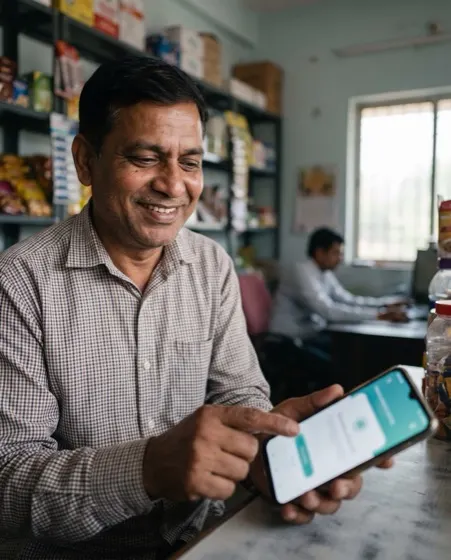
01Emailed documents
Documents read in the chat, the moment they arrive.
- Name, date of birth and address matched; anything missing asked for
- A video-KYC slot booked in the same conversation
Onboarding in hours

CommercialAutoKYC · onboarding & re-KYC for banks and NBFCs
AutoKYC by Autowhat AI is KYC automation software for banks, NBFCs and insurers that onboards customers and runs periodic re-KYC on WhatsApp. Customers send documents on WhatsApp or the web; AutoKYC reads them, checks them against your policy, asks for what is missing and hands only the exceptions to a person — with maker-checker before anything touches your core.
WhySound familiar?
From heads of operations, onboarding and compliance at banks, NBFCs and insurers. Composite quotes from discovery calls — the problems are real; the names are left out.

“Half our applicants drop off waiting for documents.”
Documents arrive by email in pieces; each follow-up adds a day and loses a customer.
Head of onboardingMulti-day TAT, high drop-off
“Every application goes to a person, even the clean ones.”
Checks are manual, so the team spends its day on files that needed nobody.
Operations managerPeople on the wrong files
“Re-KYC season means frozen accounts and branch queues.”
Customers are asked to visit a branch to confirm what has not changed.
Compliance headFrozen accounts and complaints
HowWhat changes with AutoKYC
Product screens with illustrative data. In a working session we map one of your journeys.
01Emailed documents
Onboarding in hours
02Every file manual
People on the files that need them

03Branch re-KYC
No frozen accounts

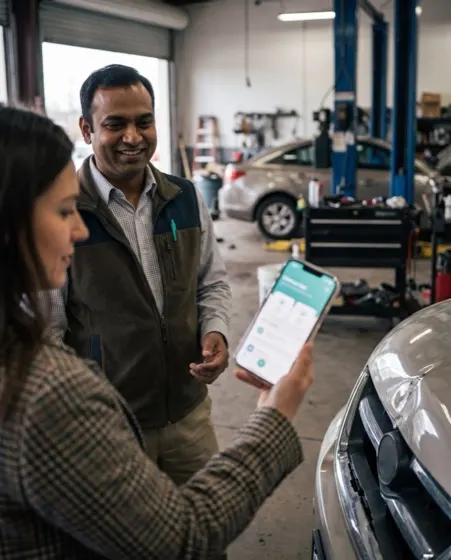
FieldAutoKYC in the field
The workplace it runs in, the person who uses it on a phone, the team at the desk and the detail it reads.



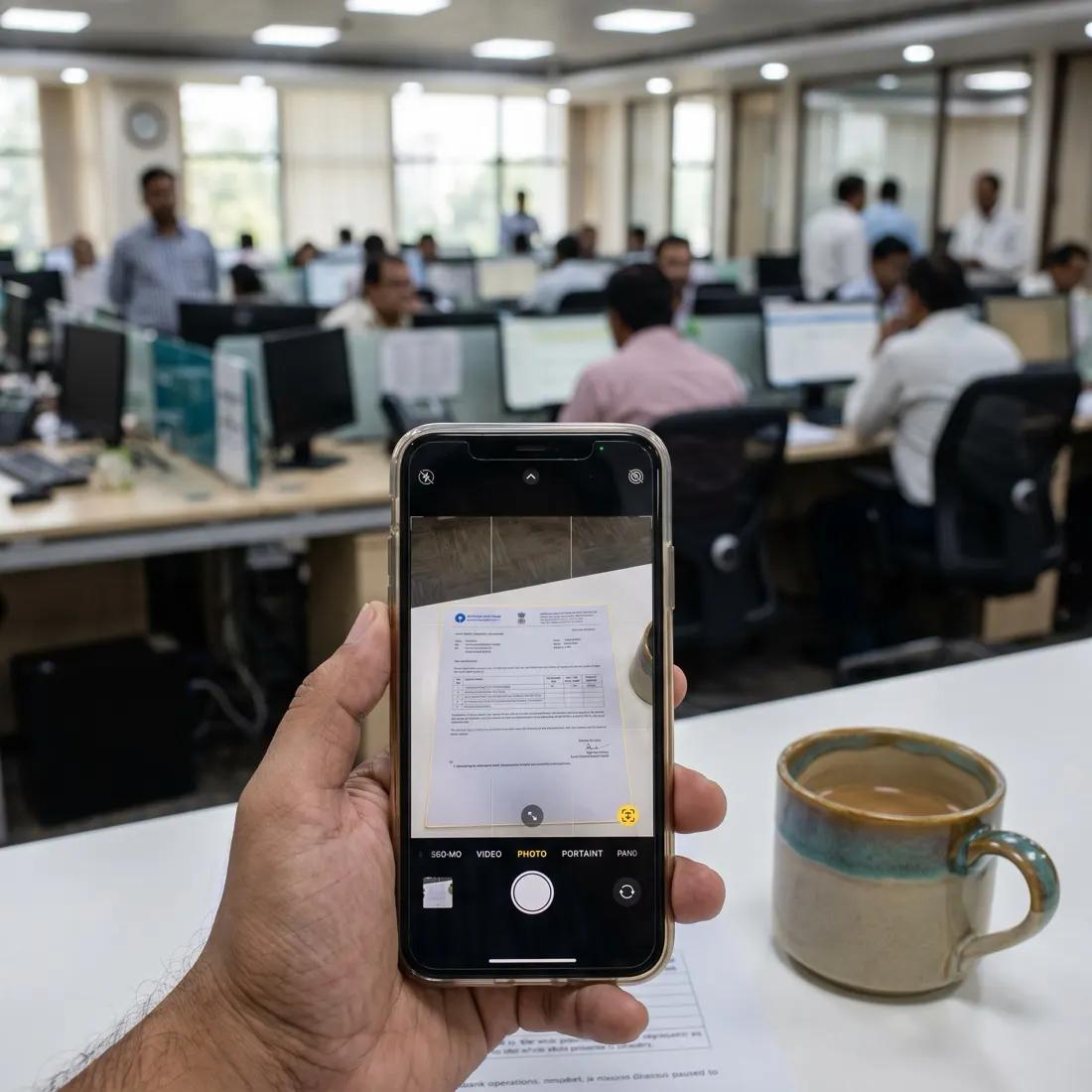
Photographs are illustrative — real customer sites are not shown.
01The screens
The pipeline, the re-KYC campaign and the customer’s side on WhatsApp.
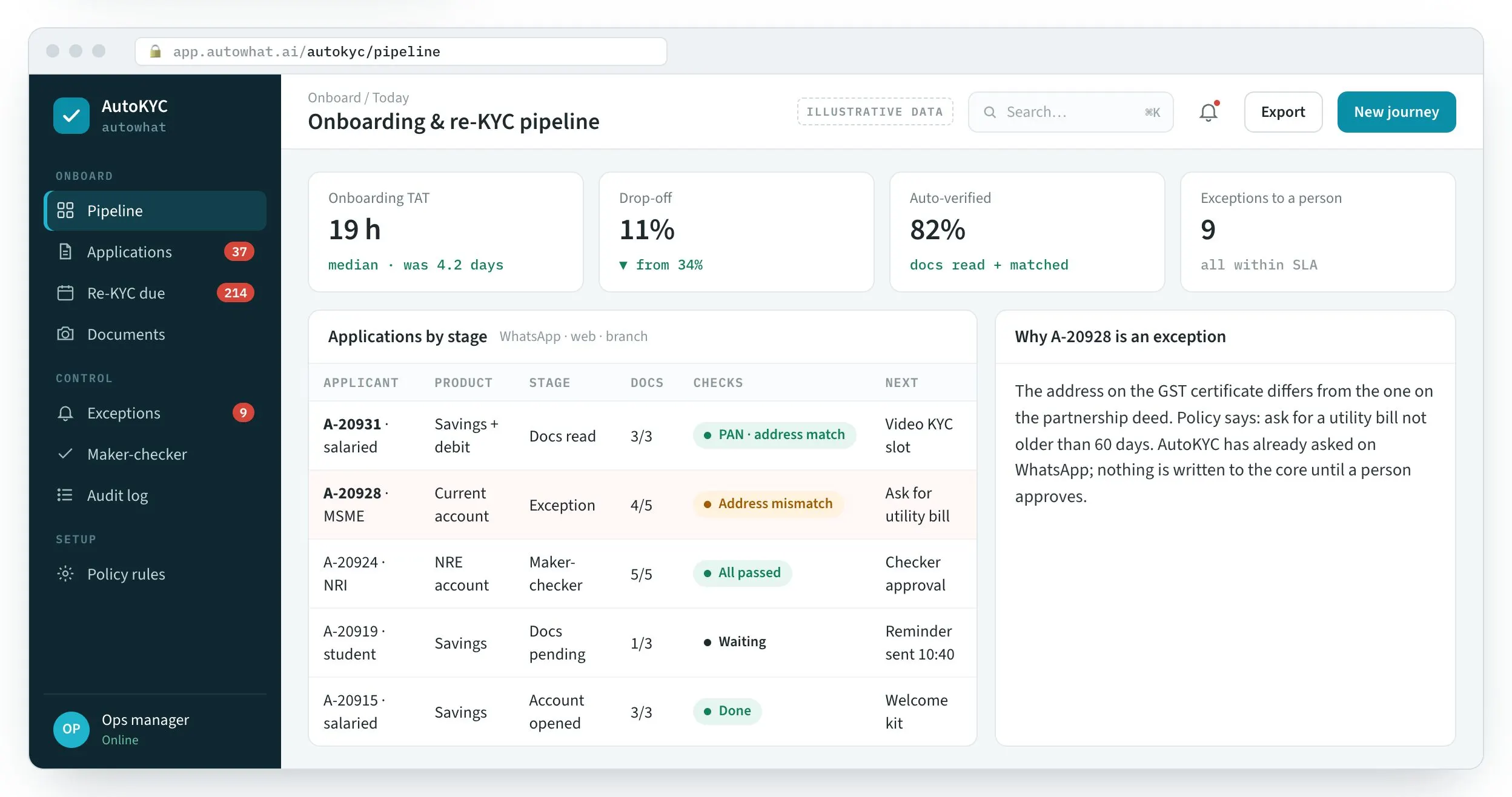
Every application by stage, with documents read and checks run — exceptions explained.
Product screens with illustrative data — every name, place and figure is a placeholder.
02Before and after
Onboarding and re-KYC still run on emailed documents and phone calls. That is where the days and the drop-off come from.
| Area | Today | With AutoKYC |
|---|---|---|
| Documents | Emailed, re-keyed | Read on arrival, matched to the application |
| Checks | Manual, uneven | Your policy, applied the same way every time |
| Exceptions | Everything goes to a person | Only exceptions, with the reason |
| Re-KYC | Branch visits, frozen accounts | Completed on WhatsApp by risk segment |
| Audit | Spread across systems | One log for every read, decision and write |
03Above your core
AutoKYC sits above your systems of record. It reads by default and writes only through the APIs you open.
WhatsApp · web · branch
The customer starts where they already are — no new app.
Document AI
ID, address and income documents structured on arrival.
Registries
PAN, CKYC and account-aggregator checks where you allow them.
Your policy
Rules and bands you write; outside the band, a person decides.
Maker-checker
Below threshold, a second person approves before any write.
Your core
Account opened through the API you open — nothing else.
Re-KYC
Periodic re-KYC by risk segment, on WhatsApp.
Audit log
Every read, decision and write in one log.
04The platform
Start with one product journey; the same spine runs every other.
05How we deliver
You pick the metric; we build on your stack and stay after go-live.
MoreRelated Commercial products
Use casesKYC software for NBFCs and banks
KYC software for an NBFC in India has to take documents the way borrowers send them and apply the lender’s own policy, not a vendor’s fixed rules. AutoKYC collects ID, address and income documents on WhatsApp, the web or at a branch, reads them on arrival and matches name, date of birth and address to the application, including the officially valid documents (OVDs) your policy accepts. PAN, CKYC and account-aggregator checks run where you allow them, and anything missing is asked for in the same chat. Your rules and bands decide the clean files; outside the band a person decides, and below threshold a second person approves before anything is written to your core through the APIs you open. It runs on managed cloud, in your own VPC or on-premises, with India data residency when required, and every read, decision and write sits in one audit log.
Customer onboarding software for banks takes an applicant from the first document to an opened account without the file waiting in email. With AutoKYC the customer starts where they already are, with no new app: documents sent on WhatsApp, the web or at a branch are read on arrival, missing items are requested in the same conversation, and a video KYC (V-CIP) slot can be booked there, with liveness and face match in the document layer. Only exceptions reach a person, with the reason, and maker-checker sits before the account is opened through the API you open. The same spine runs four journeys: savings and current accounts, NRI accounts, loans and cards, and insurance proposals. After onboarding, periodic re-KYC runs on WhatsApp by risk segment. Where applicants abandon, and how to measure it stage by stage, is covered in how to reduce KYC onboarding drop-off; the full chat journey is in digital KYC onboarding on WhatsApp.
How the two ways of working compare, file by file, is set out in manual vs automated KYC verification.
OverviewAutoKYC · KYC automation software
KYC automation software for banks and NBFCs takes the repetitive parts of customer onboarding off a person's desk: reading ID, address and income documents, matching them to the application, and chasing what is missing. In India, most banks, NBFCs and insurers still collect KYC documents over email and at branches. Each follow-up adds a day, applicants drop off while they wait, and re-KYC season brings branch queues and frozen accounts for customers whose details never changed.
AutoKYC lets customers send documents on WhatsApp, the web or at a branch. It reads them on arrival, matches name, date of birth and address, asks for anything missing in the same chat and can book a video-KYC slot. Your policy is applied the same way every time; only exceptions reach a person, with the reason. Maker-checker sits before any write to your core, and re-KYC runs on WhatsApp by risk segment.
Customers start where they already are, with no new app. Documents are read in the chat the moment they arrive, and missing items are requested in the same conversation.
ID, address and income documents are structured on arrival and checked by rules and bands you write. PAN, CKYC and account-aggregator checks run where you allow them.
Clean files do not wait for a person; exceptions arrive with the reason. Below threshold, a second person approves before anything is written to your core.
Self-declaration where nothing changed and documents where it did. Campaign progress is tracked by segment, with branch lists for the customers who still need a visit.
A video-KYC slot can be booked in the same conversation, and liveness and face match sit in the document layer of the platform.
Read-only by default, writing only through the APIs you open, with a kill switch per agent. Every read, decision and write sits in one log, on managed cloud, your VPC or on-premises.
| Manual / spreadsheets | Generic software | AutoKYC | |
|---|---|---|---|
| Document collection | Email and branch, in pieces | Upload portal or app the customer must find | WhatsApp, web or branch, read on arrival |
| Missing documents | A call or email per follow-up | Customer told to re-upload | Asked for in the same chat |
| Policy checks | Manual, uneven between people | Fixed vendor rules | Your rules and bands, applied the same way every time |
| Re-KYC | Branch visits, frozen accounts | Bulk SMS or email | On WhatsApp by risk segment, self-declaration where nothing changed |
| Control and audit | Spread across systems | Varies by tool | Read-only by default, maker-checker, one audit log |
LearnAutoKYC guides and tools
10 pages on the problems AutoKYC solves. See them all on one page →
FAQQuestions we get about AutoKYC
AutoKYC is an Autowhat AI product for heads of onboarding, operations and compliance in BFSI. Short, factual answers for buyers, procurement and the assistants people ask first.
In short. AutoKYC is an Autowhat AI product for heads of onboarding, operations and compliance in BFSI. It is built for heads of onboarding, operations and compliance in BFSI. It exists to remove the problems those teams describe in almost every first conversation: multi-day onboarding and drop-off while documents wait in email; every file reviewed by hand, even the clean ones; and re-KYC season means branch queues and frozen accounts. With AutoKYC, teams get documents read in the chat; anything missing asked for, your policy applied the same way; only exceptions to a person, and re-KYC by risk segment on WhatsApp. It connects to WhatsApp Business API, CKYC / account aggregator, Your core via API and Maker-checker, is used by Customers · ops · compliance, and runs on whatsapp + web. Like every Autowhat AI product, AutoKYC goes live on one site, lane or process first, usually within weeks, on managed cloud, in your own VPC or on-premises, and shares one operational record with the other products, so the second deployment reuses the data and integrations of the first.
AutoKYC by Autowhat AI is KYC automation software for banks, NBFCs and insurers. Customers send documents on WhatsApp, the web or at a branch; they are read on arrival, checked against your policy, and only exceptions reach a person, with maker-checker before any write to your core. It is built for heads of onboarding, operations and compliance.
It is software that reads customer KYC documents, checks them against an institution's policy and routes only the exceptions to a person. AutoKYC does this for banks, NBFCs and insurers, with documents collected on WhatsApp, the web or at a branch.
Choose software that takes documents where customers already are, applies your own KYC policy rather than fixed vendor rules, sends only exceptions to a person and keeps a second person's approval before any write to your core. AutoKYC is built that way for banks, NBFCs and insurers; it is not the right choice if you only need a standalone video-call tool.
Drop-off falls when applicants are not sent to a new app or portal and are not left waiting for a reply. AutoKYC reads documents in the WhatsApp or web chat as they arrive and asks for anything missing in the same conversation. If applicants leave at a later step, such as funding the account, fix that step first.
Segment customers by risk, message each segment from the bank's official WhatsApp number, take a self-declaration where nothing changed and documents where something did, and track progress by segment. AutoKYC runs re-KYC this way and lists the customers who still need a branch visit. Periodicity and accepted channels follow RBI's KYC Directions and your own policy.
Customer onboarding software for banks takes an applicant from the first document to an opened account. In AutoKYC, documents sent on WhatsApp, the web or at a branch are read on arrival, missing items are asked for in the same chat, a video-KYC slot can be booked there, and only exceptions reach a person before maker-checker approves the write to your core.
The customer sends ID, address and income documents in a WhatsApp chat. AutoKYC reads them on arrival, matches name, date of birth and address, asks for anything missing and can book a video-KYC slot in the same conversation.
With manual KYC every file goes to a person and checks vary between reviewers. With AutoKYC your policy is applied the same way every time, clean files move on, and only exceptions reach a person with the reason, behind maker-checker.
Yes. AutoKYC is built for banks, NBFCs and insurers, connects to WhatsApp Business API, CKYC and account aggregator where allowed, and can run on managed cloud, in your own VPC or on-premises with India data residency when required.
With AutoKYC the customer sends documents on WhatsApp, the web or at a branch. They are read on arrival, PAN, CKYC and account-aggregator checks run where you allow them, and your rules and bands decide. Outside the band a person decides, and below threshold a second person approves before any write to your core.
There is no public list price. AutoKYC is priced per deployment after a 30-minute working session on your own data, where the first product journey and scope are agreed.
It connects to WhatsApp Business API, CKYC / account aggregator, Your core via API, Maker-checker. Users: Customers · ops · compliance. Channel: WhatsApp + web.
On managed cloud, in your own VPC (AWS, Azure or GCP) or on-premises, with your keys. SOC 2 Type II and ISO 27001 controls, India data residency when required, and local or open-weight models when policy demands it. The data stays yours.
06Working session
Thirty minutes: your onboarding steps mapped, the documents that slow it named, and a first scope.