01Ordered call lists
Ranked by who will pay, on the channel they answer.
- Propensity and best channel per account, every morning
- Guard-rails on contact hours and scripts built in
Higher early-bucket cure

CommercialAutoCollect · collections agents for lenders
AutoCollect by Autowhat AI is loan collection software for collections teams at banks and NBFCs. Accounts are ranked by propensity to pay; reminders and payment links go out on WhatsApp; voice agents take promises in the borrower’s language; field visits are routed for the rest — inside contact-hour rules and approved scripts, with every call summarised and scored.
WhySound familiar?
From collections heads and managers at banks and NBFCs. Composite quotes from discovery calls — the problems are real; the names are left out.

“We call in order of amount, not of who will pay.”
The easiest cures wait behind accounts that will not pay this week, and the bucket rolls forward.
Collections headBucket roll-forward
“Most borrowers just need a reminder and a link.”
Agents spend their day dialling people who would have paid from WhatsApp.
Collections managerAgents on the wrong calls
“We only hear about bad calls from complaints.”
A fraction of calls are sampled, so script and contact-hour breaches surface too late.
Compliance officerConduct risk
HowWhat changes with AutoCollect
Product screens with illustrative data. In a working session we design a test against your control group.
01Ordered call lists
Higher early-bucket cure
02Calls for a reminder
Agents free for the hard cases

03Sampled calls
Conduct proven, not hoped for

FieldAutoCollect in the field
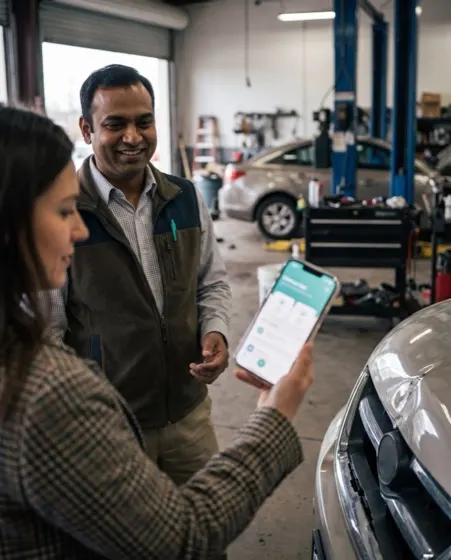
The workplace it runs in, the person who uses it on a phone, the team at the desk and the detail it reads.

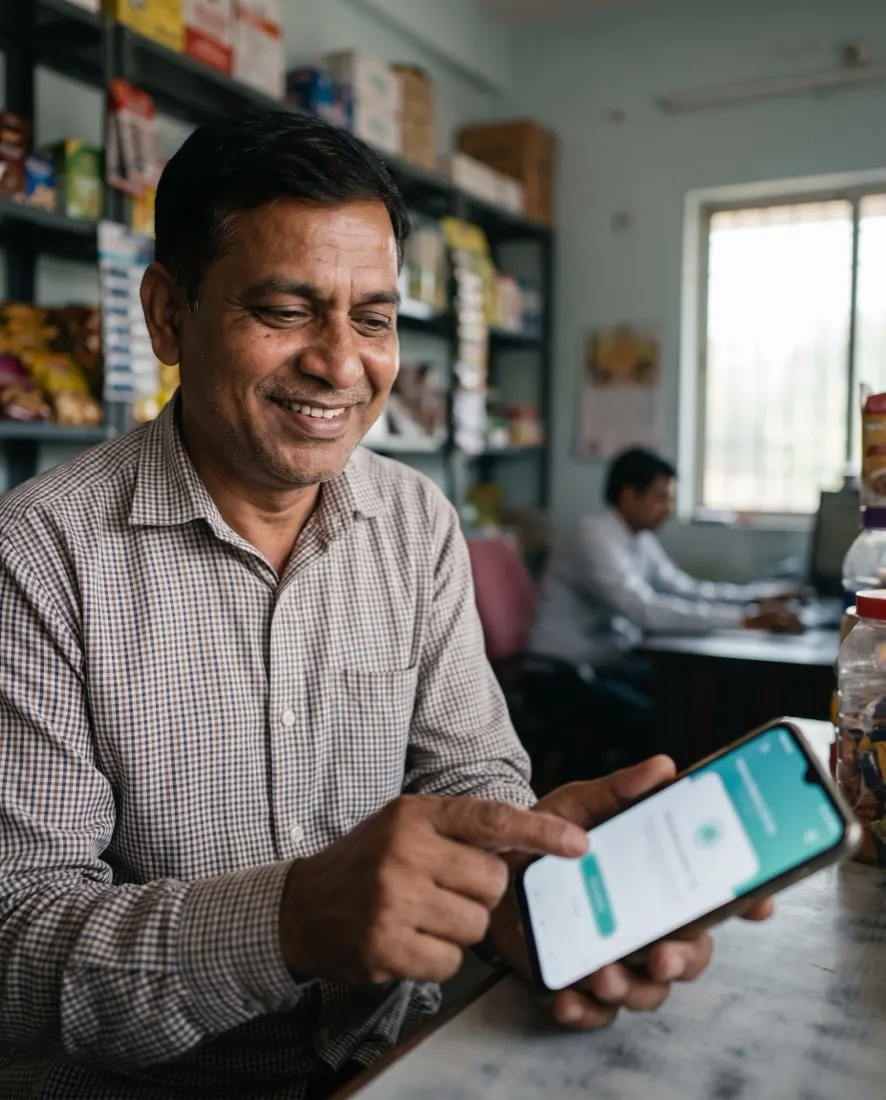
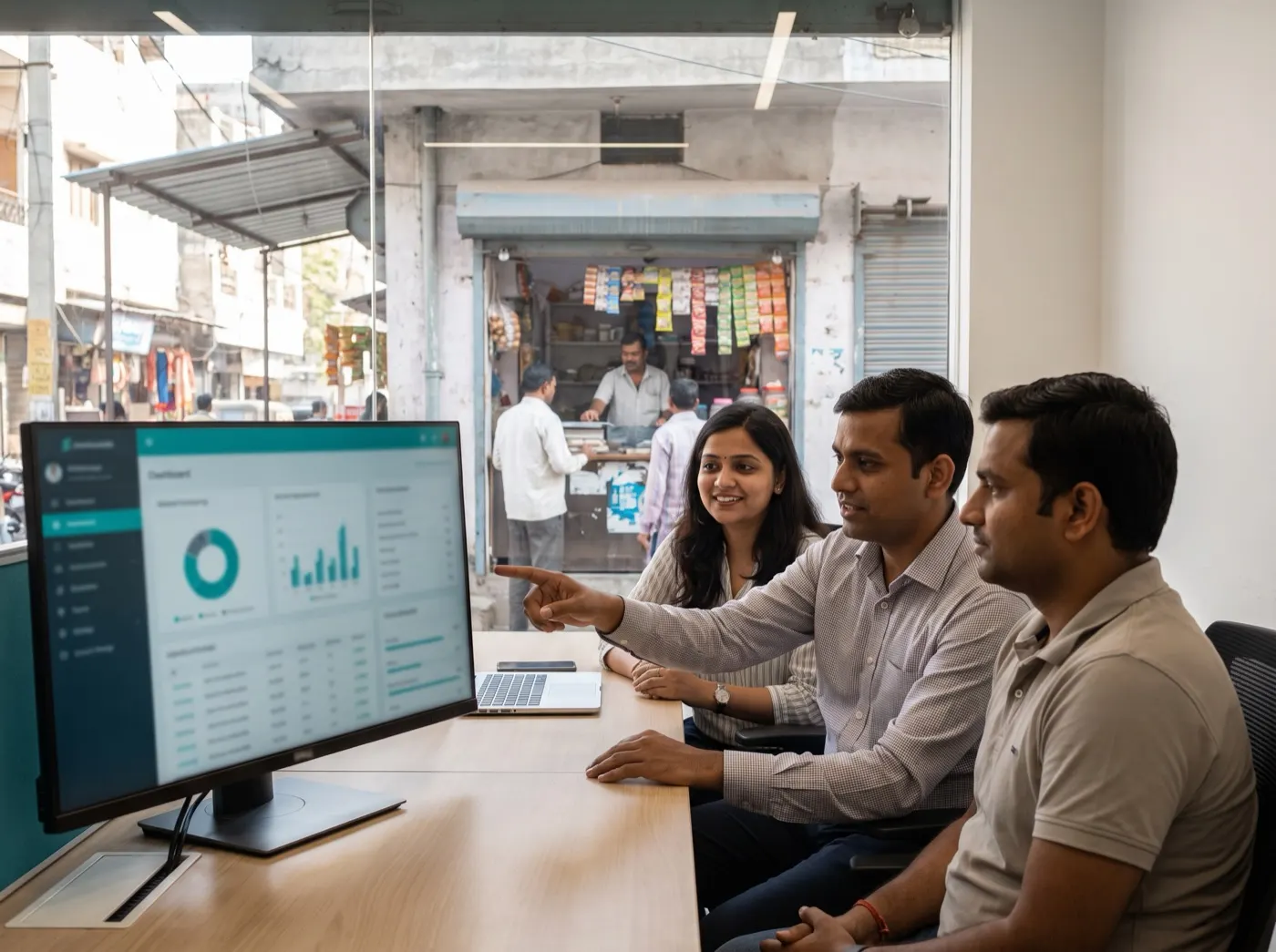
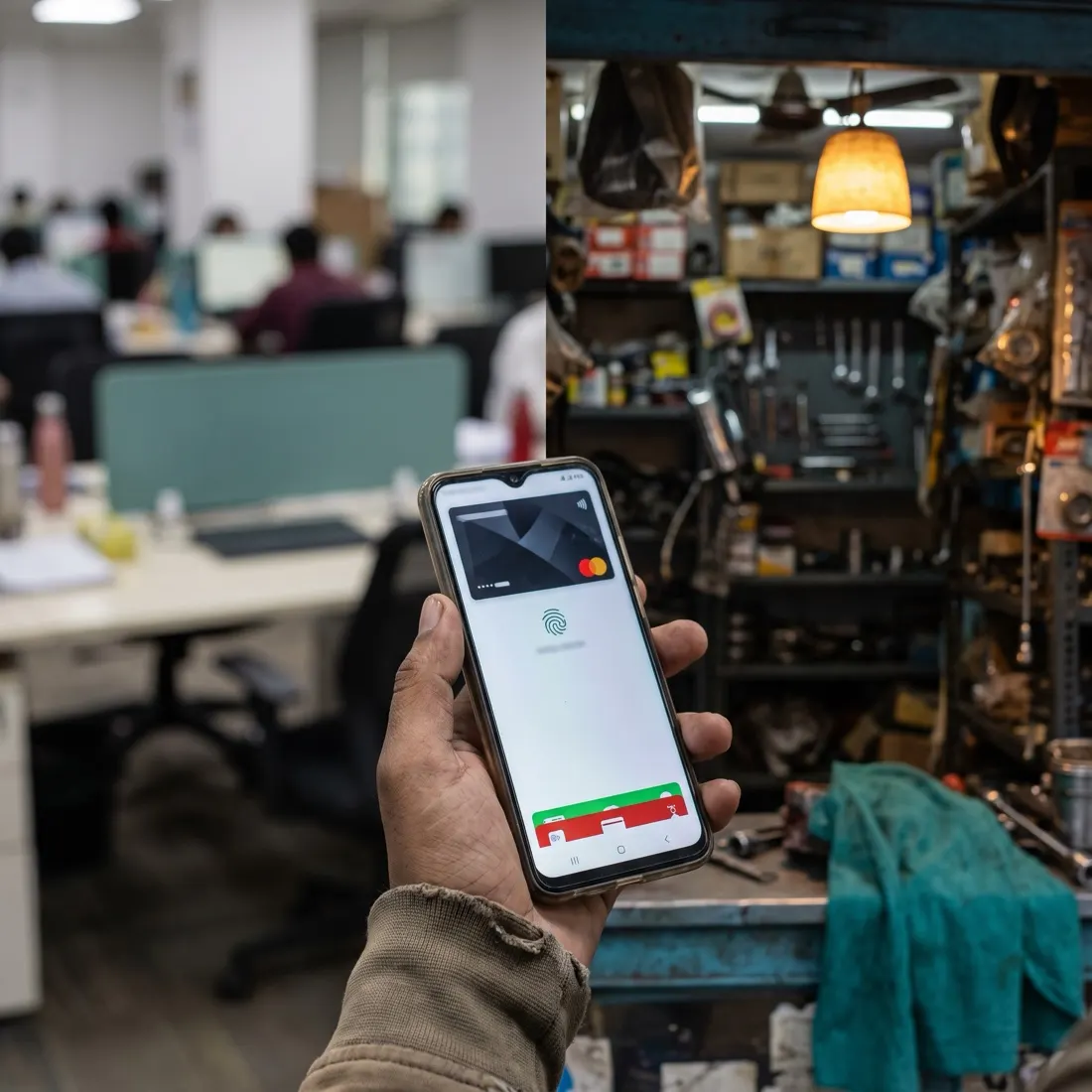
Photographs are illustrative — real customer sites are not shown.
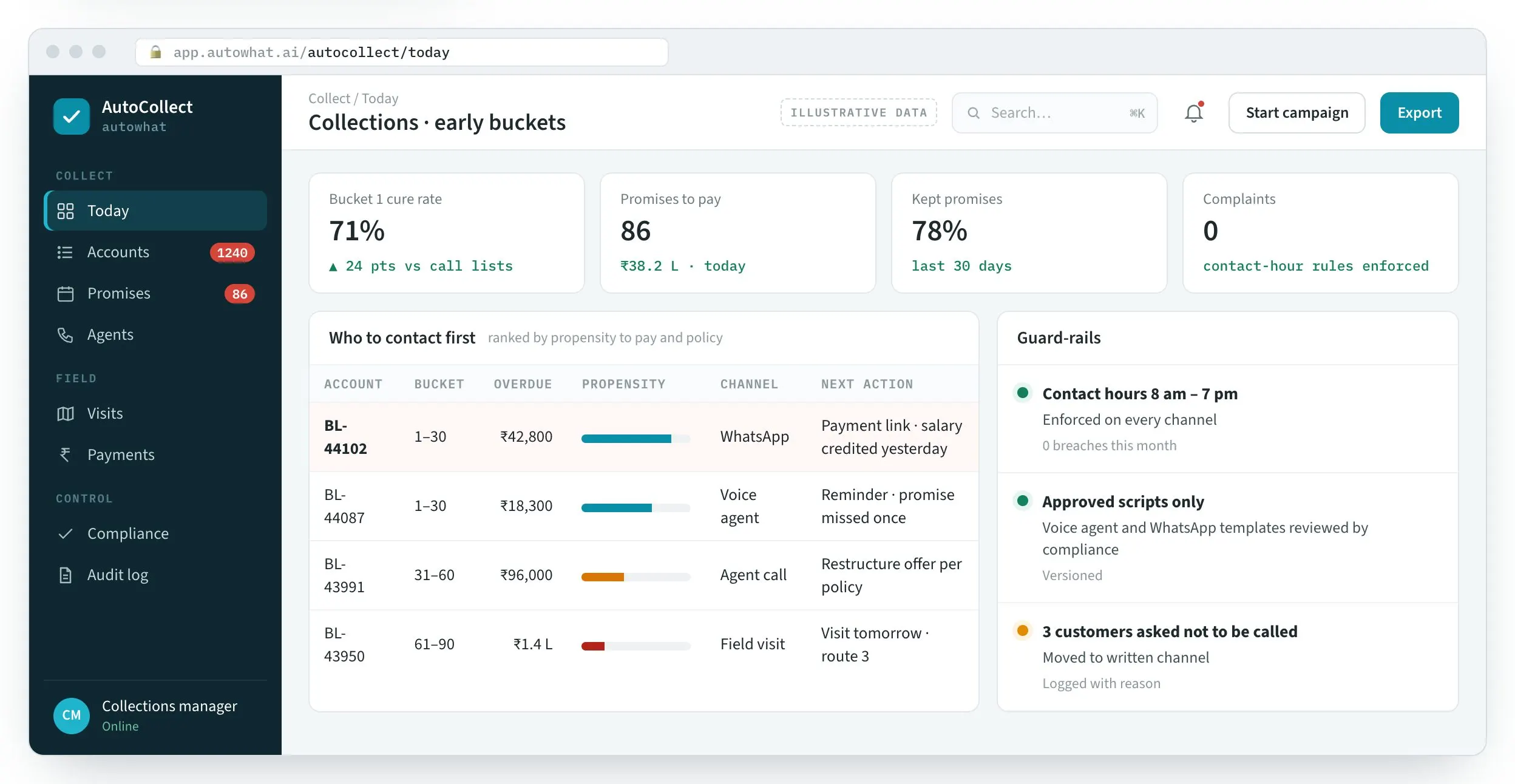
01The screens
The ranked worklist, the borrower’s WhatsApp and the scored calls.
Accounts ranked by propensity to pay, with the channel and next action — inside guard-rails.
Product screens with illustrative data — every name, place and figure is a placeholder.
02Before and after
Ordered call lists treat every borrower the same; the bucket rolls forward while agents dial.
| Area | Today | With AutoCollect |
|---|---|---|
| Worklist | Ordered by overdue amount | Ranked by propensity to pay |
| Channel | Calls only | WhatsApp, voice agent, person or field — by borrower |
| Promises | In notes | Recorded, reminded and tracked |
| Compliance | Sampled | Every call scored; contact hours enforced |
| Hardship | Missed | Detected and sent to a person |
03Ranked, reminded, recorded
Your policy decides what can be offered; AutoCollect makes sure the right borrower hears it at the right time.
LMS
Due and overdue accounts loaded daily from your LMS.
Propensity
Accounts ranked by likelihood to pay and the best channel.
Reminders and payment links before and after the due date.
Voice agents
Promises taken in the borrower’s language, within contact hours.
People
Disputes, hardship and restructuring go to a trained person.
Field
Late buckets routed to field agents with proof of visit.
Payments
Payments matched to promises; broken promises re-queued.
Compliance
Every call summarised and scored against approved scripts.
04The platform
Start with one portfolio and bucket; the rest join on the same engine.
05How we deliver
On the LMS and dialler you already run.
MoreRelated Commercial products
Use casesDebt collection and voice agents
Debt collection software for an Indian lender has to decide, every morning, which overdue borrowers to contact, on which channel and with what message, and then follow each one to payment. AutoCollect loads due and overdue accounts from your LMS each day and ranks them by propensity to pay and the channel the borrower answers. Early accounts get WhatsApp EMI reminders and payment links; each promise to pay (PTP) is recorded, reminded and matched to the payment, and a broken promise goes back into the worklist. Accounts are worked by days past due, a returned mandate is handled as a NACH bounce, and later buckets go to field agents with proof of visit. Results are read as collection efficiency against a control group, not a before-and-after chart.
AutoCollect’s voice agents call borrowers whom the worklist marks for a call, in Hindi, English and other languages, and take a promise date or note the reason a payment is late. They call only within contact hours, 8 am to 7 pm, on approved scripts, and respect do-not-call lists. Every voice call is summarised and scored for script, compliance and outcome, the same way as an agent’s call. A borrower who raises a dispute or hardship is handed to a trained person with the call summary, because those conversations are never automated. How voice agents compare with telecallers is set out in AI calling vs human telecalling, and the rules every call must meet are in the debt collection call compliance checklist.
OverviewAutoCollect · loan collection software
Loan collection software, also called debt collection software or a collections management system, organises the work of getting overdue EMIs paid: who to contact, on which channel, with what message, and what happened next. Many Indian banks and NBFCs still call down a list sorted by overdue amount, so borrowers who would pay after a simple reminder wait behind accounts that will not pay this week, buckets roll forward, and only a sample of calls is ever checked for script and contact-hour breaches.
AutoCollect is WhatsApp EMI reminder and NBFC collection software for banks and NBFCs. It loads due and overdue accounts from your LMS every day and ranks them by propensity to pay and best channel. EMI reminders and payment links go out on WhatsApp before and after the due date; voice agents take promises in the borrower's language within contact hours; later buckets are routed to field agents with proof of visit. Payments are matched to promises, broken promises re-queued, and every call is summarised and scored. Disputes and hardship always go to a person.
Each morning accounts are ranked by likelihood to pay and the channel the borrower answers, with the next action shown.
Reminders and payment links go out before and after the due date, and promise dates are taken in the same chat.
Voice agents take promises in Hindi, English and other languages, within contact hours and on approved scripts only. Each voice call is summarised and scored like an agent's call, and a borrower who raises a dispute or hardship is handed to a trained person with the summary.
Promises are recorded and reminded, payments are matched to them, and broken promises go back into the worklist automatically.
Every call, by people or voice agents, is summarised and scored for script, compliance and outcome; contact hours and do-not-call lists are enforced.
Later buckets are routed to field agents with proof of visit, receipts and cash deposit matching.
| Manual / spreadsheets | Generic software | AutoCollect | |
|---|---|---|---|
| Worklist order | By overdue amount | Static rules or segments | Ranked by propensity to pay and best channel, daily |
| Channels | Calls only | Bulk SMS or a dialler | WhatsApp, voice agent, person or field, by borrower |
| Promises to pay | In agent notes | Logged, rarely followed up | Recorded, reminded, matched to payments, re-queued if broken |
| Call compliance | Sampled | Recording without review | Every call scored; contact hours enforced |
| Hardship and disputes | Often missed | Same flow as everyone | Detected and sent to a trained person |
LearnAutoCollect guides and tools
10 pages on the problems AutoCollect solves. See them all on one page →
FAQQuestions we get about AutoCollect
AutoCollect is an Autowhat AI product for collections heads and managers at banks and NBFCs. Short, factual answers for buyers, procurement and the assistants people ask first.
In short. AutoCollect is loan collection software from Autowhat AI for collections heads and managers at banks and NBFCs. It exists to remove the problems those teams describe in almost every first conversation: call lists in order of amount, not of who will pay; agents dialling borrowers who only needed a reminder; and conduct issues found through complaints. With AutoCollect, teams get accounts ranked by propensity and best channel every morning, WhatsApp payment links and promise dates with broken promises re-queued, and every call summarised and scored, with hardship sent to a person. It connects to your LMS, WhatsApp and payment links, voice agents and dialler, is used by collections teams, desk agents and field agents, and reaches borrowers on WhatsApp, by voice and in the field. Like every Autowhat AI product, AutoCollect goes live on one site, lane or process first, usually within weeks, on managed cloud, in your own VPC or on-premises, and shares one operational record with the other products, so the second deployment reuses the data and integrations of the first.
Pick one that ranks accounts by likelihood to pay, works across WhatsApp, calls and field visits, enforces contact hours on every call and connects to your LMS. AutoCollect by Autowhat AI is built for banks and NBFCs on those lines. A lender wanting legal notices and dispute resolution as the core need may need a different tool.
AutoCollect is loan collection software for collections teams at banks and NBFCs in India. It loads due and overdue accounts from the LMS daily, ranks them by propensity to pay, sends WhatsApp reminders and payment links, uses voice agents for promises and routes later buckets to field agents, with every call scored.
Loan collection software, also called debt collection software, decides which overdue borrowers to contact, on which channel and with what message, then records promises and tracks payments against them. AutoCollect does this for banks and NBFCs across WhatsApp, voice agents, people and field agents, within contact-hour rules and approved scripts.
Largely yes. In India, lenders say loan collection software, debt collection software or collections management system for the same category: software that decides who to contact, on which channel, records promises and tracks payments. AutoCollect is debt collection software for banks and NBFCs that covers WhatsApp, voice agents, agent calls and field visits.
An amount-based list calls the largest overdue first, whether or not they will pay. A propensity list ranks accounts by likelihood to pay and best channel, so easy cures are reached early in the bucket.
Software that runs both channels from one worklist, so a missed payment after a WhatsApp reminder moves to a voice call without anyone re-keying it. AutoCollect by Autowhat AI does this within contact hours and approved scripts. A lender that only needs bulk reminders, with no calls or promise tracking, may not need a collections system.
A clear reminder in approved wording, a payment link, and a way to reply with a promise date. AutoCollect sends these before and after the due date, records the promise in the same chat, reminds on that date and re-queues the account if the promise is broken. Disputes and hardship go to a trained person.
AutoCollect enforces contact hours (8 am to 7 pm) on every channel, uses approved scripts only, and summarises and scores every call. Disputes and hardship are never automated; they go to a person.
Contact should get more personal as days past due grow. Early buckets suit WhatsApp reminders, payment links and voice agents; middle buckets need agents who take and track promises; later buckets need field visits with proof of visit. AutoCollect works each DPD bucket this way, and disputes and hardship always go to a person.
A delinquency bucket is a band of days past due, commonly 30 days wide, used to group overdue accounts so each stage is reported and worked differently. Names such as 0 bucket or X bucket vary by lender. AutoCollect maps your buckets first, then works early buckets with WhatsApp reminders and voice agents and routes later buckets to field agents.
There is no public list price. AutoCollect is priced per deployment after a 30-minute working session on your own data, where the first portfolio and bucket and scope are agreed.
Test it on one bucket against a control group, not with a before-and-after chart. A random share of accounts keeps the old process while the rest get the new one over the same due dates; then compare cure rate, promise kept rate, roll-forward, complaints and contact-hour breaches. AutoCollect goes live this way, with the baseline taken first.
AutoCollect connects to your loan management system (LMS), WhatsApp and payment links, voice agents and your existing dialler; due and overdue accounts are loaded from the LMS every day. It is used by collections heads and managers, desk agents and field agents, and reaches borrowers on WhatsApp, by voice and through field visits.
On managed cloud, in your own VPC (AWS, Azure or GCP) or on-premises, with your keys. SOC 2 Type II and ISO 27001 controls, India data residency when required, and local or open-weight models when policy demands it. The data stays yours.
06Working session
Thirty minutes: your buckets, scripts and contact rules — and a test design against a control group.