

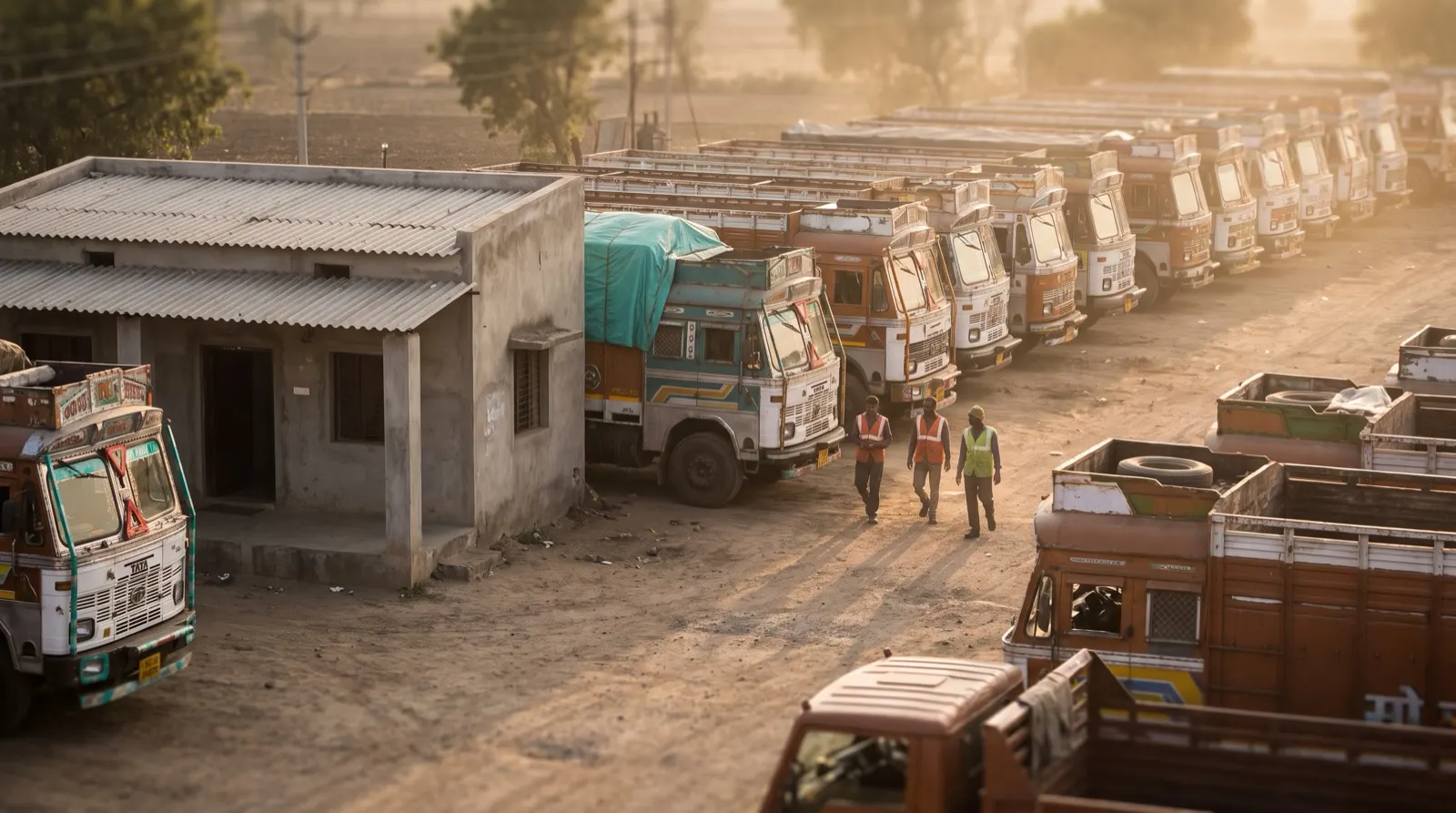
A branch manager opens the “Ops Indore” group at 8 am to 200-odd unread messages. There is a blurry POD photo with no LR number, three “gaadi khaali hai” updates, a voice note from a consignee and a thumbs-up under a driver’s advance request. Nobody can say whether that thumbs-up meant ₹5,000 or ₹8,000. The work of the whole branch happened here overnight, and almost none of it reached the books.
Our view is that the trouble with running transport on WhatsApp was never the chat itself; it is that nothing said there turns into a record.
Another app loses to the phone already in the driver’s pocket
A driver already has WhatsApp, already sends photos and locations, and already uses it with family. A new app asks for a download, a login, screens that may not be in their language, and storage on a phone that is often full. Customers and consignees are even less likely to install anything for one transporter.
Whatever channel the work moves to must be one the least willing participant already uses. In Indian transport, that is not a debate. It is WhatsApp.
Two channels are worse than one
Here is an illustrative fleet, not a customer. Say a transporter has 60 drivers, each finishing two trips a week. That is 60 × 2 = 120 PODs a week. The company rolls out a driver app. Forty-five drivers install it, but only 20 use it every week. Those 20 send 20 × 2 = 40 PODs through the app. The other 80 still arrive on WhatsApp.
So the office now checks two places for 120 documents, and the app covers a third of them. The rollout added a channel without removing one. This is the usual ending, and it is a design problem, not a training problem.
A thumbs-up under a photo is an approval nobody can audit. The fix is a record behind the chat, not a ban on the chat.
The missing piece is a record behind the chat
What goes wrong is specific. A POD photo in a group is not attached to its LR. An approval emoji has no amount. A “kahan hai gaadi?” message is answered by someone who must ring the driver first. The information exists. It just never lands where accounts and operations can use it.
The cost shows up later, in other people’s time. Accounts cannot bill without the POD, so someone scrolls back through a week of photos. A dispute over an advance becomes one person’s memory against another’s. A customer who asked twice where the truck was gets a third answer from a different person.
So we would keep the channel and put records behind it:
| What happens in chat today | What should happen behind it |
|---|---|
| POD photo sent to a group | POD matched to its LR, billing unblocked |
| “Kahan hai gaadi?” call or message | Answer from GPS and the LR, without a call |
| Thumbs-up on an advance | Typed approval, confirmed, with a PIN above a threshold |
| Breakdown message to the owner | SOS alert to operations, management and maintenance |
That is the design of SCM for Transporter: an assistant that recognises who is writing, checks what their role may see and answers from the company’s own records. For the set-up side, our guide on WhatsApp for transport business covers status, POD and approvals step by step.
A channel is universal only in people’s own words
A transport office in India works in Hindi, English, Marathi and the Hinglish in between, often by voice note. A system that only accepts neat English text is a system only office staff will use. Speech-to-text for voice notes and support for all four languages matter more than any feature list, because they decide whether drivers and customers take part at all.
Voice deserves special attention. A driver at a dhaba at night will not type “LR 24-1187 delivered, POD attached”. He will hold the mic button and talk for twenty seconds. If the system cannot turn that into an update against the right trip, the driver learns the system does not listen, and goes back to calling the branch.
The case against running operations on WhatsApp
The objections are real. Groups on personal numbers vanish when a manager leaves. Messages get buried. Data sits on phones the company does not control. A purpose-built app can also offer forms that work offline and checks that a chat cannot.
We take these seriously, and most of them point to the same fix. Move to the WhatsApp Business Platform on an official company number, not a manager’s personal phone. Log every conversation and every update made from chat. Keep sensitive work off the chat entirely. Ledgers, bank reconciliation, period locks and GST and TDS summaries need a proper screen and a person sitting down. Run the fleet on WhatsApp, and close the books in the office. Where a team truly needs offline forms in dead zones, an app may still earn a place for that one job.
Customers deserve a link, not a login
The same thinking applies to customers. They want to know where their consignment is, not to join your system. A public tracking link per LR that carries no financials, expires and can be revoked stops the calls without exposing anything else. For the technical route to an official number, see WhatsApp Cloud API for transport companies.
What to do this week
- List every WhatsApp group your branches use for work, and who owns each one.
- Count last week’s PODs, and how many arrived by chat versus any other route.
- Move company conversations to one official business number.
- Start with read questions such as truck status, LR status and POD pending.
- Agree approval roles and a PIN threshold before allowing any write from chat.
The channel decision was made years ago by drivers and customers. The decision left to the owner is whether that channel keeps records. More on that in our guides for transport companies.