

Glossary · Supply chain & plants
Cross-dock meaning
A cross-dock moves goods from inbound to outbound trucks with little or no storage. See how cross-docking works in India and how it differs from a warehouse.
A cross-dock moves goods from inbound to outbound trucks with little or no storage. See how cross-docking works in India and how it differs from a warehouse.
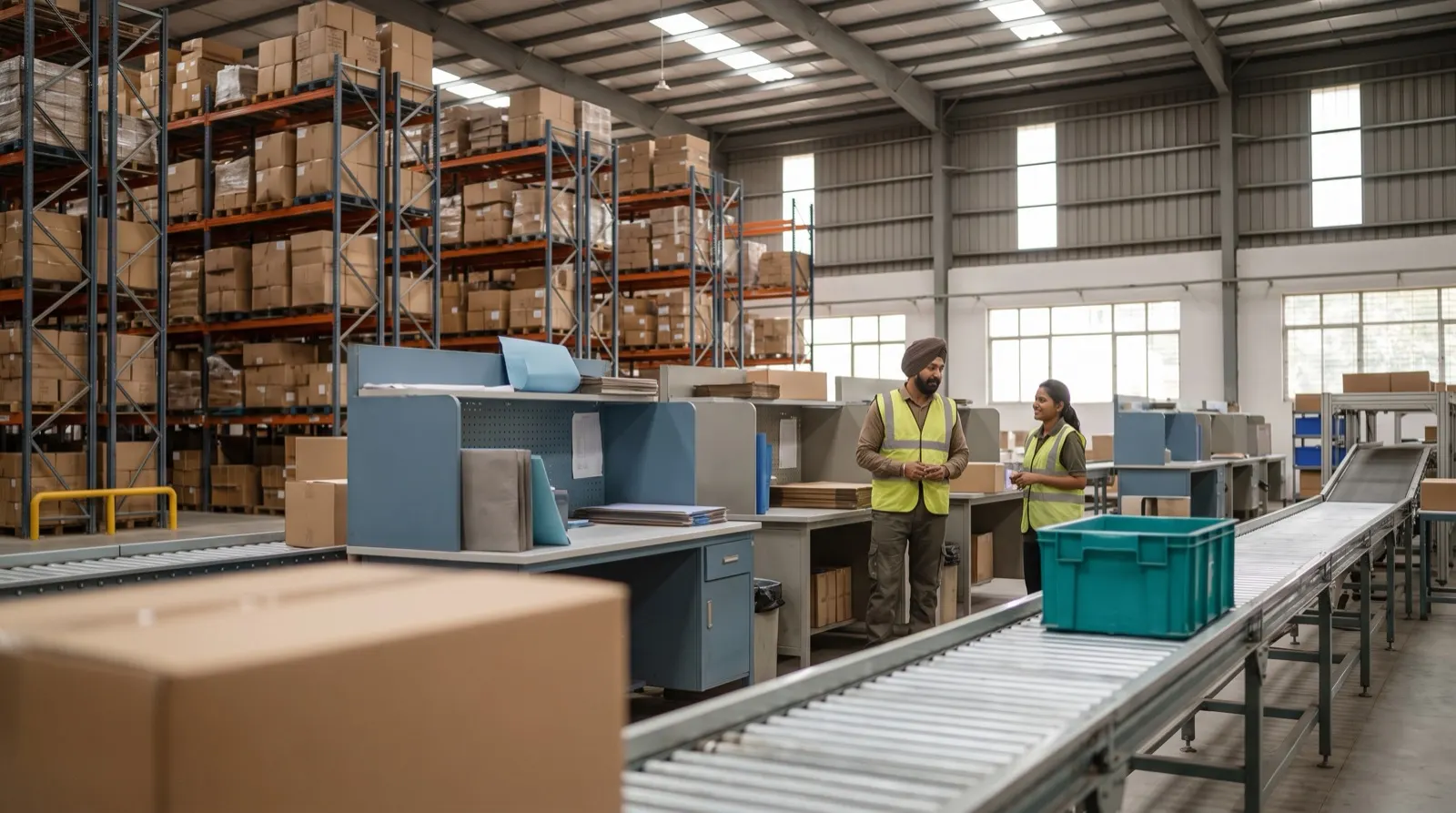
Full trucks arrive from plants or suppliers at the inbound side of the dock. Instead of going to racks, pallets or cartons are checked, labelled by destination and moved across the floor to the outbound bay where the vehicle for that route is waiting. The building is usually long and narrow with doors on both sides, because the job is movement, not storage.
Parcel and e-commerce networks use it to consolidate shipments at hubs. FMCG manufacturers use it when full truckloads from a plant are broken into smaller loads for distributors in one region. Part-load (PTL) transporters run their godowns as cross-docks, consolidating many consignors' goods by destination city. It suits fast-moving goods with predictable demand far better than slow or seasonal stock.
Illustrative numbers only. A 24-pallet truck arrives at 06:00 from a plant.
| Outbound route | Pallets | Vehicle departs |
|---|---|---|
| Route A | 8 | 09:00 |
| Route B | 6 | 09:30 |
| Route C | 6 | 10:00 |
| Route D | 4 | 10:30 |
Every pallet leaves within four and a half hours. If the inbound truck arrives at 11:00 instead, all four routes either wait or leave light, and the pallets go into temporary storage. That is why a cross-dock lives or dies on arrival discipline.
Small-order distribution warehouses usually work the other way: stock is received, put away, then picked into many orders. A WMS for small-order warehouses such as Warehouse OS logs vehicle, gate and challan at receiving, suggests put-away in a 3D twin, and scans each bag to its dispatch box. For how that put-away step should be decided, see warehouse putaway rules, and for shelf-life handling across depots, FEFO vs FIFO.
Where this shows up in our work. Warehouse OS: Procurement read from PDF, putaway in a 3D twin, orders weighed into bags and scanned to boxes. Book a 30-minute working session with an engineer.
Cross-docking means unloading goods from an incoming truck and loading them onto outgoing trucks within hours, sorted by destination, without storing them in racks in between.
A warehouse stores goods and picks orders from stock over days or weeks. A cross-dock only sorts and transfers goods between vehicles, usually within the same day, so it holds very little stock.
Fast-moving goods with steady demand and pre-planned destinations suit it best, such as FMCG cartons, parcels and part-load consignments. Slow-moving, seasonal or inspection-heavy goods usually need proper storage.