01Spreadsheet matching
Every recon matched daily, on rules you write.
- Exact, tolerance and fuzzy narration matching
- Breaks classified, aged and owned
Close every day, not every month

CommercialAutoRecon · reconciliation desk & MIS for financial institutions
AutoRecon by Autowhat AI is reconciliation software for banks, NBFCs and payment companies, built for their finance, operations and treasury teams. Every recon — UPI, cards, NEFT/RTGS, nostro, vendors — matched daily on rules you write; breaks explained and aged; the MIS and board pack drafted with every number traced to the query that produced it.
WhySound familiar?
From finance, operations and treasury heads at banks, NBFCs and payment companies. Composite quotes from discovery calls — the problems are real; the names are left out.

“Month-end is a week of spreadsheets.”
Recons are matched in macros that one person understands; breaks age until someone notices.
Head of operationsMonth-end crunch
“We do not know why the breaks happen, only that they do.”
The same breaks recur every day because nobody turns them into a rule.
Recon leadRecurring breaks
“The board pack takes six days of copy-paste.”
Numbers are pulled from five systems by hand, and every change means doing it again.
CFOPack prep eats the week
HowWhat changes with AutoRecon
Product screens with illustrative data. In a working session we run one day of your files.
01Spreadsheet matching
Close every day, not every month
02Recurring breaks
Breaks that stop recurring

03Copy-paste packs
Pack prep in hours

FieldAutoRecon in the field
The workplace it runs in, the person who uses it on a phone, the team at the desk and the detail it reads.




Photographs are illustrative — real customer sites are not shown.
01The screens
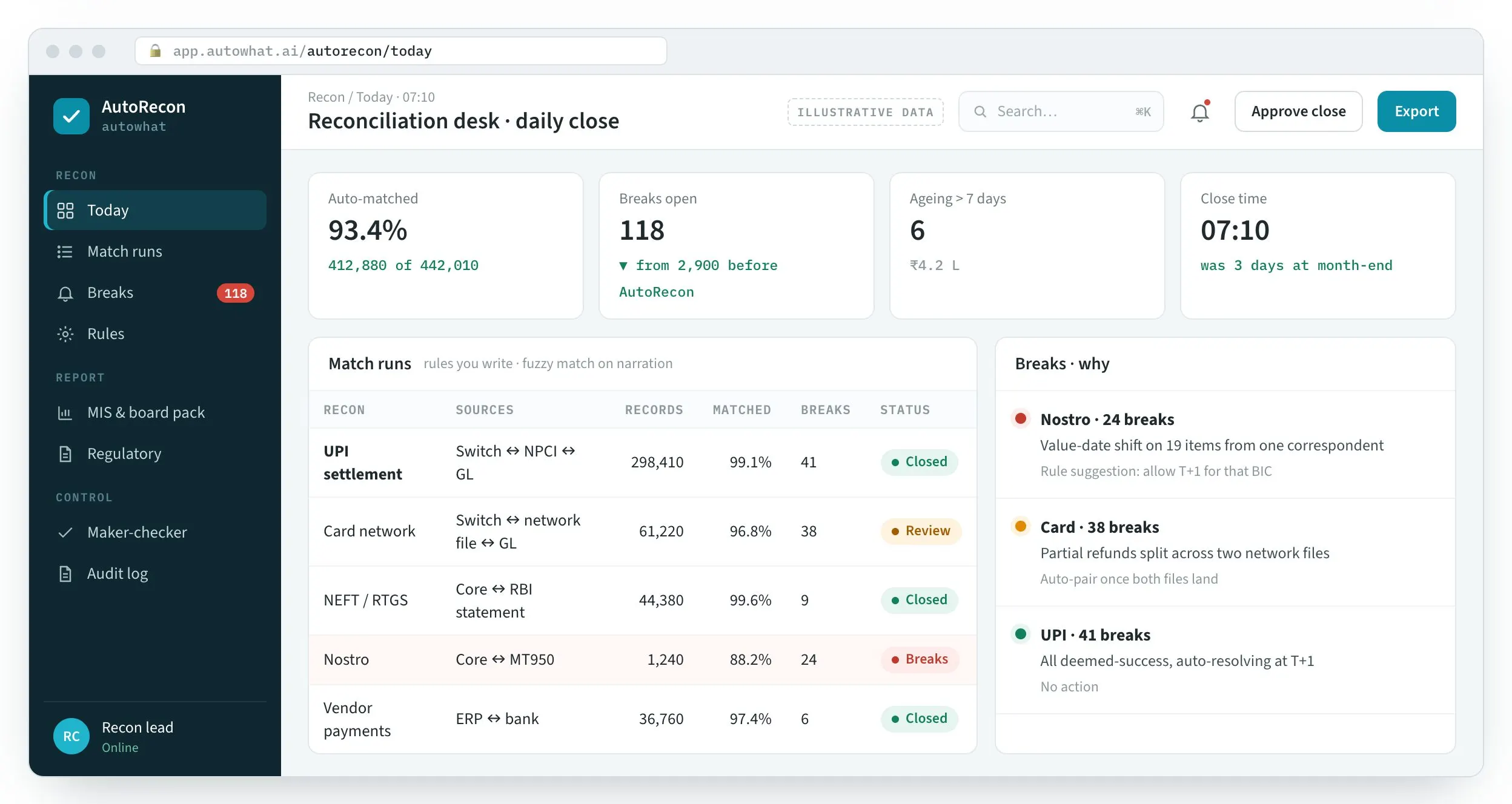
The recon desk, the board pack and the morning close.
Every match run with records, match rate and breaks — and why the breaks happened.
Product screens with illustrative data — every name, place and figure is a placeholder.
02Before and after
Recons are matched in spreadsheets, breaks age quietly, and the board pack takes a week of copy-paste.
| Area | Today | With AutoRecon |
|---|---|---|
| Matching | Spreadsheets and macros | Rules you write, run daily |
| Breaks | Age quietly | Explained, aged and owned |
| Rules | In one person’s head | Versioned, with maker-checker |
| MIS | Copy-paste for a week | Drafted with every number traced |
| Regulatory returns | Rebuilt each time | Drafted from the same record |
03Match, explain, report
Read-only by default: AutoRecon reads your files and systems and writes nothing to your core unless you open the path.
Files · APIs
Switch, network, core, GL, bank and MT statements loaded as they land.
Formats
Every source mapped to one schema; bad rows rejected with a reason.
Your rules
Exact, tolerance and fuzzy narration matching.
Breaks
Each break classified, aged and given an owner.
Rules
Recurring breaks become a suggested rule for the checker.
Daily
The close approved by maker and checker.
MIS · board
Packs drafted with every number traced to its query.
Regulatory
Returns drafted from the same record, checker before submission.
04The platform
Start with the noisiest recon; the rest join on the same engine.
05How we deliver
On the files and systems you already have.
MoreRelated Commercial products
Use casesUPI and nostro reconciliation
UPI reconciliation software proves that every UPI transaction agrees across the bank’s switch, the network’s settlement data and core banking, and finds the ones that do not. AutoRecon loads the switch and network files, the core and the GL as they land, maps them to one schema and matches them every day on rules you write. The RRN (retrieval reference number) is the usual key for UPI and the UTR number for NEFT/RTGS: exact rules pair clean references, and fuzzy narration rules catch the ones buried in free text. Each break is classified, aged and given an owner, so a failed-but-debited transaction surfaces in the next daily run instead of at month-end. The full routine is in UPI reconciliation for banks, and disputed payments are covered in what a chargeback is.
Nostro reconciliation software matches each nostro account’s mirror ledger in your core or GL against the correspondent bank’s MT950 statement. AutoRecon runs this daily on rules you write, with tolerance rules for amount and timing differences such as charges and value dates. Every open item is classified, aged and given an owner until it clears, and recurring items become suggested rules that take effect only after a checker approves them. Because the same engine runs UPI, cards and NEFT/RTGS, treasury and operations work from one record. The daily routine is set out in the nostro reconciliation process checklist.
CompareTypes of reconciliation software
Reconciliation software falls into three broad types: bank reconciliation (BRS) features inside accounting software, financial close tools for corporate finance teams, and institution-side recon desks for banks, NBFCs and payment companies. Check six things before you choose: the sources it reads, the rule types, the break workflow, access to your core, where it runs and how reporting is built.
| Check | Accounting software BRS | Financial close tools | Bank recon desk (AutoRecon) |
|---|---|---|---|
| Sources | Bank statements against the books | GL balances, sub-ledgers and statements | Switch and network files, core, GL, MT950 statements and ERP |
| Rule types | Mostly amount, date and reference matching | Account-level matching and certification | Exact, tolerance and fuzzy narration rules you write, versioned |
| Break workflow | Unmatched lines listed for review | Exceptions tracked to month-end sign-off | Each break classified, aged and owned; recurring breaks become suggested rules |
| Access to core | Not applicable | Usually connected to the ERP | Read-only by default |
| Where it runs | The vendor's cloud or desktop | Mostly the vendor's cloud | Managed cloud, your own VPC or on-premises; India data residency when required |
| Reporting | A reconciliation statement | Close checklists and reports | Daily close, MIS, board packs and regulatory returns with every number traced to its query |
OverviewAutoRecon · reconciliation software for banks
UPI reconciliation software for banks and PSPs matches the same transactions as recorded in different places: switch and network files, the core and GL, bank and MT statements, vendor ledgers. Mismatches become breaks to investigate. At many Indian banks, NBFCs and payment companies, UPI, card and NEFT/RTGS recons still run in spreadsheets and macros one person understands, breaks age quietly until month-end, and the board pack takes days of copy-paste from several systems.
AutoRecon is recon software that loads switch, network, core, GL, bank and MT statement files as they land, maps every source to one schema and matches them daily on rules you write: exact, tolerance and fuzzy narration. Each break is classified, aged and given an owner, and recurring breaks become suggested rules for a checker. The daily close is approved by maker and checker, and MIS, board packs and regulatory returns are drafted with every number traced to its query.
UPI and IMPS, cards and network, NEFT/RTGS, nostro and vendor recons run on one engine, matched every day. References such as the RRN for UPI and the UTR for NEFT/RTGS are matched exactly, and fuzzy narration rules catch references buried in free text.
Each nostro account's mirror ledger in the core or GL is matched daily against the correspondent bank's MT950 statement on rules you write, including tolerance rules for amount and timing differences. Every open item is classified, aged and given an owner until it clears.
Rules you write are versioned and run daily, including fuzzy narration matching for entries that never line up exactly.
Each break is classified, aged and assigned, and the desk shows why breaks happened, not just that they did.
When the same break recurs, AutoRecon explains the pattern and proposes a rule that takes effect only after maker-checker.
MIS, board packs and regulatory returns are drafted from the same record, each number linked to the query that produced it, with changes since the last pack highlighted.
AutoRecon reads your files and systems and writes nothing to your core unless you open the path, on managed cloud, your VPC or on-premises.
| Manual / spreadsheets | Generic software | AutoRecon | |
|---|---|---|---|
| Matching | Spreadsheets and macros | Fixed two-way match templates | Rules you write, exact, tolerance and fuzzy, run daily |
| Breaks | Age quietly | Listed as exceptions | Classified, aged, owned and explained |
| Rules | In one person's head | Changed without review | Versioned, with maker-checker |
| MIS and board pack | Copy-paste for days | Separate reporting tool | Drafted with every number traced to its query |
| Access to core | Manual exports | Often needs write integration | Read-only by default |
LearnAutoRecon guides and tools
9 pages on the problems AutoRecon solves. See them all on one page →
FAQQuestions we get about AutoRecon
AutoRecon is an Autowhat AI product for finance, operations and treasury heads in financial services. Short, factual answers for buyers, procurement and the assistants people ask first.
In short. AutoRecon by Autowhat AI is reconciliation software for banks, NBFCs and payment companies, built for finance, operations and treasury heads in financial services. It exists to remove the problems those teams describe in almost every first conversation: a week of spreadsheets at month-end; the same breaks recurring every day; and board packs that take six days of copy-paste. With AutoRecon, teams get UPI, cards, NEFT/RTGS, nostro and vendor recons matched daily, recurring breaks turned into suggested rules, maker-checker, and packs drafted with every number linked to its query. It connects to Switch & network files, Core & GL, MT950 statements and ERP, is used by recon, finance and treasury teams, and runs on the web and WhatsApp. Like every Autowhat AI product, AutoRecon goes live on one site, lane or process first, usually within weeks, on managed cloud, in your own VPC or on-premises, and shares one operational record with the other products, so the second deployment reuses the data and integrations of the first.
It matches transactions across switch, network, core, GL and bank statements and flags the breaks that do not match. AutoRecon does this daily for banks, NBFCs and payment companies on rules the institution writes.
A bank needs institution-side reconciliation software that reads switch and network files, core banking, GL and bank statements, not a bookkeeping BRS feature. AutoRecon by Autowhat AI matches UPI, cards and NEFT/RTGS daily on rules the bank writes and ages every break. It is not the right choice if you only match one bank statement against your books.
They run a three-way match: each UPI transaction in the switch log is paired with the network's settlement record and the core banking posting, usually on the RRN, with amount and date checks. Anything missing on one side becomes a break. AutoRecon runs this match daily; at very low volumes a spreadsheet keyed on the RRN can do.
Choose a tool that loads settlement files as they land, matches them to the ledger on rules you can version, and gives every unmatched item an owner and an age. AutoRecon does this for NBFCs and payment companies, read-only by default. For a handful of transactions a day, a spreadsheet with a clear match key is enough.
Nostro reconciliation software matches a bank's own mirror ledger of its foreign-currency nostro accounts against the statements its correspondent banks send, usually as SWIFT MT950 messages, and lists the open items that do not match. AutoRecon runs nostro recons daily on rules you write, and ages every open item with an owner until it clears.
AutoRecon by Autowhat AI is reconciliation software for banks, NBFCs and payment companies. It matches UPI, cards, NEFT/RTGS, nostro and vendor recons daily on rules the institution writes, explains and ages every break, and drafts the MIS and board pack with each number traced. It is not built for small businesses reconciling a single bank account.
A break is a transaction that does not match across sources. AutoRecon classifies each break, ages it, assigns an owner and turns recurring breaks into suggested rules for a checker to approve.
Yes. AutoRecon drafts MIS, board packs and regulatory returns from the same reconciled record, with every number traced to the query that produced it and a checker before submission.
There is no public list price. AutoRecon is priced per deployment after a 30-minute working session on your own data, where the first recon and scope are agreed.
Finance, operations and treasury heads in financial services. Daily reconciliation across switch, network, core, GL and bank statements on rules you write; breaks explained, aged and owned; MIS, board packs and regulatory returns drafted with every number traced to its source.
UPI, cards, NEFT/RTGS, nostro and vendor recons matched daily; recurring breaks turned into suggested rules, maker-checker; packs drafted with every number linked to its query.
It connects to Switch & network files, Core & GL, MT950 statements, ERP. Users: Recon · finance · treasury. Channel: Web + WhatsApp.
With a 30-minute working session on your own data — an engineer from the relevant sector, not a sales queue. The first wave is scoped in that call; most products go live on one site, lane or process within weeks and then scale.
On managed cloud, in your own VPC (AWS, Azure or GCP) or on-premises, with your keys. SOC 2 Type II and ISO 27001 controls, India data residency when required, and local or open-weight models when policy demands it. The data stays yours.
06Working session
Thirty minutes: your noisiest recon, its sources and rules — and a first scope.